$10,000 for rooftop solar? No, thanks. Why homeowners are rejecting an Ontario rebate that ‘doesn’t make any sense’ - Toronto Star
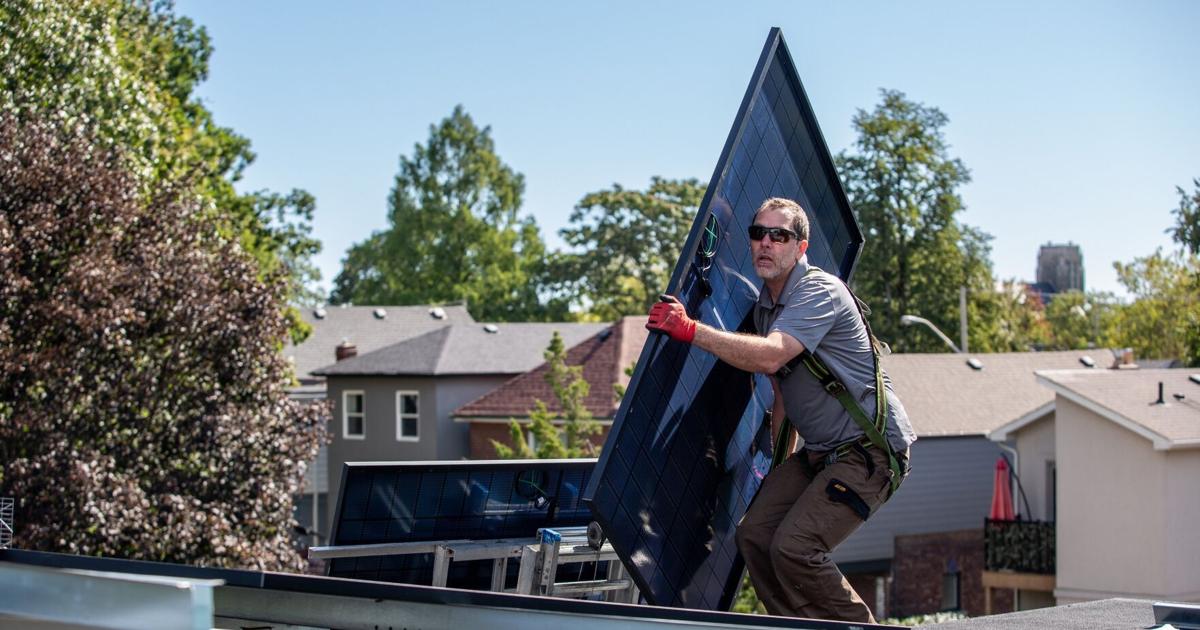
Ontario's Home Renovation Savings Program requires homeowners to choose between $10,000 and the ability to sell power back to the grid.
Heliotechnik Solar’s Beau Badore installs solar panel system in Toronto.
When Peter Leiss decided to get solar panels and a battery installed, he could have put in the paperwork to qualify for a $10,000 rebate from the provincial government.
That’s because Leiss says the rebate comes with a catch that makes it impossible to accept.
“If we had taken the rebate, all the excess power that’s produced goes into the grid and you don’t get any credit for it,” he said. “It doesn’t make any sense.”
Leiss isn’t alone. Despite shelling out tens of thousands of dollars to generate clean electricity, most people installing solar panels and batteries are turning down the government subsidy, the Star has learned.
“For probably 95 percent of our clients, it’s actually not a good option,” said Beau Badore, owner of solar panel installer Heliotechnik. Homeowners, he says, will pay off their system more quickly by turning down the rebate and getting paid for their excess power.
Restricting the rebate in such a way not only discourages folks from installing solar, experts say, it also hampers society from reaping the benefits: cheaper electricity and lower bills.
Ontario is the only province that makes people choose. Other provinces not only allow homeowners to receive a government rebate and sell their solar generation into the grid, many require it in order to capture the full value of the technology.
Solar power has been hailed as the cheapest form of energy in history, is being installed on rooftops around the world and can push power into the grid to alleviate bottlenecks, avoiding costly grid upgrades and keeping power bills down for everyone. In the U.K. and Australia, solar is flooding grids with so much energy, it has led to utilities offering free electricity. But experts say these benefits only work if those with solar panels are incentivized to share their power.
“This is a huge missed opportunity,” said Badore.
Internal Ministry of Energy documents, obtained via access-to-information legislation, show that the province was warned that taking away the ability of solar panel owners to sell their power would “significantly limit the uptake of residential solar PV systems.”
An internal analysis found that payback periods for solar installations would almost double without “net metering,” which pays households for exported energy with credits that offset their power bills.
The payback period for a non-exporting solar system would be between 30 and 40 years or “higher than its economic useful life of 25 years,” the government analysis found. Net metering reduces that payback time to 23-29 years, while allowing system owners to both take the rebate and export energy reduces the payback time to 17-22 years.
Adding a battery makes the rule even worse for homeowners, pushing up the payback period to 73 to 100+ years with the rebate alone. If homeowners could claim both incentives, that would come down to 26 years, the analysis found.
Badore installs a system in East York.
These lengthy payback timelines mean installers might suggest their customers not sign up for the rebate “since (net metering) offers a better business case,” the analysis found.
The ministry still ended up recommending the either/or approach, because it considered allowing both to be “double-dipping of government incentives,” the documents state.
“Our government launched the largest energy efficiency framework in Canadian history, offering rebates of up to $10,000 for households through the Home Renovation Savings Program to lower costs while supporting the adoption of (small scale generation like rooftop solar),” said Noah Mawji, spokesperson for Ontario Energy Minister Stephen Lecce, in an emailed statement.
The province has taken steps to reduce barriers and support smarter planning for these small power producers, “as part of an all-of-the-above approach to meet rising energy demand while keeping electricity affordable,” he wrote.
Combining the rebate and net metering was allowed in Ontario until 2024, when the Home Efficiency Rebate+ program abruptly stopped taking new applications. Since January 2025, when the new Home Renovation Savings Program was launched, only 339 people have received a solar panel and/or battery rebate, said the Independent Electricity System Operator, which helps administer the program. There is no tally of the total number of solar projects installed province-wide during that time, but installers estimate only one in 10 customers opt for the rebate.
Forcing people to choose transforms a policy that ostensibly encourages rooftop solar into one that limits its adoption and stifles its benefits, experts say.
“If you are not net metered, your system is only useful for you,” said Phil McKay, senior director of member programs at the Canadian Renewable Energy Association. “So you get a smaller system and there’s less power for your neighbours.”
Typically, rooftop solar produces electricity that’s used first to power the home or business it sits upon. Excess power can be fed into a battery and stored for later — when the sun goes down — or exported into the grid for others to use.
This benefits the owner by reducing their power bill, but it also benefits the grid both right away and over the long term.
Because solar panels produce most during midday hours, they reduce the need for expensive natural gas generation at peak times, reducing the cost of electricity for everyone. Over the long term, rooftop solar can save the power system from having to make costly upgrades to transmission lines because it produces power where it is used, replacing the power that would otherwise have to be delivered over long distances.
A recent study by Clean Energy Canada quantified those savings and found that rooftop solar, combined with smart thermostats, home batteries and two-way EV chargers, could save utilities and ratepayers $3.5 billion over the next 20 years.
As Canada and the world grapple with a massive increase in electricity demand to power data centres, EVs and heat pumps, “we’re going to need any power we can get,” said McKay.
Ontario projects that electricity demand could increase by 90 per cent over the next 25 years.
“Solar is rock solid. You pay once for the device, and you’ve got a fixed price for the energy it will be producing for 20 plus years,” he said. “And, of course, you’ve got all the climate benefits of displacing fossil fuel generation.”
The City of Toronto has set a goal to get 50 per cent of its power from renewable or low-carbon sources by 2030 and 75 per cent by 2050. “Solar will play a significant role,” the city states in its TransformTO strategy.
Australia and the U.K. have more solar and wind power than their electrical systems know what to