13 injured in Houthi missile and drone attacks on 3 Saudi cities
Direct Source Verification:
This story is aggregated from The Express Tribune (tribune.com.pk). Full reporting rights and copyright belong to the primary publisher.
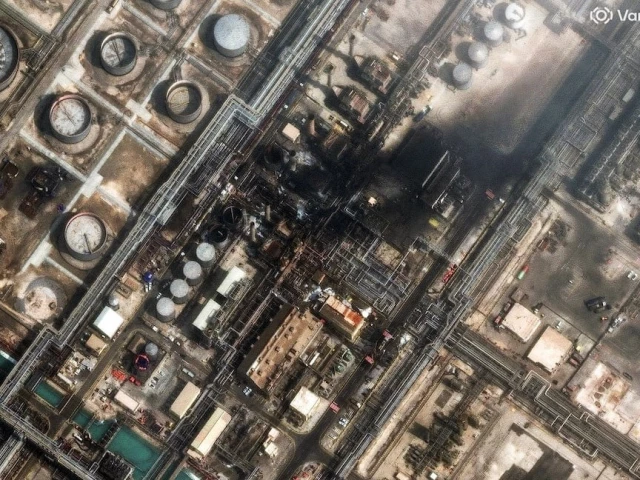
7 homes and 2 vehicles damaged in attacks on Khamis Mushait, Abha and Taif, says spokesman for Saudi-led coalition
Thirteen civilians were injured in ballistic missile and drone attacks carried out by Yemen’s Houthi group on three Saudi cities, the Saudi-led coalition said early on Tuesday.
Coalition spokesman Turki al-Malki said the attacks targeted Khamis Mushait, Abha and Taif on Monday, leaving the victims with minor to moderate injuries.
Seven homes and two vehicles were also damaged, he said.
Al-Malki accused the Houthis of deliberately targeting civilians and civilian infrastructure and said the coalition would take measures to deter further attacks under the right to self-defence.
Meanwhile, the General Directorate of Saudi Civil Defence issued "potential danger" alerts early Tuesday in six cities: Jeddah, Yanbu, Taif, Abha, Jazan and Alula.
Later, it said the danger "has passed."
"For your safety, continue following #CivilDefense instructions and avoid gathering and filming. In case of emergency, call (911)," it added.
The statement came after Houthi military spokesman Yahya Saree said Monday that Saudi warplanes carried out 54 strikes across five Yemeni provinces over the previous 24 hours.
Saree said F-15 and Typhoon fighter jets were used in the strikes and warned they “would not go unanswered.”
Yemen forces say Houthis mobilised over 76,000 fighters in west coast battles
Yemen’s government-aligned forces said Monday that the Houthi group mobilised over 76,000 personnel during recent battles along the western coast, claiming that the operations involved "Iranian and Lebanese experts" to take control of the Bab al-Mandab Strait.
In a statement on the US social media platform X, the spokesperson for the government-backed National Resistance Forces, Major General Sadiq Dwaid, said the operations had been "planned and prepared months in advance," adding that they were executed "under the direct orders of Iran’s Islamic Revolutionary Guard Corps with Iranian and Lebanese experts participating in their management."
Read: PM Shehbaz condemns Houthi attacks, vows efforts to defuse regional tensions in call with MBS
The National Resistance Forces defended a 170-kilometre (105-mile) front while also protecting beaches and islands, noting that between August 9 and September 9, 130 ballistic missiles, 145 suicide drones and 15 explosive-laden boats were launched.
Dwaid said these attacks included 23 missiles and 18 drones targeting positions held by Lieutenant General Tariq Saleh, the force's commander and deputy chairman of Yemen's Presidential Leadership Council.
Houthis strike Saudi targets anew as talks over Strait of Hormuz stall
Yemen's Houthis launched a new wave of attacks on Saudi Arabia and were digging into positions on the western coast of Yemen along the Red Sea, Yemeni officials said, as urgent deliberations took place in Riyadh over how to respond to their lightning advance.
Meanwhile, Gulf Arab states postponed planned talks with Iran, raising concerns the Middle East conflict could spread further and threaten global oil supplies.
The Houthis on Monday said they fired dozens of missiles and drones at a military airbase in Khamis Mushait in southern Saudi Arabia, targeting aircraft hangars, radar systems, runways and ammunition depots in retaliation for Saudi airstrikes in Yemen.
Saudi authorities issued emergency alerts there and in three other southern cities. Thirteen civilians were wounded in the Houthi attacks, the Saudi-led coalition in Yemen said.
The Houthi advances in recent days, including the taking of Perim Island at the mouth of the Red Sea, have put further pressure on Saudi oil exports after an aerial attack on Thursday knocked Saudi Arabia's east-west pipeline offline. Riyadh blamed the pipeline attack on Iranian-backed forces in Iraq.
Saudi Arabia built the 1,200-kilometre (745-mile) pipeline across its territory from the Gulf to the Red Sea in the 1980s to bypass the Strait of Hormuz when it came under threat from the Iran-Iraq war at that time.
Traders said a prolonged shutdown of the Saudi pipeline could cut off as much as 4% of global oil supply while the strait is largely blockaded. Riyadh has not said when operations might resume.
Responding to the Houthi offensive, the Saudi and Yemeni air forces have stepped up aerial bombardment of Houthi targets, including around the historic Red Sea port of Mocha, but the Houthis have maintained effective control over almost the entire western coast of the country along the Red Sea, the officials with Yemen's internationally recognised government said.
Read more: Diplomacy stumbles with postponement of meeting on Strait of Hormuz proposal
“The Houthis are being put under heavy pressure. They in turn are putting more and more pressure on the Saudis, increasing their campaign of missile and drone attacks,” one of the Yemeni officials said.
Crude oil prices rose more than 4% on Monday before settling about 1% higher.
Americans hesitant to step in
The renewed Yemen conflict poses another challenge for US President Donald Trump.
Three sources have told Reuters that Washington has so far resisted Saudi requests for direct military intervention beyond intelligence support. Trump said over the weekend he had spoken with the Saudi crown prince and that the Houthis had also contacted Washington urging it to stay out of the conflict.
Saudi state media reported that Crown Prince Mohammed bin Salman met US regional commander Admiral Brad Cooper in Jeddah on Monday.
Saudi Arabia has led a coalition battling the Houthis since 2015, but the conflict had largely quietened under a ceasefire in recent years. Fighting reignited this month, with the Houthis pushing back forces aligned with the internationally recognised government.
Hopes for diplomacy fade
Oman had been due to host a meeting on Monday with Iran and Gulf states to discuss negotiations aimed at reopening the Strait of Hormuz, which before the war carried 20% of the world's oil exports. But Oman announced that the meeting had been postponed. Iran said the postponement was at the request of Saudi Arabia.
Trump on Monday repeated his frequent claim that Iran was eager to make a deal quickly, but Mohsen Rezaei, secretary of Iran's Supreme National Security Council, called the president's message a distraction, saying on X early on Tuesday that there would be "No talks until Iran's conditions are met."
Don’t get distracted by the U.S. president’s mixed signals—from “no negotiations” to “we’re ready to talk.” The stakes around oil and the straits have changed. Damage control won’t stop what’s coming.
No talks until Iran’s conditions are met. Period!
— محسن رضایی (@ir_rezaee) September 14, 2026
Underscoring the volatility of shipping through the region, conflicting reports circulated about how and when an oil tanker was damaged.
Without giving a date, Iran's Revolutionary Guard Corps said the Panamanian-flagged oil tanker El Gaia was hit by sea mines as it passed through a prohibited zone south of the Strait of Hormuz, Iran's Fars news agency reported on Monday.
But the US military's Central Command immediately said the report was false and the tanker was "struck by an Iranian missile last month and rendered inoperable."
🚫 CLAIM: Iran's Islamic Revolutionary Guard Corps (IRGC) claims a Panama-flagged oil tanker recently struck a naval mine in the Strait of Hormuz. This is FALSE.
✅ FACT: The Panama-flagged oil tanker El Gaia was struck by an Iranian missile last month and rendered inoperable.… pic.twitter.com/JXi2X8d5oV
— U.S. Central Command (@CENTCOM) September 14, 2026
The United Nations' International Maritime Organisation reported El Gaia was damaged on Saturday, but did not say how, and that two seafarers were missing.
Reuters could not immediately contact the ship's owners in Dubai to verify any of the accounts.
The world's most important oil shipping lane has been mostly shut down since the war began on February 28, as Iran has threatened vessels that transit the waterway without its authority.
"The IRGC Navy firmly declares that the Strait of Hormuz is closed and still under our smart control," the Revolutionary Guards said in the statement.
Original Source
https://tribune.com.pk/story/2629383/13-injured-in-houthi-missile-and-drone-attacks-on-3-saudi-cities