13 questions, one red label: FSSAI's reply to the Supreme Court
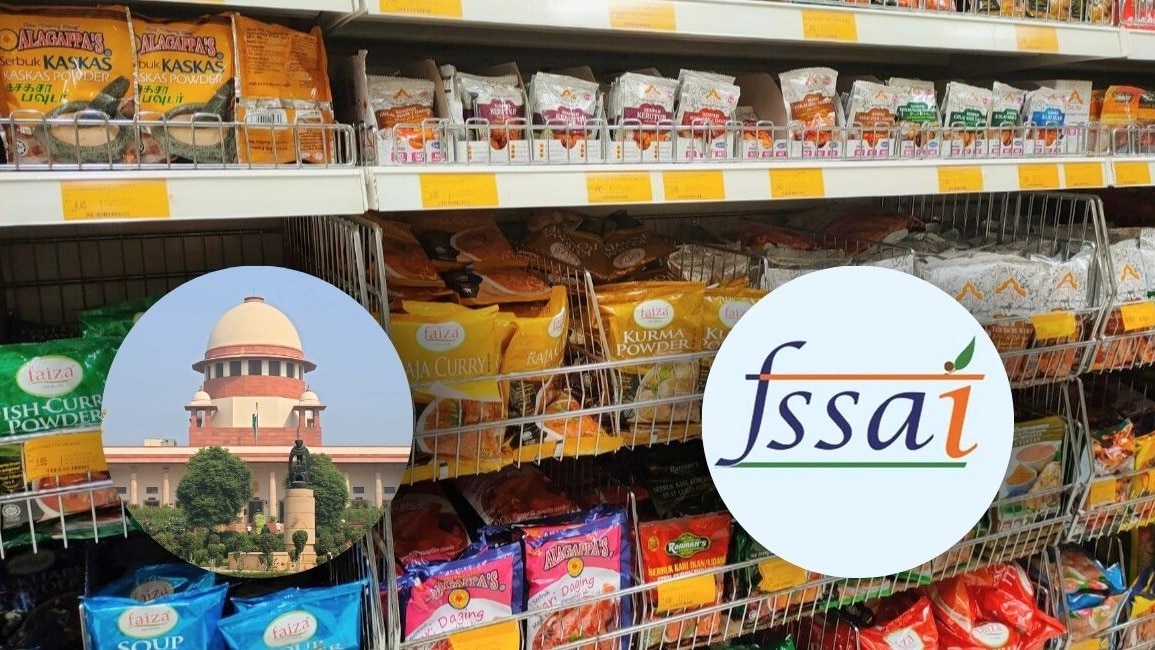
The Supreme Court asked FSSAI 13 questions about the warning label proposed for packaged foods. Here's what it answered, and what it didn't. How India eats could be about to change. Maybe.
On September 10, the Supreme Court sent the Food Safety and Standards Authority of India (FSSAI) a list of 13 questions about its plan to introduce warning labels on packaged foods. On September 23, FSSAI replied in a 43-page affidavit, well ahead of its November 28 deadline.
The headline answer is yes. India will get a red warning label on packaged foods high in sugar, salt or fat. It will be a red hexagon on a white square, placed at the top left of the front of the pack, with HIGH SUGAR, HIGH SALT or HIGH FAT written inside.
The details are where it gets interesting. We went through the affidavit question by question.
What the court asked: Whether the limits would be based on total sugar and saturated fat, as indicated at a 2021 stakeholder meeting, and how trans fat would be factored in.
What FSSAI said: Neither. The label will count only added sugar and added fat.
Saturated fat is excluded because, FSSAI says, ICMR-NIN's Dietary Guidelines 2024 do not set a per-100g limit for it. Trans fat will not get a front-of-pack warning either, since an existing rule already caps industrial trans fat at 2%.
The court had asked how trans fat would be factored in. FSSAI's response explains why it will not be included in the warning label.
FSSAI's reasoning is that sugar in fruit and milk comes with fibre and nutrients, while added sugar provides empty calories. But that leaves some questions.
A drink sweetened with fruit concentrate can be very high in sugar. Would it escape the label?
Once a product is sealed, a laboratory cannot easily tell added fat from fat that was already present. Who will verify what companies declare?
In one part of the affidavit, FSSAI says ICMR's limits take total sugar and fat into account. A few pages later, it says added sugar and added fat should be counted. Which is it?
FSSAI's own school food rules, attached to the affidavit, prohibit foods high in saturated fat and trans fat. Why do those two nutrients disappear from the front-of-pack warning?WHEN WILL YOU ACTUALLY SEE IT?
What the court asked: A "reasonable and fixed timeline".
What FSSAI said: About four months to finalise the rules, including a 60-day window for public and WTO comments. This would be followed by a 365-day transition period for companies, which FSSAI calls a "voluntary implementation period". Under FSSAI policy, labelling changes take effect only on July 1.
Do the maths and the earliest the warning label could become mandatory is July 2028. The affidavit does not give an end date.
FSSAI's stated reason for the long transition period is to spare food companies the cost of discarding already-printed packaging.WILL JUNK FOOD BE TREATED DIFFERENTLY?
What the court asked: In two separate questions, whether the limits would take into account how processed a food is. That would mean treating ultra-processed products containing additives differently from minimally processed foods.
What FSSAI said: No. Processing and nutrition are "distinct concepts". Only sugar, salt and fat content will determine whether a warning label is required.
So, a freshly made lemon water with too much sugar and a packet of chips would be judged by the same yardstick.
That raises another question: why leave the degree of processing out entirely?CAN EVERYONE READ IT?
What the court asked: How the label would work for people with different levels of literacy, and why FSSAI chose one combined hexagon instead of a separate warning for each nutrient.
What FSSAI said: The label will contain text in English or Hindi, as required under current rules. There will be no separate symbol or picture for each nutrient. FSSAI argues that pictograms could cause confusion and that "symbols alone cannot replace nutritional literacy."
One hexagon will list all the nutrients in which a product is high.
Why English or Hindi, rather than both? And what about the millions of shoppers who do not read either language comfortably?
Chile and Mexico use separate warnings for each nutrient. Why has India chosen to combine them?
The label's size is only said to "align with" Canada's model. Why is there no Indian rule specifying how much of the front of the pack it must cover?WHAT ABOUT SCHOOLS?
What the court asked: How the government plans to teach children to read food labels and understand nutrition.
What FSSAI said: It has written to the Education Ministry and the CBSE chairman proposing a curriculum chapter on nutrition literacy, including how to read food labels. It also wants schools to be encouraged to obtain its Eat Right School certification.
CBSE's sugar and oil boards have been in schools since 2025.
But these letters were sent on June 1, well before the Supreme Court's order. The affidavit includes no reply from either the Education Ministry or CBSE. For now, the curriculum chapter remains a proposal.advertisementWHY TWO PHASES? AND WHAT ELSE DID FSSAI SAY?The court had asked for the reasoning behind the proposed two-phase plan. FSSAI has dropped that approach and moved to a single phase, under which a product high in even one nutrient would get the warning label.
That is a stronger outcome, but the affidavit does not explain the change.
For beverages, sugary drinks will have the drink category named inside the hexagon. No separate limits for beverages have been specified.
On whether the red colour could be confused with the non-vegetarian food mark, FSSAI said the non-veg logo is brown and has a different shape, so there should be no confusion.
On additives, the court had asked whether companies could simply replace sugar with additives. FSSAI said existing rules governing additives are sufficient. Products containing artificial sweeteners will have to declare their presence on the front of the pack.ONE MORE QUESTION REMAINS
The affidavit refers to the Food Authority's decision on the red hexagon and the proposed limits, but does not include the decision itself.
So, where is the record showing how these thresholds were approved?advertisementTHE BOTTOM LINEOn whether India will get a warning label, FSSAI's answer is yes.
But on the questions that determine how much protection the label will actually provide, such as which sugar counts, whether saturated fat counts and whether ultra-processed foods should face tougher treatment, the answers are either no or not quite.
And consumers may not see the change on their packets until 2028.
The Supreme Court asked 13 questions. Now it has to decide whether FSSAI's answers are enough.- EndsPublished By: Priyanka KumariPublished On: Sep 24, 2026 07:30 IST