1980s AI photo trend: Politics over a past that never happened
The retro-AI craze has moved well beyond Instagram nostalgia. In India, it has become a peculiar meeting point of Bollywood memory, personal vanity, political propaganda and the rapidly expanding infrastructure behind generative AI.
The latest 1980s photo wave is particularly revealing because it shows how quickly a harmless-looking visual fad can become political ammunition—and how little distance there now is between a joke, a meme and a deliberately misleading image.
India has spent the past two years repeatedly turning AI image generation into mass internet culture—from Studio Ghibli-style portraits to action figures and hyper-realistic selfies. Then came Google's Gemini image-generation boom, particularly after its Nano Banana model took off. Google itself says more than 500 million images had been generated globally through the feature, with India among its biggest markets. Among the distinctly Indian uses it identified were retro portraits and recreations inspired by 1990s Bollywood.
The attraction is obvious. A contemporary photograph can be fed into an AI model and transformed into something resembling a family-album photograph from another era: big hair, wide collars, chunky jewellery, aviator sunglasses, Ambassador cars, faded colours, analogue film grain and the slightly imperfect lighting of an old studio photograph. Crucially, it requires neither Photoshop nor any real design skill. The machine does the remembering.India has proved particularly receptive to this kind of nostalgia. The 1980s and 1990s occupy a peculiar cultural space here: liberalisation, Doordarshan, audio and video cassettes, Maruti cars, Hindi cinema, cable television, cricket heroes and the emergence of the consumer culture that defines today's middle class. AI can compress all of that into one photograph.
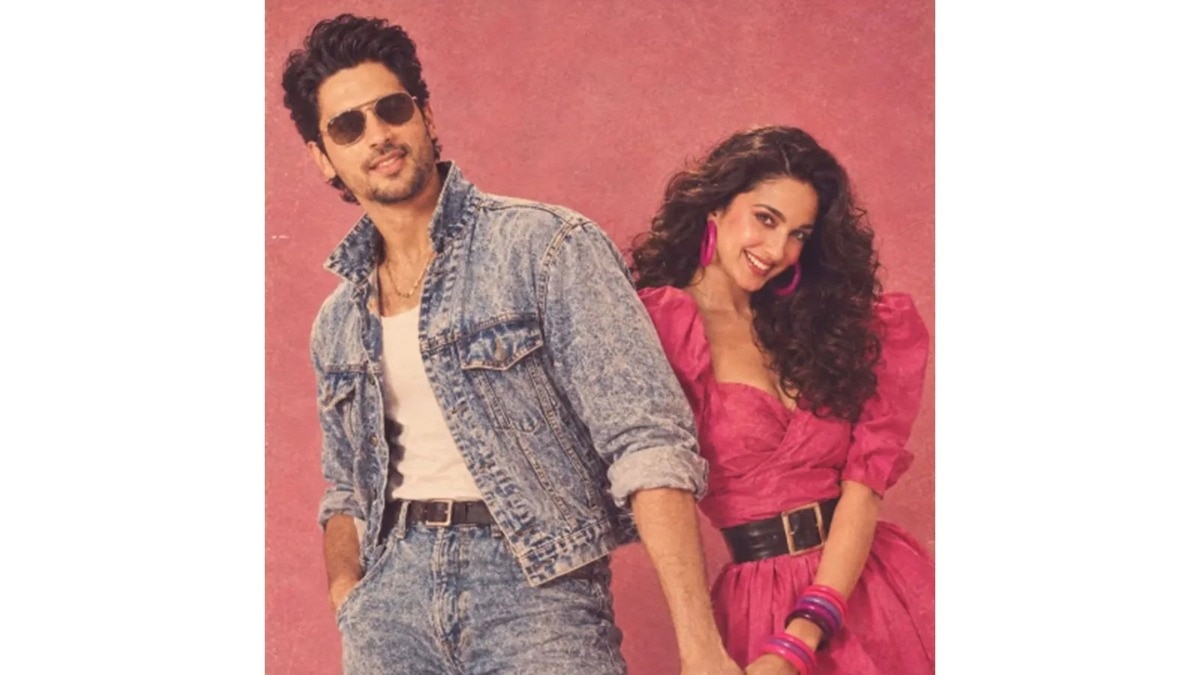
That is why the trend has swept through celebrities. Kiara Advani and Sidharth Malhotra shared a joint retro image; Sonakshi Sinha and Zaheer Iqbal joined the nostalgia wave; former India cricketer Irfan Pathan posted multiple AI-generated looks; and poet Kumar Vishwas was among those who participated. Rajya Sabha MP Raghav Chadha also posted a retro AI image with wife Parineeti Chopra.
The political class was hardly going to remain outside the frame. Piyush Goyal, Kiren Rijiju, Chirag Paswan, Himanta Biswa Sarma, Shivraj Singh Chouhan and Anurag Thakur all joined the 1980s photo wave in different ways. Congress MP Shashi Tharoor took the joke in another direction: rather than ask AI to manufacture his youth, he posted photographs actually taken in the 1980s. Renuka Chowdhury similarly produced a genuine magazine cover from the decade.
That distinction is more important than it first appears. One group is using AI to manufacture an approximation of memory; another is reminding us that memory already exists in archives, albums, magazines and negatives. The machine-generated photograph looks authentic precisely because it borrows the visual language of something that really existed.
The most consequential turn came in the BJP-Congress meme war. What began as politicians making themselves look younger rapidly became a contest over who could use the same technology to rewrite—or ridicule—the other's past.
The Congress's Kerala unit posted an AI-generated image styled as a 1980s Gujarat street scene, showing a man purportedly resembling Union home minister Amit Shah sitting in a Maruti Omni. The Omni, ubiquitous in 1980s India and repeatedly used as a cinematic “kidnapping van”, carries an entire pop-cultural association with crime. The Congress also circulated an altered image depicting Prime Minister Narendra Modi at a railway station apparently taking a passenger's wallet.
The BJP retaliated. Its Gujarat, Kerala and Telangana units circulated their own AI-generated vintage images, targeting Congress and particularly Sonia Gandhi. Some of the images were suggestive, including depictions of women resembling Sonia in bars alongside male politicians. One image was captioned as being set in “Lusiana, Italy”, apparently invoking her birthplace. Some of the posts were later deleted. The Congress subsequently announced legal action, and the All India Mahila Congress filed a complaint against the Gujarat BJP's official X handle.
The BJP also responded to the Congress's Gujarat/Omni imagery by invoking the 1984 anti-Sikh riots and the Congress's record under Indira Gandhi. Rather than manufacture a young Modi, the BJP also used real photographs of him from the 1980s—an interesting counterattack because it effectively said: our history does not need to be generated.
This is where the phenomenon becomes bigger than another social-media fad. An AI photograph has the visual authority of documentary photography without necessarily possessing documentary truth. It looks like evidence while being an invention.
That is potentially powerful in Indian politics. A photograph traditionally carries an implicit promise: this happened. AI breaks that. A sufficiently convincing image of a politician in a particular place, beside a particular person or apparently doing a particular thing can travel thousands of times before anyone asks whether it was real.
The retro aesthetic makes the problem harder. Grain, faded colours and imperfect focus are normally signs of authenticity to the human eye. AI can reproduce those imperfections deliberately. In other words, the very things that make an old photograph believable can now be manufactured. And political parties have discovered that the cost of doing so is tiny. A photograph, a prompt and a social-media account can create the entire scene. The result is a new form of political communication: history as meme, meme as attack ad, attack ad as apparently authentic photograph.
There is an uncomfortable irony beneath. The photographs look analogue but producing them requires an intensely digital industrial system of data centres, chips, electricity and cooling.
The environmental cost of AI is difficult to calculate precisely because companies do not routinely disclose the energy, water and carbon footprint of individual image generations. Research published in 2025 found enormous variation between image-generation models—as much as a 46-fold difference in energy consumption—meaning there is no single reliable “cost” for an AI photograph.
But the larger direction is unmistakable. A recent analysis in Patterns estimated that AI systems could be responsible for 32.6 million to 79.7 million tonnes of CO emissions in 2025, alongside 312.5 billion to 764.6 billion litres of water consumption. The estimates are uncertain partly because AI-specific corporate disclosures remain limited.
A research by the United Nations University highlighted another uncomfortable point: the environmental burden increasingly comes not simply from training models but inference—ordinary people repeatedly using them. Day-to-day usage may account for roughly 80-90 per cent of the total AI energy demand. So the person generating one retro photograph is obviously not single-handedly causing a climate crisis. The problem is scale.
India has an additional reason to pay attention. Data-centre water use in the country was estimated at about 150 billion litres annually in 2024-25, with projections of around 358 billion litres by 2030, according to figures cited by the policy think-tank Council on Energy, Environment and Water (CEEW).
That makes the retro-AI phenomenon an oddly perfect snapshot of the AI age. It is playful, democratic and culturally inventive; it allows an ordinary Indian teenager to achieve in seconds what once required a professional photo editor. It also demonstrates how easily technology built for creativity can migrate into politics, where questions of consent, deception, misogyny, historical distortion and reputation become much more serious.
Perhaps the most revealing thing about the craze is that Indians are not merely using AI to imagine the future. They are using it to manufacture the past. And that past, unlike the one preserved in old albums, never actually happened.