23 papers by 19, Oxford in his 20s: How Aadarsh Mishra built a life in research
As a schoolboy in Lucknow, Aadarsh Mishra was not particularly interested in simply getting the right answer. He wanted to know why.
At St Francis' College, mathematics and science appealed to him because they offered a way to understand the world through logic, observation and problem solving.
"I was naturally curious and was always more interested in understanding how and why something worked than simply memorising an answer," Mishra says.
That curiosity would eventually take him from Lucknow to engineering studies in India, research projects at institutions including IIT Delhi, Cardiff University and finally the University of Oxford.
Now, he has added another distinction to an already unusual academic journey: Mishra has been elected a Fellow of the Royal Asiatic Society.
His CV includes research across materials science, condensed matter physics, nanotechnology, nanomedicine and biomedical engineering.
He was recognised in the India Book of Records for getting 23 research papers published by the age of 19, as an undergraduate.
He then became one of the youngest Indian Fellows of the Royal Astronomical Society and was named a Champion by the British Society for Nanomedicine in 2024.
But the academic milestones tell only one part of his story.
Behind them were financial difficulties, the death of his father, part-time work while studying in the UK and health challenges of his own.
"Those experiences made me more determined and resilient and taught me to value opportunities when they came my way," he says.
They also left him with a belief that has followed him through his career: "Education can fundamentally change the direction of a person's life." KALAM, RAMANUJAN AND THE IDEAS THAT SHAPED HIM
Mishra's interest in science was shaped as much by what he read as what he studied.
APJ Abdul Kalam was one of his biggest influences. Kalam's Wings of Fire and My Journey: Transforming Dreams into Actions shaped his ideas about science, ambition, education and perseverance.
He was also influenced by Swami Vivekananda, the Bhagavad Gita and Ramdhari Singh Dinkar's Rashmirathi, which helped shape his ideas about discipline, duty, self-belief and resilience.
Ramanujan's unusual approach to mathematics made Mishra think about how mathematical ideas could be combined with other disciplines.
"Over time, I became particularly interested in bringing together mathematics, engineering and biology," he says.
That combination would eventually lead him towards biomedical engineering and research into the physical behaviour of biological tissues. (Representative image) WHEN RESEARCH STOPPED BEING A SIDE ACTIVITY
At Manipal University, Mishra began getting involved in research alongside his engineering studies.
He worked across materials science, nanotechnology and condensed matter physics, spending hours reading scientific literature and thinking about questions that did not have straightforward answers.
"What particularly attracted me to research was the freedom to ask questions and develop ideas of my own."
For Mishra, engineering could be more than applying formulas or designing technologies that already existed. "It could also be used to discover new knowledge, develop new materials and approaches, and ultimately address problems that affect people's lives."
An early Ministry of Defence-related project at IIT Delhi also showed him how engineering research could connect with real-world technological and national challenges.
Then came Cardiff.CARDIFF WAS A DREAM, BUT MONEY WAS A PROBLEM
Mishra received an Elite Engineering Scholarship to study Mechanical Engineering at Cardiff University. Getting there, however, was not easy.
"Finances were a major issue when I wanted to study in the UK," he says.
He worked part-time alongside his studies before securing an industrial placement with a medical device company in Cardiff, where he worked as an R&D Engineer.
That experience became another turning point.
For the first time, he could see engineering, experimentation and research being translated into technologies with direct healthcare applications.
His academic path was beginning to move from conventional mechanical engineering towards biomedical research. (Representative image) OXFORD BROUGHT THE FIELDS TOGETHER
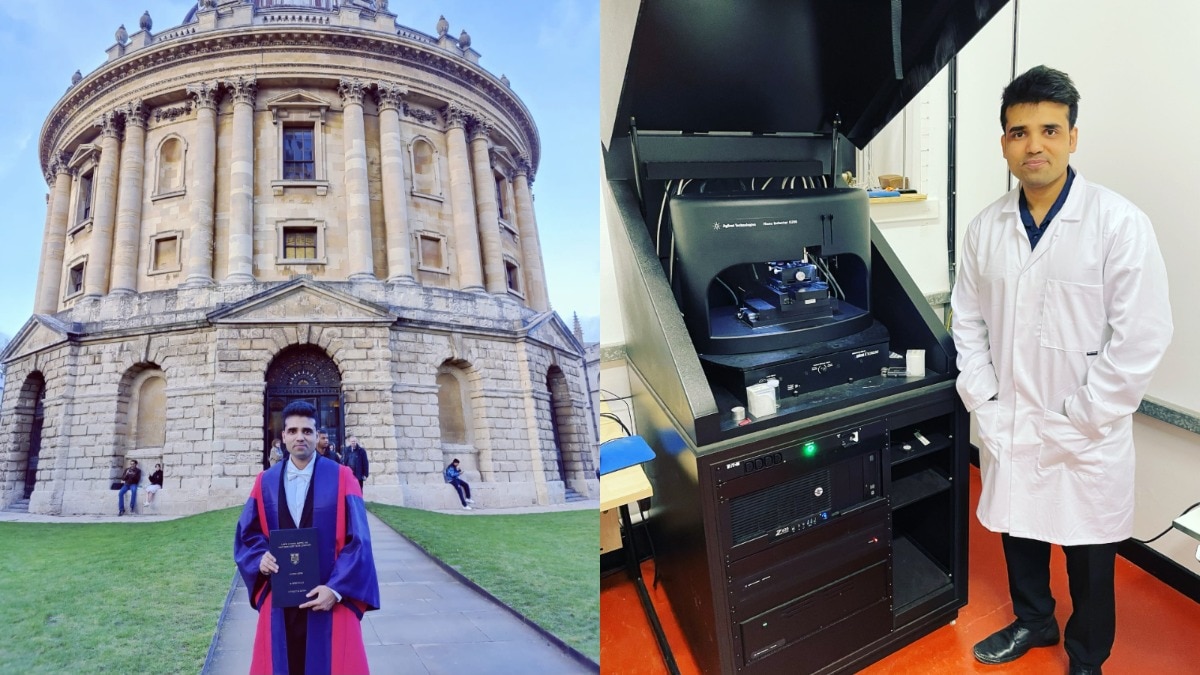
Mishra's next major step was the University of Oxford, where he undertook a DPhil in Engineering Science after receiving a competitive NIH Research Studentship.
The funding covered his overseas-rate tuition fees and provided living-cost support, removing one of the biggest barriers he had faced earlier in his education.
At Oxford, his research moved into ultrasound, acoustics, tissue mechanics and biomedical engineering.
His DPhil research focused on passive acoustic mapping for monitoring burst wave lithotripsy.
Since then, his work has expanded into rheology, viscoelastic modelling, biomechanical modelling and tissue-mimicking materials such as agarose hydrogels.
In simple terms, he is interested in understanding how biological tissues behave mechanically and whether those changes can tell researchers something about disease or treatment.
"Biological tissues are mechanically complex materials," he explains.
Some tissues do not behave like simple elastic materials. Their response can depend on factors such as how quickly and for how long they are subjected to force.
Mishra's research seeks to understand these properties and explore whether changes in tissue mechanics could eventually contribute to better tissue characterisation, imaging, diagnosis and treatment monitoring.
He is careful not to oversell the science.
Much of the work remains at the fundamental and preclinical stage, and clinical validation would be needed before such approaches could become part of routine healthcare. At St Peter's College, University of Oxford WHY THE ROYAL ASIATIC SOCIETY FELLOWSHIP MATTERS
Mishra's latest recognition comes from a society that sits outside the immediate boundaries of his biomedical research.
He has now been elected a Fellow of the Royal Asiatic Society, after earlier associations with the Royal Astronomical Society and the British Society for Nanomedicine.
Each represents a different part of his intellectual journey.
The British Society for Nanomedicine connects to his interest in nanotechnology and healthcare. The Royal Astronomical Society reflects his broader interest in science and discovery.
The Royal Asiatic Society, however, has a particularly personal connection.
"I grew up in India, built the foundations of my education and early research there, and then continued my academic journey in the UK," he says. "My career has therefore been shaped by experiences across both countries."
He hopes the fellowship will help him build wider academic connections between India, South Asia and the UK, including across science, technology and knowledge exchange. THE PART OF HIS STORY THAT IS NOT ON HIS CV
Academic CVs tend to compress years of life into a few lines.
Mishra's would mention universities, fellowships, publications and research.
It would not show the financial calculations that accompanied his decision to study abroad. It would not show the loss of his father in 2013. And it would not show the hospital visits that have been part of his own life in recent years.
Mishra has undergone repeated medical investigations, including MRI scans and blood tests.
During some hospital visits, he encountered patients undergoing treatment for serious illnesses, including cancer.
Those experiences changed the way he thought about the purpose of his research.
"Seeing what patients and their families go through has made the human side of healthcare much more real to me and strengthened my desire to use my research to do something meaningful for patients," he says.
His mother, Kanak Lata Mishra, has also been a constant source of support through difficult periods.
And there is now a much bigger ambition behind his research. (Representative image) HIS BIGGEST AMBITION IS NOT ANOTHER FELLOWSHIP
Mishra's long-term dream is to establish a cancer hospital in India where patients who cannot afford treatment can receive high-quality care free of cost.
It is an ambitious goal, and he knows it. But for him, it gives a larger purpose to the scientific work he has spent years pursuing.
"I do not want research to remain only in laboratories or scientific publications; I want it ultimately to make a difference to people,” he says.
His research is still some distance from clinical application. There is substantial work to be done before tissue mechanics, acoustic techniques or related approaches can become part of routine patient care.
His research into tissue mechanics and disease is still developing. There is considerable work ahead before such approaches could translate into routine clinical practice.
But the larger purpose is clear. He wants science to move beyond laboratories and papers and eventually reach the people who need it.
For Indian students considering research or international education, Mishra's advice comes from personal experience. "Do not decide that an opportunity is beyond your reach before you try."
He suggests looking for scholarships, research opportunities, internships and alternative routes rather than assuming that an international academic career is financially or academically out of reach.
"The journey may not be straightforward, but persistence can create opportunities that initially seem impossible."
For someone whose own journey began with a child in Lucknow asking why things work, perhaps that is the most fitting thread running through it all.
The questions changed, the laboratories, and the countries changed.
But the curiosity did not.- EndsRead | He broke toys as a child, today 20,000 students are learning maths through his gamesRead | This 8-year-old founder learns at hackathons, factories instead of classrooms
Roshni has been working in the journalism industry for over a decade, telling stories that matter. She loves writing about student innovations, latest research, and people striving to make the world better for children -- through education, social change, or environmental efforts.
With a special focus on education, the job industry, and mental health, she also enjoys uncovering lesser-known scientists and changemakers from history whose work continues to shape our lives today. Away from work, Roshni finds joy in reading, painting, photography, and exploring the spiritual and the occult.