3 Japanese scholars examine Filipino migration story in UAE - Rappler
Already have Rappler+? Sign in to listen to groundbreaking journalism.
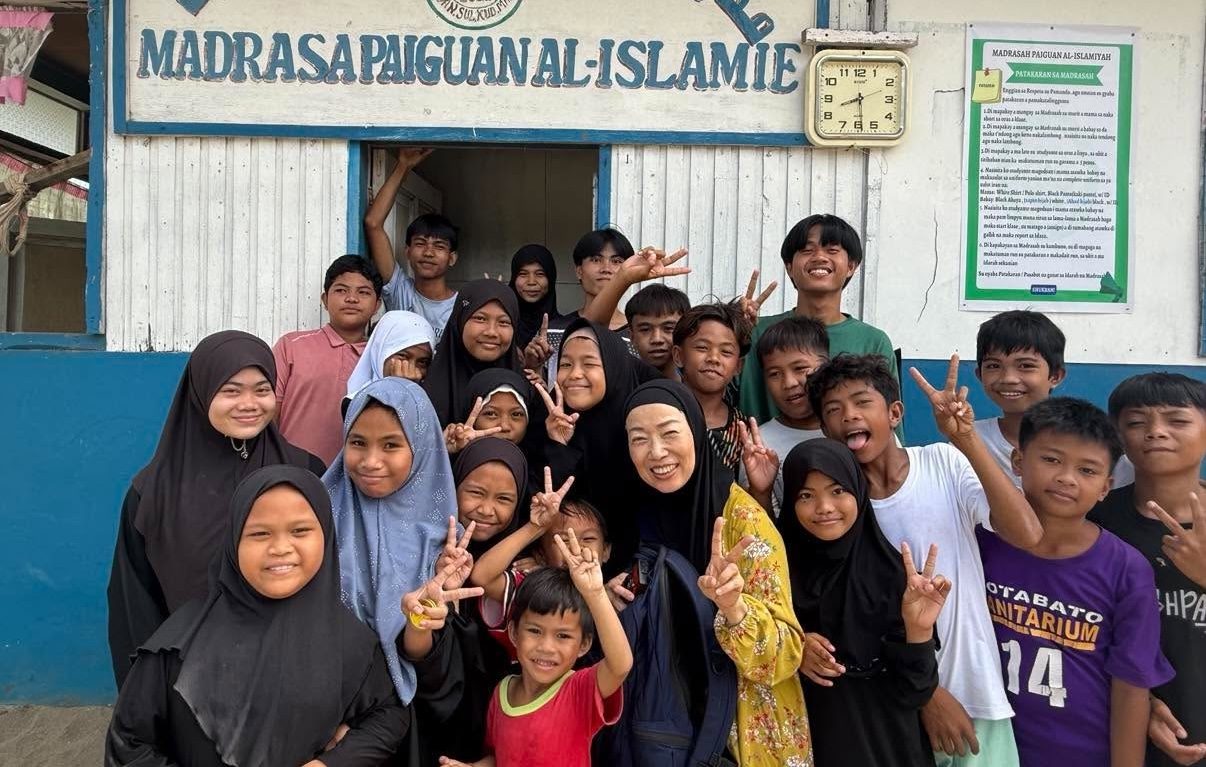
SECOND HOME. Dr. Masako Ishii (center, in yellow) with school children in Mindanao.
This is AI-generated. Read the article for full context. Report any errors.
DUBAI, United Arab Emirates – Why would three college professors from Japan write a book on overseas Filipino workers (OFWs) in UAE?
Drs. Naomi Hosoda, Masako Ishii, and Akiko Watanabe said they’ve always been interested to study the Philippines — to learn more about its people, and perhaps, provide the world a better understanding of the Filipinos.
Hosoda, who has been in the Philippines for seven years — four in Manila where she worked as a journalist for the Manila Shimbun from 1994 to 1998, and some more years in Samar where she, then a doctorate student, conducted ethnographic research on the Samarnon migration — has long been curious to learn about the Filipino movement elsewhere around the world.
“My interest in the Philippines began when I was a graduate student in Canada and chose the country as the focus of my research topic. Why do so many Filipinos go abroad to work in such a wide range of professions?“ she asked.
Ishii, who, from March 1995 to March 1996 was based in General Santos City and Sarangani Province, has, since 2022, spent more than a year in total in Cotabato City monitoring the transition process of the Bangsamoro Autonomous Region in Muslim Mindanao (BARMM).
Watanabe, meanwhile, has stayed mostly in Manila from 2001 to 2006, and traveled to different places in Luzon, Visayas, and Mindanao.
All holding doctorates and specializing in Philippine studies, the three Japanese scholars are set to launch a book about Filipino migration to the UAE. Alongside seven contributing authors, the book explores why the country has become one of the top destinations for OFWs.
They decided to write the book to document how the lives of Filipinos in the Gulf have transformed over the years. They noted that it has been over 50 years since the Philippines first began exporting labor to alleviate economic stagnation at home and meet the growing demand for workers in the Middle East during the 1970s oil boom.
“Gulf cities like Dubai have experienced drastic changes since the 1970s. But what about the people living there?” Hosoda asked.
The professors highlighted that while existing literature covers the daily lives of Indian, Arab, and European expatriates in the Gulf, no books have focused specifically on the Filipino community.
“We chose the UAE as our case study site because it is where we conducted most of our research, and it is widely seen as a model country for urban development driven by a global workforce,” Hosoda said.
“The nexus of the Philippines as the sending country and the UAE as the receiving county, we imagined, could be a very interesting case study for us to learn how a massive human flow could transform both urban spaces and migrant people.”
Filipinos comprise the fifth biggest number of foreigners in the UAE at one million, according to official estimates.
“We also need to emphasize the fact that we were able to conduct research in the UAE because of the kindness of people we encountered there, especially Filipinos living in the country,” Hosoda said.
The book, entitled Filipino Migration to the United Arab Emirates: Trajectories of Navigating Long-term Temporariness, also features seven contributors — five Filipinos and two French.
It has 12 chapters discussing subjects from origins of the migration to the UAE, to Filipino entrepreneurship and what lies ahead, among others. Work on the book started in 2024.
The three scholars are no strangers to the contemporary Philippine setup.
“I had been studying about Muslims in Manila and then explored my focus on Filipinos in the Gulf. It’s partly to return the favor for all the kindness they’ve extended to me, and partly because I want to further raise/change their standing in Japan and around the world,” said Watanabe.
Ishii also finds it interesting to note the economic relations between Japan and southern Philippines, and the armed conflict there.
“Mindanao is an island from which Japan has long imported timber, bananas, pineapples, and tuna. Japan and the southern Philippines have therefore long maintained significant historical and economic ties,” she said.
“Nevertheless, the armed conflicts that have taken place in this neighboring country remain relatively little known among the Japanese public. This is one of the reasons why I have continued to study and teach about the southern Philippines.”
Ishii first learned more about the country in 1989, during which she found out about the war in the southern Philippines.
“Since then, I have become interested in studying the armed conflicts in a country neighboring Japan,” she said.
“I have also learned that the armed conflict and the resulting displacement had expanded the physical range of movement of Muslim women. Some eventually began traveling abroad to work as overseas Filipino workers. However, many of them experienced mistreatment while working in the Middle East,” Ishii added.
“This, in turn, compelled me to document the experiences of Muslim Filipina domestic workers and to draw attention to the challenges they faced.”
Hosoda, meanwhile, has been keen to pass on what she has learned to her students.
“After finishing my master degree, I became a journalist and then a doctoral student in Japan. Finally, I became a researcher, and write books and papers. Basically, I have been researching the same topic ever since,” she said.
“I teach my students in Japan and elsewhere what I have learned from my research because the lives of the Filipino migrants I have encountered teach us many important life lessons, such as values, faith, community, nation, and history.”
What’s even more interesting is why their students are taking up Filipinology.
“They are interested in the Philippines as a country where people speak English, and they view it as a country struggling with poverty,” said Watanabe.
Intercultural marriages is another factor.
“Students at my college are interested in Filipinos, as many of them have had classmates of Filipino descent — whose mother or father is Filipino — since elementary or high school,” said Ishii.
Migration is another interest in Hosoda’s classes at Nagasaki University.
“I teach about Filipino society and their out-migration to approximately 100 undergraduate students and several graduate students per year,” noted Hosoda.
“Undergraduate students take my courses because they are interested in learning about Asian countries other than Japan and/or the actual lives of international migrants, including Filipinos.”
Watanabe is an associate professor at the Bunkyo University’s Faculty of International Studies in Tokyo. She has a doctorate from Kyoto University awarded in July 2012. Her thesis is about the formation of Muslim communities in Metro Manila.
Ishii is a professor at Rikkyo University’s College of Intercultural Communication also in Tokyo. She has a doctorate in international relations awarded in 2000 in Sophia University, likewise in Tokyo. Her thesis is Stories of Muslim Women in the Philippines: Armed Conflict, Development, and Social Change.
A professor in Nagasaki University’s School of Global Social Sciences and Humanities, Hosoda has a doctorate degree in Southeast Asia Area Studies from Graduate School of Asian and African Area Studies in Kyoto University. Her thesis was entitled, Socio-cultural Aspects of Migration from Samar Island, Philippines. The doctorate was awarded in 2007. She also has two awards for her previous book, Searching for ‘Luck’: An Ethnography of Filipino Migrants and their Affective Ties.
The three have written other books about migration into the Gulf. – Rappler.com