3 world leaders walked into a room — and took aim at international law and institutions - CBC

From left, Russian President Vladimir Putin, Chinese President Xi Jinping and U.S. President Donald Trump arrive for a trilateral meeting at Kylin Villa in Shenzhen, China, on Thursday. The three leaders met on the sidelines of the Asia-Pacific Economic Co-operation (APEC) summit hosted by China. (Getty Images)Social SharingBefore Vladimir Putin sat down across from Xi Jinping and Donald Trump at a high-end resort on the outskirts of Shenzhen, China, a Kremlin aide proclaimed to a reporter that the Russian president was in a brilliant mood.
Ukraine may have attacked Russia’s prized Kerch Bridge to Crimea for the third time this week just a few hours earlier, but Putin was surely elated by the choreographed events at the APEC summit.
Before his one-on-one meeting with Trump, the U.S. president gave him a warm greeting, calling Putin "my friend."
By the end of the main event — the 90-minute trilateral sit-down — the leaders issued a four-point "Declaration towards Peace" that not only largely aligned with Putin’s priorities but also pushed back against global institutions such as the United Nations and the International Criminal Court (ICC).
The joint statement called for an increase in the global supply of refined petroleum products, which would be welcome news to Russia’s heavily sanctioned energy industry.
It also warned that the ICC "and other similar bodies must not abuse their jurisdiction."
That is a message Putin stands firmly behind, given that the ICC has issued a warrant for his arrest, accusing him of war crimes in Ukraine.
"The leaders of China, Russia and the U.S. seem to be united in their belief in a rigid concept of sovereignty in which their countries can do what they wish, with little accountability," wrote Jonathan Eyal, associate director of the Royal United Services Institute, in a briefing note sent to journalists after the meeting.
"This was a summit supposedly designed to deal with global questions, but one which ended up with an outright rejection of globalization."
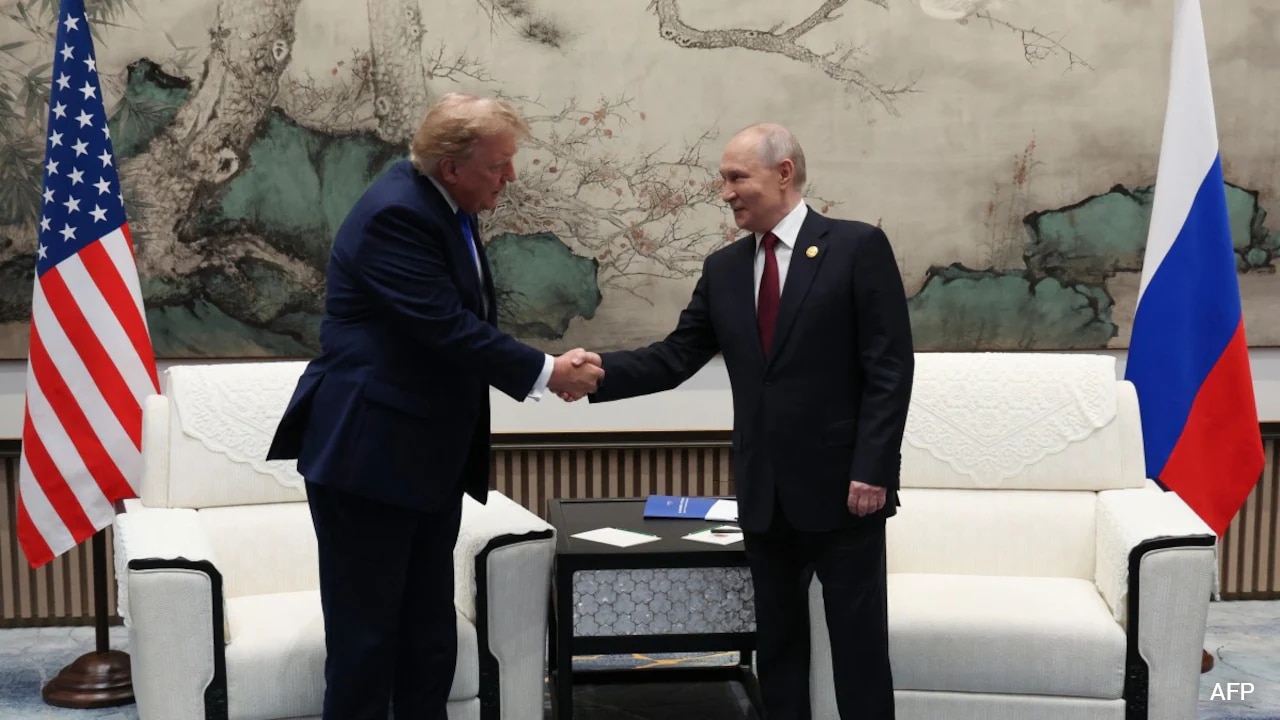
In this photograph distributed by the Russian state agency Sputnik, Putin and Trump shake hands on the sidelines of the APEC summit in Shenzhen, China, on Thursday. (Getty Images)
In the post-meeting statement, there was no mention of Ukraine. Afterwards, in front of a room full of journalists gathered in Shenzhen, Putin took questions and echoed the same talking points he has been pushing for years regarding Ukraine, NATO and his claim that Kyiv and Europe are blocking the road to peace.
While the official meeting was brief, the publicity and political analysis leading up to it were not.
Some experts and pundits mused that the meeting could be reminiscent of the Yalta talks in 1945, where the leaders of the U.S., the U.K. and the Soviet Union met to solidify their spheres of influence near the end of the Second World War.
Russian media leaned into the comparison. As the trilateral meeting was wrapping up on Thursday, a reporter from Kommersant, a Moscow-based publication, shouted a question at Putin asking if the meeting resembled a "Yalta 2.0," to which Putin nodded affirmatively.
Far from being an international pariah, he was at the centre of a major geopolitical event alongside global powers, even as Russian weapons continued to target Ukrainian cities.
Afterwards, in response to a question from BBC News, Putin was adamant that the summit was not a "photo opportunity."
"It is serious joint work," he said. "The goal is to find mutually acceptable solutions for the three of us, primarily in the field of security."
A cloud of smoke rises over Kyiv, Ukraine, on Thursday after a local air defence unit shot down a Russian drone. (Reuters)
It's not clear how much the war in Ukraine factored into the conversation. Chinese President Xi didn’t specifically mention it in his public comments, though he did talk about the need for major powers to "safeguard world peace."
China has officially remained neutral throughout Russia’s full-scale invasion but has supported Moscow's war machine by selling it technology and buying its sanctioned oil. Kyiv, along with European countries, has called on Beijing to ramp up pressure on Russia to help end the war.
China's state-run Xinhua news agency reported that ahead of the meeting, Xi spoke about nuclear weapons, calling them a "sword of Damocles hanging over humanity" and pushing for them to be "completely banned."
It’s estimated that China has around 600 nuclear weapons, while both Russia and the U.S. each have more than 5,000.
While the official statement said all three leaders agree that a nuclear war "cannot be won and must never be fought," Russia appeared to deliberately remind everyone that it holds the largest stockpile of nuclear weapons.
As Putin arrived in China, state television host Yevgeny Popov — who is also a lawmaker with the ruling United Russia party — was live on air when a military official carrying a briefcase walked past. Popov asked if it was the "nuclear briefcase," which is designed to connect Putin to the country’s nuclear arsenal.
The officer confirmed it with a grin.
Russia also deployed two of its nuclear-capable bombers to Vietnam this week, prompting Japan and South Korea to scramble fighter jets in response.
Sergey Radchenko, a professor at the Henry A. Kissinger Center for Global Affairs at the Johns Hopkins School of Advanced International Studies in Washington, D.C., told CBC News he found the statement on preventing nuclear war interesting, because it harkened back to summits held between U.S. president Ronald Reagan and Soviet general secretary Mikhail Gorbachev in the 1980s.
Xi and Trump are seen meeting on Thursday. (Reuters)
However, Radchenko said overall, there were few details.
He said it wasn’t surprising that all three leaders are pushing to reform the UN, where the three countries sit as permanent members of the Security Council.
More interesting, he said, was that they all signed onto a statement focusing on the need to respect the "immunities" of state officials.
The Trump administration has railed against the International Criminal Court before, and last year levelled sanctions against the court, accusing it of "baseless actions targeting America and our close ally Israel."
"It’s clear that Putin would want to be against the International Criminal Court. But it's kind of interesting to see Trump also sign on to this," Radchenko said.
"It kind of shows his general orientation and his mindset. He clearly thinks that he should be above the law, just as Putin and Xi should be above the law."
Briar Stewart is a CBC correspondent, based in London. During her nearly two decades with CBC, she has reported across Canada and internationally. She can be reached at briar.stewart@cbc.ca or on X @briarstewart.