4 takeaways from Trump’s summit with Xi in Washington
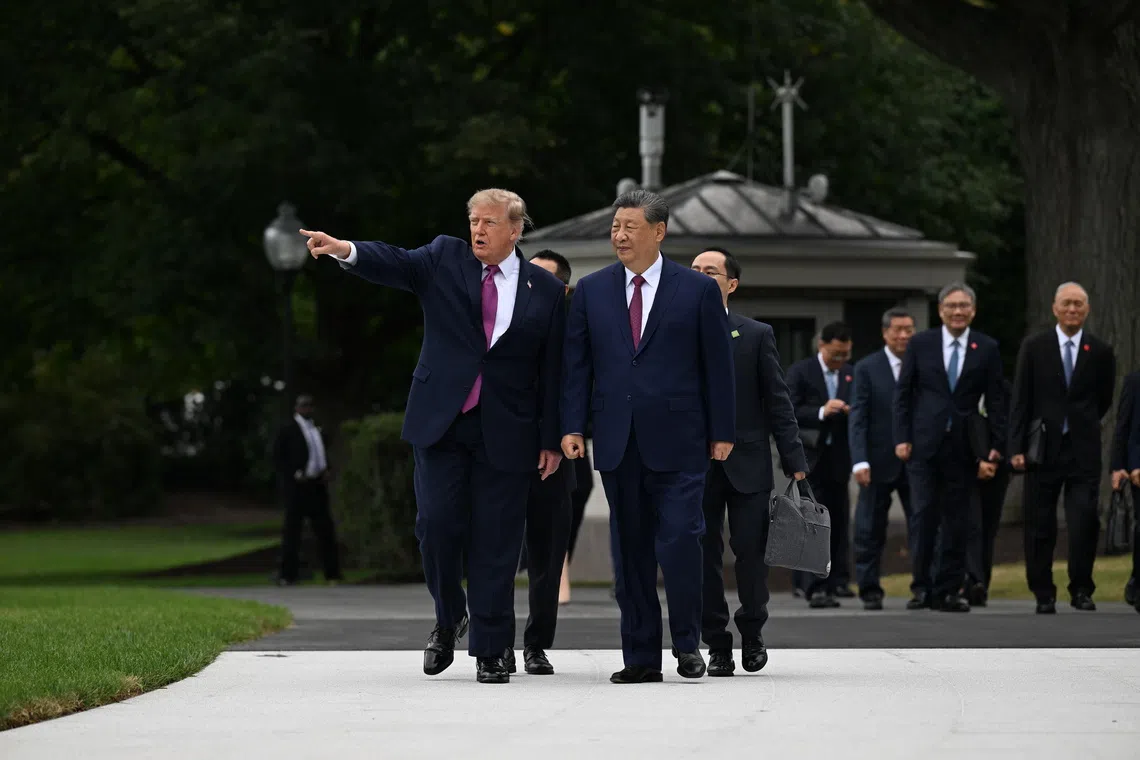
US President Donald Trump giving Chinese President Xi Jinping a tour of the new White House helipad on Sept 24.
WASHINGTON - US President Donald Trump welcomed Chinese President Xi Jinping to the White House on Sept 24, with talks on trade and artificial intelligence and the growing strategic rivalry between the countries all in the spotlight during an elaborate state visit.
US Treasury Secretary Scott Bessent said the two sides had extended a trade truce that was due to expire in November during talks, but only by two months. He said the extension would give the two sides “more time to see what we can do on the economic front”.
But rather than locking in a durable agreement, the extension appears to push the central questions – tariffs, Chinese purchases, rare-earth supplies and technology restrictions – into the next round of negotiations.
Bessent said on Sept 23 that Beijing was meeting its requirement in the earlier agreement to buy 25 million tons of soybeans but was lagging on its pledge to buy US$17 billion (S$21.8 billion) in other agricultural goods. US officials have said rare-earth deliveries were also falling short, another sign that significant gaps remain.
For companies, the result is a familiar form of instability: tariff rates remain lower for now, but decisions must still be made against a shifting policy backdrop.
Trump and Xi could have more opportunities to hammer out a more permanent deal ahead of the new Jan 10 deadline, with two multilateral summits scheduled in Shenzhen and Miami before the end of the year.
As expected, Xi pressed Trump on the Taiwan issue, saying, according to China’s official news agency Xinhua, that China hoped the United States would “handle the Taiwan question with prudence to lay a solid foundation for bilateral strategic cooperation and the development of China-US ties”.
The agency’s English-language service also wrote that Xi hoped the US would oppose Taiwan independence.
That would be a tougher version of Washington’s long-standing formulation that it does not “support” independence. There are no signs that the Trump administration plans to change its wording.
There was no immediate White House readout of the exchange, but US officials have long avoided explicitly stating opposition to Taiwanese independence. Any shift in language would raise questions about Washington’s resolve to defend the island and provoke opposition in Congress.
Washington is Taiwan’s most important international backer and is bound by US law to provide it with the means to defend itself.
Trump raised questions about that commitment after his summit with Xi in May when he described a pending arms package for Taiwan worth up to US$14 billion as a “negotiating chip”.
Xi, not for the first time while meeting Trump, invoked the “Thucydides Trap”, an academic theory that competition between a rising power and an established one tends towards war.
While the Chinese leader said the risk “can be overcome”, his reference underscored the extent to which concerns about a potential US-China military conflict continue to shadow relations between the world’s two largest powers.
Xi argued that both nations stand to gain from cooperation and lose from confrontation, and he called for regular military dialogue and stronger crisis-prevention mechanisms.
Trump, for his part, drew on the two nations’ shared history to emphasise the potential for cooperation. They could accomplish much by pursuing common interests, he said, invoking their wartime alliance against Japan.
For Trump, Xi’s White House visit was an opportunity to show off a Washington being remade in his image.
After Xi treated Trump in Beijing to a tour around a Ming dynasty temple and a walled-off garden retreat rarely opened to foreigners, the US president returned the favour with a different kind of spectacle: Troops wearing wigs and tri-corner hats marched in formation and played music in a Rose Garden redesigned to look like a Trump golf club.
Fighter jets and bombers roared overhead during ceremonies staged on Sept 23 and Sept 24, one so loud it caused Trump to flinch.
Trump has talked for months about needing more authority, often over the objection of courts and the US Congress, to beautify and remodel the nation’s capital ahead of Xi’s visit, although many of the projects, like the new White House ballroom and the Reflecting Pool, are not yet finished or have run into problems.
When the White House press corps was called to cover the two leaders, it wasn’t to hear them talk about the weighty affairs of state. Instead, it was to watch them tour the Marine One helicopter and the recently redesigned South Lawn of the White House, replete with a large helipad emblazoned with the presidential seal.
Speaking to reporters, Trump brushed away questions about their policy discussions.
“He loves good granite,” Trump said of Xi. “Great meeting.” REUTERS