‘4F’ crisis cannot be left to itself: Jaishankar calls for global guardrails - The Indian Express
Highlighting that the global order is under stress due to intense competition and geopolitical tensions, External Affairs Minister S Jaishankar said Monday that the international community should develop frameworks and guardrails for fuel and food supplies. The comments come amid the United States passing the Russia sanctions bill, which would have huge implications on New Delhi’s energy imports from Moscow.
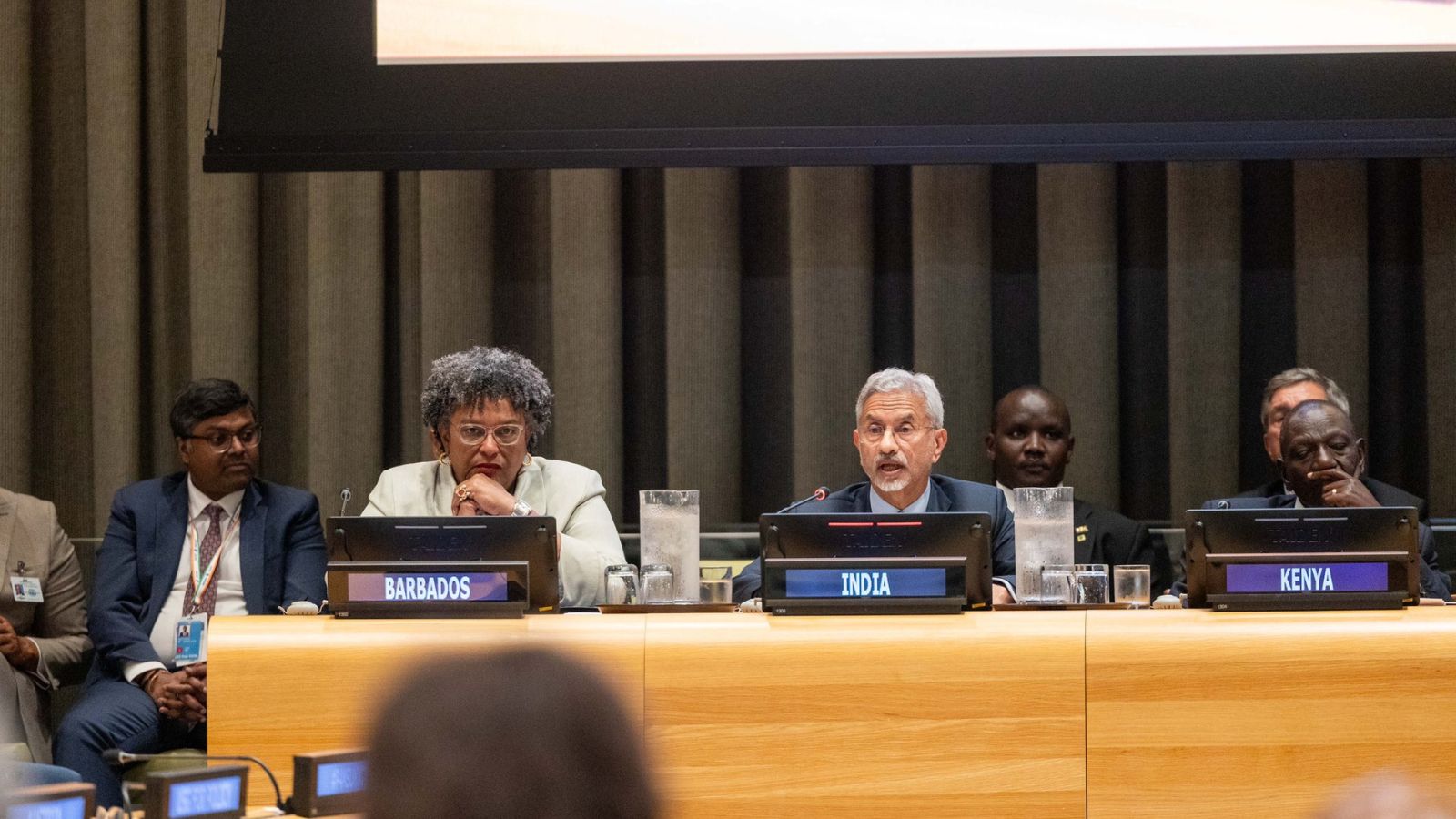
Speaking at the first-ever ‘Partners for Multilateralism, International Law, Peace and Prosperity (P4M)’ Summit held in New York on the margins of the high-level 81st session of the United Nations General Assembly (UNGA), Jaishankar said that for some decades, the world has witnessed a steady rebalancing, which was a long-expected structural evolution.
India has co-sponsored an inaugural multilateralism summit at the UN “at a time when the global order is under stress”, when New Delhi says more participative deliberations and transparent decision-making are overdue.
“India is glad to join as a co-sponsor. We meet at a time when the global order is under stress,” Jaishankar said in his remarks at the summit held in the UN headquarters. “However, extreme competition, geopolitical tensions and actual conflicts have given this an entirely different character. If left unchecked, it would call into question the very spirit of international cooperation, and that is why it is so essential that multilateralism asserts itself strongly at this juncture,” he said.
The summit comes as the 15-nation UN Security Council remains deeply polarised, with sharp divisions among its five permanent, veto-wielding members: China, France, Russia, the UK and the US. New Delhi has been pitching for a seat on the United Nations Security Council to reflect the realities of today’s world.
Jaishankar emphasised at the summit that while ongoing conflicts persist, nations can address specific dimensions as they seek broader peace.
“The ‘4F’ crisis of fuel, food, fertiliser and finance cannot be left to itself. When new capabilities and concerns arise, there is a very powerful case for frameworks and guardrails. Where there is a threat of chokepoint dominance and disruption, de-risking and diversifying must be encouraged,” he said.
“And where there is a compelling cause or a powerful case, the like-minded must have the confidence to come together,” he added.
Jaishankar was joined by the summit’s co-sponsors: President of the European Council Antonio Costa, President of Kenya William Ruto, Australian Prime Minister Anthony Albanese, and Barbados Prime Minister Mia Mottley.
The External Affairs Minister also stressed that multilateralism will be best served when international law, rules and norms are scrupulously observed. “For multilateralism to forge ahead, its advocacy and its practice must both be strengthened. Reformed multilateralism is therefore essential. More participative deliberations and more transparent decision-making are both overdue,” he noted.
Emphasising that “very real issues” are at stake, including the future of peace and international security, climate action and climate justice, countering terrorism and strengthening supply chains, Jaishankar said it all depends on a “will to cooperate.”
Meanwhile, Jaishankar also participated in the first foreign ministers’ meeting of India with the four-member Visegrad group of Central European countries, calling it a “new historic occasion”. The Visegrad Group (V4) is a cultural and political alliance of the Czech Republic, Hungary, Poland, and Slovakia that aims to advance cooperation in military, economic, cultural, and energy affairs.
At their first meeting on the margins of the 81st UNGA, India and the four-member group on Monday agreed to step up political, economic and defence cooperation.
On the first day of his New York visit, Jaishankar also held several bilaterals, including with his counterparts from Ukraine, France, Moldova and Hungary. His engagements on Monday commenced with a meeting with French Foreign Minister Jean-Noël Barrot.
“Our regular meetings and telecons enable us to maintain the momentum of our Special Global Strategic Partnership,” Jaishankar said in a post on X after his meeting with Barrot. “Regional and global issues, specifically the Ukraine and Gulf crisis, were discussed. Also exchanged views on multilateral issues, including the reform of the UN Security Council.”
Jaishankar also met Ukraine’s Foreign Minister Andrii Sybiha in New York, weeks after meeting the Ukrainian leader in Kyiv earlier this month. After the meeting, Sybiha said he was pleased to meet with Jaishankar to discuss peace efforts, bilateral cooperation, and international developments.
“We spoke about the situation in the Black Sea and its market implications. Restoring freedom of navigation is critical for global food security. Ukraine is ready to play a constructive role, and we value India’s engagement,” Sybiha said.
Jaishankar also held a “great first meeting” with Deputy PM and Foreign Minister of Hungary Anita Orban, wherein the two “resolved to work together to deepen ties, and advance the bilateral strategic partnership”.
Jaishankar will address world leaders at the General Debate from the UNGA podium on September 26.
Divya A reports on travel, tourism, culture and social issues - not necessarily in that order - for The Indian Express. She's been a journalist for over a decade now, working with Khaleej Times and The Times of India, before settling down at Express. Besides writing/ editing news reports, she indulges her pen to write short stories. As Sanskriti Prabha Dutt Fellow for Excellence in Journalism, she is researching on the lives of the children of sex workers in India. ... Read More