A ball in your face at 60kmh: Older pickleball players more prone to eye injuries - The Straits Times
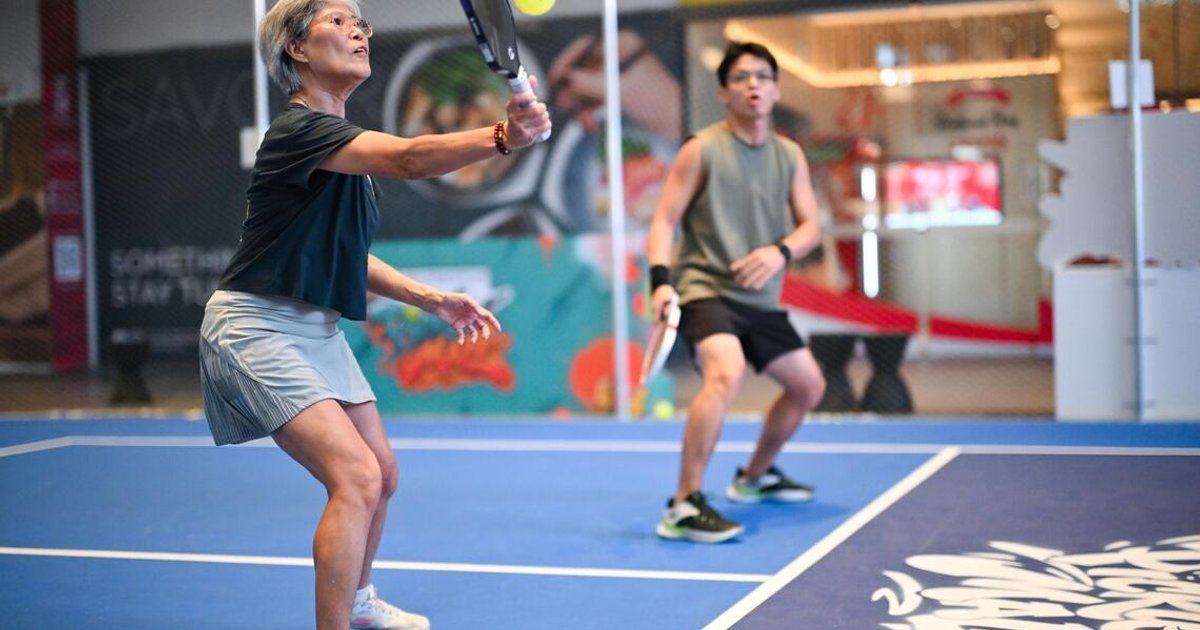
Eye injuries are more likely to result from falls or a direct hit by the ball, and such injuries occur more frequently among older players.
SINGAPORE – As the popularity of pickleball surges in Singapore, a number of its players, particularly older ones, could end up leaving the court for the emergency room.
Doctors at Khoo Teck Puat Hospital have seen patients with eye injuries “sustained while playing pickleball, particularly following direct impact of the ball to the eye”, said Yeo Tun Hang, head of ophthalmology and visual sciences at NHG Eye Institute at the hospital.
“A patient sustained a direct impact from a pickleball and developed retinal breaks, requiring laser (treatment) to reduce the risk of retinal detachment.
“Another pickleball injury resulted in dislocation of a previously implanted intraocular lens, requiring surgery to refix the lens,” Yeo told The Straits Times.
Meanwhile, the Singapore National Eye Centre (SNEC) has attended to a case of pickleball-related corneal abrasion.
Another pickleball player visited the National University Hospital (NUH) and was diagnosed with two conditions caused by trauma from the game: iritis, an inflammation of the iris and the surrounding front chamber tissues; and microhyphema, a mild form of eye bleeding where blood enters the clear fluid-filled space between the cornea and the iris.
Singapore hospitals do not have registries specifically related to the game so such injuries cannot be reliably quantified to determine whether there has been an increase in recent years, Yeo said.
But pickleball statistics are available in the US, where there is an estimated 20 million players.
Using a nationally representative sample of pickleball-related eye injuries reported by emergency departments in the US, researchers estimated that these injuries have increased by about 400 incidents a year – from fewer than 200 in 2021, to 1,262 in 2024.
Almost half (43%) of these injuries frequently arose from direct impact by the ball, and players over 50 years old showed a 39% higher risk of getting such injuries, compared with younger players, the researchers found.
The study was published by peer-reviewed journal JAMA Ophthalmology online in October 2025.
Pickleball involves fast exchanges between players at relatively close range, and a ball striking the eye directly can transmit significant blunt force.
While most people play without getting an eye injury, a direct strike can occasionally result in a serious and potentially sight-threatening injury.
Experts said lightweight paddles can send the plastic balls flying at speeds of up to 60kmh.
But it is not just about the speed of the ball, said John Komar, assistant dean of research support at the Office for Research at the National Institute of Education, Nanyang Technological University (NIE-NTU).
It is also about reaction and movement.
“Players in pickleball are very often very close to the opponents, compared with tennis where you (hardly) see both opponents at the net. Although the ball is slower in pickleball, players have simply no time to avoid it as reaction time is an incompressible time, whatever sport you are playing,” Komar said.
Ophthalmologist Marcus Ang, who heads the corneal and external eye disease and refractive surgery departments at SNEC, said senior pickleball players need to be aware of ocular injuries in any sport, especially in racket games, and should wear protective eyewear when necessary.
“In the event of (an eye) injury, they should seek emergency consultation immediately at an emergency department with eye specialist care. Some injuries such as microscopic hyphema, may be mildly symptomatic at first, but if ignored, may lead to some complications,” he said.
Given that it is played on a smaller-sized court, the travel distance for the ball is less and travel time is shorter, raising the risk of the ball contacting the player’s body.
Pickleball is a relatively new popular sport with a unique player profile, said Swarup Mukherjee, deputy head of the physical education and sports science department at NIE.
“The majority of players are in their fifth or sixth decade of life – an age when the body’s reflexes and reactions naturally slow down. Given that (pickleball) is played on a smaller-sized court, compared with tennis, the travel distance for the ball is less and travel time is shorter. This might raise the risk of the ball contacting the player’s body,” he said.
But he added: “The number of injuries is rising not because the risk element is increasing, but because there is a greater number of players playing pickleball.
“The question is therefore not how many injuries are documented, but what is the incidence of injuries per player and in a given time of exposure to the sport.”
Regardless, pickleball provides great exercise and health benefits, Swarup said.
“It is a sport that is played on a smaller area and hence, is not very demanding on the heart and lungs. It being an intermittent nature sport stimulates reaction time, quick reflexes, better posture, balance and control. These outcomes can be of immense benefit, especially to those in their 50s and 60s,” he said.
Judith Tan is health correspondent at The Straits Times.
Related Coverage in Health