A Canadian company paid $3.7 million in tariffs before moving some production south to survive. - Toronto Star
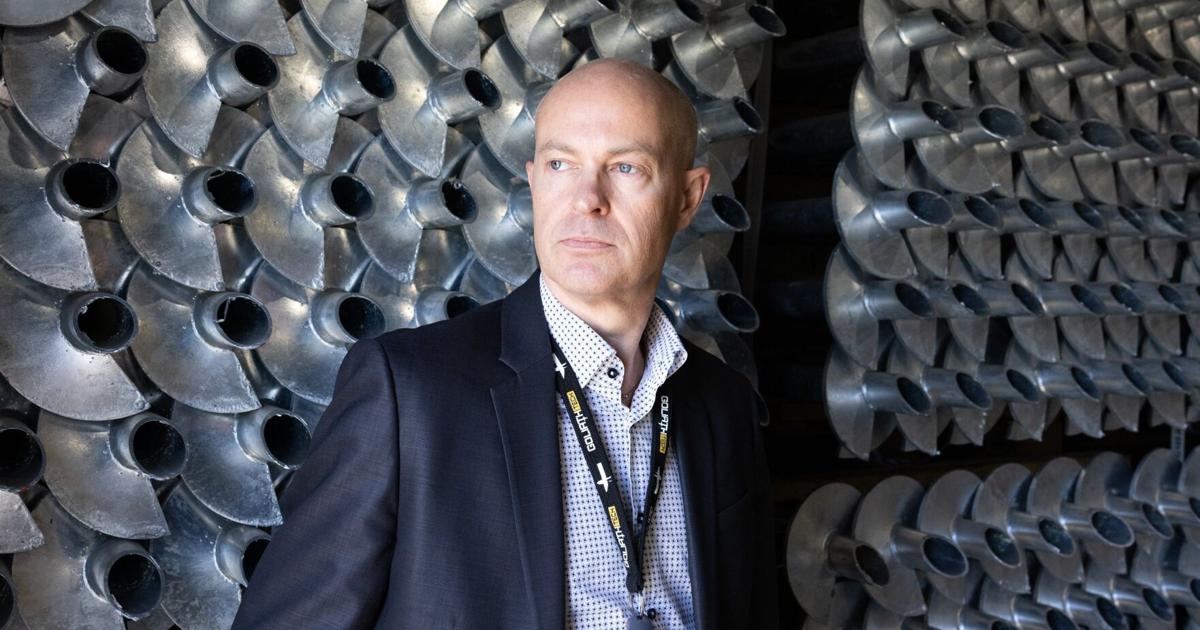
Hammered by Trump tariffs, helical screw pile manufacturer GoliathTech almost closed. CEO Julian Reusing kept the firm afloat by opening a factory in Ohio and adding franchisees in Europe and Britain.
One day last December, Julian Reusing pulled his managers into a virtual meeting to lay bare an uncomfortable truth.
His Quebec company, GoliathTech, a manufacturer of helical screw piles that operates on a franchise model, was getting battered by U.S. tariffs and running out of ways to keep its head above water.
Since the steel tariffs came into effect last March, the company has paid about $3.7 million in tariffs that it has split with its U.S. franchisees.
Reusing, 56, was eager to open a factory south of the border, but he was cash-strapped. Just days earlier, RBC had turned down financing for the company’s European franchise expansion.
Reusing appealed to his own employees for money.
There have been few moments in Canadian history when small and mid-sized manufacturers have faced such pressure. Insurmountable trade barriers with the U.S. have appeared overnight for some companies, suddenly cutting off their largest export market and forcing an urgent need to pivot.
The fight to survive can feel lonely, business owners told the Star. Several said the country’s support falls far short of what they need: the tariff relief programs don’t go far enough and structural threats to Canadian manufacturing competitiveness are making it difficult to replace lost U.S. business.
Over the past two years, GoliathTech’s Julien Reusing approached multiple Canadian government agencies and banks for financing, but was repeatedly turned down. He found his own investors to raise $2.4 million.
Luckily, GoliathTech did not go under that winter.
Instead, following that pivotal meeting in December, the company raised $900,000 through an equity sale to six of its employees, alongside $1.5 million from a private investor. Reusing opened a small factory in Ohio in March after 10 months of planning in an effort to bypass most U.S. tariffs. He also added 19 European and British franchisees, expanding the firm’s global network to 190 locations as part of a broader restructuring.
“Without a shadow of a doubt, we would be a non-existent company right now if we didn’t make that move,” said Reusing, explaining why he chose to move some production south. “It’s impossible for a company to survive where for every hundred dollars you ship, you have to give fifty dollars to the government.”
Headquartered in Magog, Que., the 13-year-old company is turning a profit for the first time in three years — a turnaround that resulted from Reusing’s own scrambling, with little help from the Canadian government or financial institutions at home.
Many company owners are not nearly as fortunate, and he says Canada needs to do more before more of them are pushed to the brink.
“The government needs to come up with some programs that would teach people how to deal with this, not just offer money,” he said. “I don’t think everybody knows how to deal with a massive revolution.”
It’s rare to find a clothing company that makes all of its products in Canada — about 95 per cent of the apparel sold here is manufactured outside the country.
When the 50-per-cent U.S. tariffs hit in August, Amit Thakkar feared they could spell the end of his Brampton textile company, Roopa Knitting Mills, which makes fabric for T-shirts, sweatshirts and leggings now caught in the tariff net.
Across the three Canadian clothing businesses he owns, Thakkar employs 120 people, with 50 to 70 per cent of sales destined for the U.S.
His disappointment only grew when Ottawa rolled out a $7.5-billion package to aid tariff-stricken businesses, the majority of which came in the form of loans.
“If you want to know my honest truth, I think those are all bulls—t,” Thakkar said. “The Canadian government wants to give us loans, but we don’t have customers anymore.”
To Thakkar, the situation is reminiscent of a problem that emerged during the pandemic, when businesses took on emergency debt that some are still struggling to repay years later.
Thakkar says he believes the best way to save his business is for Ottawa to return counter-tariff revenue to companies affected by the trade war, giving them cash to cover tariff costs or lost sales.
Julien Reusing considers himself lucky to have had the resources and experience to reshape GoliathTech. Many other businesses, he fears, do not have the same room to manoeuvre.
“If this is like the same in six months,” said Thakkar, “we’re going to be talking about shutting down or moving to the U.S.,” adding that there just isn’t enough buy-in for Canadian-made clothes from the government or domestic consumers.
Before Reusing raised money on his own to restructure his business, he went to the Business Development Bank of Canada (BDC), which launched its Pivot to Grow program last March, offering up to $5 million in loans to help businesses stay afloat and break into new markets.
It seemed like a perfect fit for Reusing’s strategy, but he was denied financing because the business had reported losses in the past two years.
“I’ve spoken with the BDC, Investissement Québec, many different government entities, and we’ve had zero money from the government,” he said. “I lost faith.”
Reusing found investors on his own.
Dennis Darby, president of Canadian Manufacturers and Exporters, said he is in constant contact with Ottawa to discuss the eligibility and access issues manufacturers are running into. The recent tariff-relief programs are well-intentioned, he said, but their success depends on execution and the speed of approvals.
A tube laser cutter in action at GoliathTech manufacturing.
“For these smaller manufacturers getting access to that funding, it can’t take six months,” he said.
When Jack Dell’Accio set out to expand Essentia Organic Mattress in 2023, he faced a choice: scale up the company’s factory in Laval, Que., or open a second plant. He chose the latter, investing in a facility in Florida that opened last October.
Mattresses are not subject to the tariffs, and the move was driven purely by logistics costs, particularly the high shipping rates in Canada.
“I have no issues building in Canada all of our raw materials, but it’s our distribution of finished product that has challenges in Canada,” said Dell’Accio, whose company generates about 70 per cent of its sales in the U.S.
The Florida plant has cut Essentia’s shipping costs by about one-third, he said. It also brought an unexpected advantage: with no state personal income tax in Florida, Dell’Accio said Essentia can attract highly skilled engineers with lower salaries than it would need to offer in Quebec.
Alex Greco, senior director of manufacturing and value chains at the Canadian Chamber of Commerce, said tariffs are only one part of the equation when Canadian companies look south, alongside factors such as taxes, regulation, financing and supply chain proximity to customers.
GoliathTech plate laser operator Stéphane Roy, removes helixes after they’ve been cut.
Canada needs to create a more attractive, business-friendly environment for domestic and foreign investment, so that it can reduce the risk of losing businesses to the U.S., he said.
“We can’t be like psychologists with the president of the United States, but we can control our own competitiveness,” said Greco.
For Reusing, the solution starts with Canadian financial institutions doing more to back manufacturers.
After the tariffs took effect last March, Reusing approached RBC several times for financing to expand his European franchise network. It was not until December, he said, that his account manager told him the bank was no longer lending against European receivables and inventory.
“It was the ultimate blow because we’ve been with RBC for seven years, very solid, great relationship.”
When asked whether the bank pulled back from corporate financing in Europe, RBC said in a statement that it is unable to comment on individual clients for privacy reasons, but “that financing decisions are made on a client-by-client basis.”
“We see significant opportunity in Europe and are expanding our financing capacity in that market, while also continuing to support clients with cross-border financing needs,” the bank said.
GoliathTech tube laser technician Josée Roy, who’s worked for nine years at company, arranges tubes.
Reusing then turned to other Canadian banks, only to be told they would not lend to a company that was “losing money.” He eventually approached a U.S. bank, and the first one he tried agreed to back him.
Last week brought some uplifting news for Canada’s capital markets, as Ottawa unveiled a “productivity mega deduction” as part of its push to attract $1 trillion in new investment over five years.
The measure expands the range of capital assets eligible for businesses to immediately deduct in their first year of use and makes the incentive permanent.
“It’s hard to predict what the future holds for investments in Canada, but this is a policy change that absolutely provides a much stronger incentive for companies to invest in Canada,” said Trevor Tombe, an economics professor at the University of Calgary.
While tariffs have not directly affected Essentia Organic Mattress, they have brought some “social negativity” from Canadian customers when they learn the company operates a factory in the U.S., said Dell’Accio.
GoliathTech laser cutting supervisor since 2020, Patrick Montmigny, prepares a machine for cutting new plates.
Dell’Accio said opening a plant across the border does not mean scaling back production in Canada, where the company still makes all of its raw materials. If anything, he said, the Florida operation gives Essentia a hedge against any future escalation in trade tensions.
“We’re a Canadian success story that exists in both markets and sometimes it feels that we’re forced to choose sides,” said Dell’Accio. “We can’t. We have a commitment and a customer base in both countries.”
Jim Stanford, economist and director of the Centre for Future Work, said there is no evidence of a migration of jobs to the United States from Canada or elsewhere. But what the data do show, he said, is that tariffs have taken a toll on manufacturing workforces on both sides of the border.
“In terms of Donald Trump’s trade war, this is a case of mutual assured destruction,” he said.
Between January 2025 and August 2026, Canadian manufacturing employment fell by 27,600, from 1.875 million to 1.847 million while the U.S. manufacturing workforce shrank by 35,000. Both countries, however, have seen a modest rebound in those numbers in recent months.
Since the new 50 per cent tariffs took effect, Northern Cables, which has manufactured commercial and industrial power cable with aluminum and copper conductors in Brockville and Prescott, Ont., for 30 years, has had to shut off its cross-border shipping.
Shelley Bacon, the company’s chief executive, said half of the company’s sales go to the U.S. and leadership will have to consider establishing a facility south of the border should the tariffs remain in place to the end of the year.
Breaking news, interactive polls, video, and voice notes. Star stories you’ll want to share, delivered where you’re already chatting. Follow the Star on WhatsApp.
Yet that offers no easy workaround, he said. Building an American operation from the ground up represents a massive capital undertaking.
“If they have trade rules that say you can’t ship product into the country and you have a good customer base and wants to buy from you, you really don’t have a lot of choice here,” he said.
Northern Cables has not laid off any of its 320 workers, instead reassigning them to expand its Canadian product lines and pursue growth domestically. Expanding beyond North America is far from a quick fix. Different standards and measurement systems mean adapting products for Europe could take years, even decades, he added.
But at home, Bacon said some Asian cable makers blocked from the U.S. market by tariffs have been pouring product into Canada at prices so low that his company sometimes cannot even buy the raw materials cheaply enough to match them.
“You can only fight one battle at a time,” Bacon said. “We seem to be fighting two battles at the same time.”
It has been 18 months of improvising under pressure for GoliathTech’s Reusing, who kept the company afloat by engineering an entirely new operational playbook to survive the tariff shock.
On top of setting up a U.S. factory, he moved the engineering department to Mexico to cut costs, began manufacturing for two competitors and made 15 trips to Europe to drum up business.
Reusing acknowledged that he was fortunate to have decades of experience to lean on from working in his father’s manufacturing business at 13 to operating a previous franchise business active in 67 countries.
Simply handing out capital won’t solve every problem, Reusing said. What Ottawa really needs to do, he argues, is to launch targeted programs that train business leaders on how to restructure operations and rebuild on the fly.
“You have to do a revolution to your company instantly,” he said. “If you take your time, you’re going to get eaten up.”
Estella Ren is a Toronto-based business reporter for the Star. Reach her via email: eren@thestar.ca