A day in the life of a Gen Z Uber Black driver who earns Rs 46,000 a week
There was a time when a fresh college graduate would rather sit at home for months than admit they were doing a job they thought was “beneath” their degree. A B.Com graduate driving a cab? Not exactly the answer you gave when a relative asked, “Beta, what are you doing these days?”
Gig work, odd jobs, driving, waiting tables — these were not even considered jobs that ‘acche ghar ke bete betiyaan’ (girls and boys hailing from good families) would opt for, and we blame society for this hypocrisy. The job had to come with a designation, an office and preferably a visiting card.
Now, something seems to be changing, for good.
Gen Z, for all the things the generation is accused of — job-hopping, lack of patience, wanting flexibility, refusing to live for work — may have understood one very old-fashioned thing rather well: koi kaam chhota ya bada nahi hota (no job is big or small).
If it pays you, teaches you something or gives you the freedom to build towards what you actually want, why should the job itself be embarrassing? As actor Ravi Kishan once put it, in a rather more colourful way, “Money follows my brother.”
And perhaps that is where Hamtor Debbarma comes in.
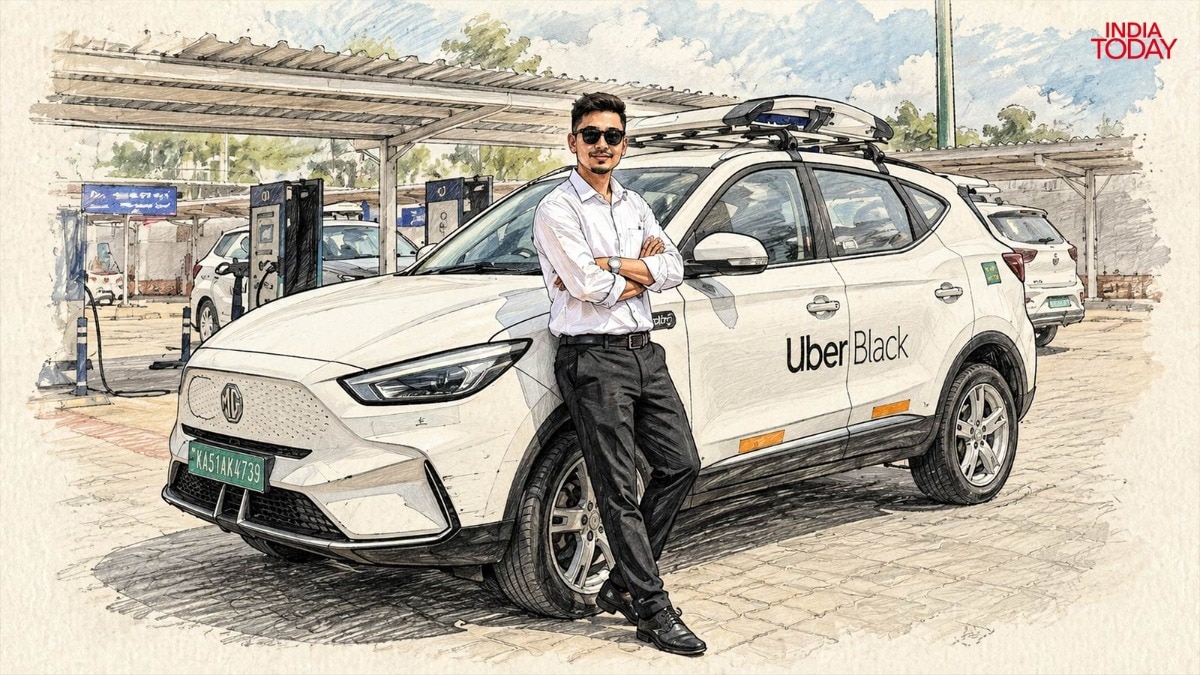
At 22, the B.Com graduate drives an Uber Black in Bengaluru. He has also started creating content and has an interest in entrepreneurship. He could have gone looking for a conventional corporate job after college. Instead, he chose to get behind the wheel.
And recently, millions of people got a glimpse of what that life looks like. His day-in-the-life video has crossed 2.3 million views. The part that really got people talking was a screenshot showing earnings of around Rs 46,000 in a week. View this post on Instagram A post shared by Hamtor Debbarma (@borokbackpacker)
The number made for a good internet headline. But Debbarma's story is actually more interesting than his earnings.Why should a graduate not drive?
Ask Debbarma if he was hesitant about taking up the profession and his answer is an uncomplicated no. “I don't think there is anything wrong with choosing a profession that you genuinely enjoy,” he tells India Today Digital in an exclusive conversation.
He has always been interested in cars and driving. When the opportunity to drive with Uber Black (a premium ride service offered by cab aggregator) came along, he wanted to experience it. There was no elaborate career crisis behind the decision. No grand rejection of corporate life. Just a young man trying something he liked.
And that is perhaps what makes the story interesting. Because the question of why he is driving often seems to come from an assumption that needs no explanation: he has a degree, so why is he doing this?
“Most people assume that after completing college, you should immediately get a conventional corporate job,” he says. But he doesn't think everyone has to follow the same route.
People ask why he is driving despite completing his degree. He doesn't take it negatively. For him, this is a phase in which he can meet people, understand himself better and work out what he actually wants to do. “I am quite comfortable with the choices I am making right now,” he says.
That sentence says more about the changing relationship young people have with work than any LinkedIn post about the future of employment possibly could.His office has four wheels
A typical day for Debbarma is not particularly glamorous. He gets ready, prepares for work and gets on the road, like any of us.
One ride could be a short, silent journey. The next could put him in conversation with an entrepreneur, a CEO, a creator or someone travelling for work. “Every ride is different because every passenger has a different story,” he says.
That is one of the things he likes about the job. “You can start your day not knowing who you are going to meet.”
There is also a strange advantage to having a workplace that keeps moving: the people you meet become part of your education. Debbarma says he enjoys the conversations and the opportunity to learn something from the people he meets.
After his rides, he switches to another part of his life — content creation and his other interests. So the day isn't simply drive, earn, go home. It is drive, meet people, create, learn, figure things out. For someone who hasn't decided exactly what he wants his long-term career to look like, that seems to suit him.The Rs 46,000 isn't really the point
Of course, it is impossible to ignore the number that sent people into the comments section of the now viral video of Debbarma.
Rs 46,000 a week sounds impressive, particularly when attached to the words “22-year-old” and “Uber Black driver”. But Debbarma himself is reluctant to make the money the entire story.
“I think the income is good, but I don't want to define my experience only through how much I earn,” he says. His earnings vary depending on how much he drives. The flexibility matters. So do the people he meets and the experience he is gaining.
One of those encounters was particularly memorable. He once met a priest named Thomas who prayed for his future before leaving the car. “It was a very simple moment, but I genuinely appreciated it and still remember it,” he says.
There have been no major bad experiences so far. He has only been driving Uber Black for a few weeks and says his experience has largely been positive. Some days are tiring. Some rides don't go according to plan. But he hasn't regretted the decision.This isn't only a 22-year-old's story
Debbarma's reason for driving is his own. But he isn't the only person who has arrived at the driver's seat after taking a different route.
Rudra, also 22, has a BCA degree and had previously worked as a finance consultant in Noida. He left after finding the long hours, around 10 to 12 hours a day, and the salary difficult to justify against the cost of living in Delhi-NCR.
Initially, he didn't even tell his family he had started driving. Today, he has a daily earning target of around Rs 5,000 and says his family has come to understand and support his decision.
Then there is Bhawna, who has been driving cabs for more than two years. She initially learnt to drive because she wanted to learn the skill. When she first got on the road, she was nervous and underconfident. Her husband, children and people she trusted encouraged her to give it a shot. Today, she says she no longer feels hesitant about driving professionally. If anything, the work has made her more confident.
Maybe that's what the old saying was getting at all along — koi kaam chota bada nahi hota, bas insaan ki soch choti ya badi hoti hai (no work is big or small; only the thinking behind it is). It's a distinctly Indian line, for a society that could still stand to actually live by it.- EndsPublished By: Tiasa Bhowal Published On: Sep 14, 2026 16:27 IST