
A decade after Brexit vote, can UK's Burnham forge new deal with EU? - CGTN
By continuing to browse our site you agree to our use of cookies, revised Privacy Policy and Terms of Use. You can change your cookie settings through your browser.
It's been ten years since the United Kingdom voted to leave the European Union.
Brexit remains a polarizing issue, especially regarding its impact on the economy and immigration.
But on November 20, British Prime Minister Andy Burnham will join EU leaders in Brussels aiming to forge a new deal that brings the two sides closer together.
And yet despite the growing calls for the UK to fully rejoin the bloc, the UK government insists that's a red line – at least for now.
On June 24, 2016, in London, UK, Nigel Farage, leader of the UK Independence Party, celebrates and poses for photographers as he leaves a 'Leave.EU' victory party for the British European Union membership referendum. /Matt Dunham/AP
When Brexit's architect Nigel Farage addressed supporters in the small hours of 24 June 2016, he declared a new era.
"Dare to dream that the dawn is breaking on an independent United Kingdom," the former leader of the United Kingdom Independence Party said to loud cheers.
But 10 years after the seismic referendum in favor of the UK leaving the European Union under Conservative Party rule, the current Labour government says the country is worse off.
"Brexit hasn't given us control," premier Burnham told his party's conference on 29 September. "We've lost some of the control we had over our economy, as a decade of low growth has put us in a weaker position, and we've lost some of our control over immigration. Brexit has done more harm than good."
And while Farage insists Brexit has been a success for giving the UK control of its borders, he's admitted the economic opportunities he pledged have fallen short.
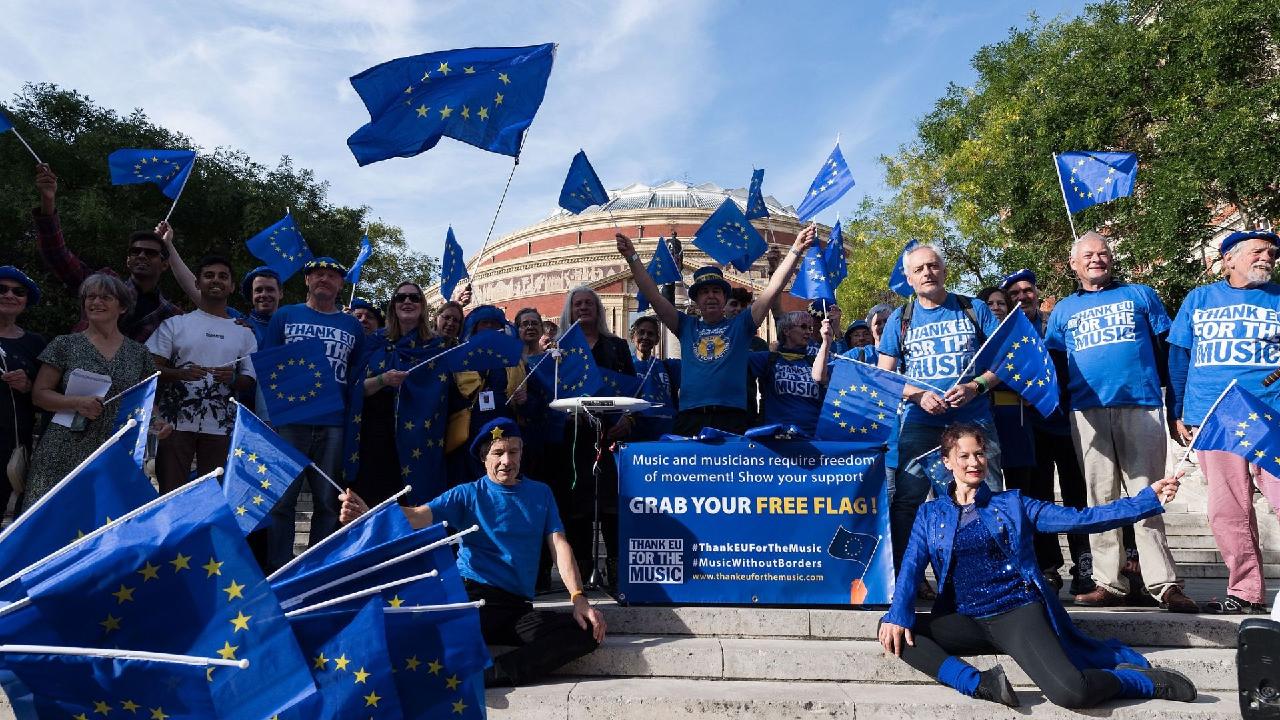
In September 2024 campaigners and musicians hold EU flags outside the Royal Albert Hall in London ahead of the final night of the Proms to highlight the lack of a post-Brexit agreement for touring arts. /Wiktor Szymanowicz/Future Publishing via Getty Images
Since taking office in July, Burnham has been meeting European Union leaders as he looks for a fresh deal with the bloc.
This includes dropping border checks on food and agricultural products – the kind of red tape that's been blamed for hindering the post-Brexit economy – as well as facilitating students working and living in the EU.
EDHEC Business School Assistant Professor of Geopolitics Theresa Reinhold says Britons are beginning to share Burnham's sentiment.
"There is a certain degree of buyer's remorse when it comes to Brexit," she told CGTN in an interview. "I think many people are disappointed because the UK economy took a hit."
And this UK rapprochement with Europe appears to be reciprocated.
President of the European Commission, Ursula von der Leyen (right) will welcome UK Prime Minister Andy Burnham (left) in Brussels for the second EU-UK Summit. /Stefan Rousseau/Pool/AFP
Outside the Lille birthplace of President Charles de Gaulle, who twice blocked the UK from joining the forerunner to the EU, visitors were enthusiastic.
Visitor Christine Lacord said: "I see no reason why we'd want to prevent it. We're cousins, we're close. But Brexit was supported by a majority of the British people."
Jeremy Auger evoked De Gaulle's role as the leader of the French resistance in the Second World War.
"If he hadn't made his call to resist the Nazis and been welcomed in Britain, we might not be French today," he added.
Another visitor, Syvlie Chiaramonti, said: "In France, there are some who'd like a Frexit. But I think we're all better off in the European Union."
French President Charles de Gaulle twice blocked the UK from joining the forerunner to the EU. /UPI/Bettmann Archive/Getty Images
The UK said in October it won't cross a red line – attempting to rejoin the EU.
Yet that red line was a manifesto commitment that lasts until the next election in 2029, so does that mean a return is ultimately possible?
Reinhold doesn't think so. "Once you look at the fine print of the debate and the details and the concessions that would be required for re-entry into the EU, then that consensus kind of disappears," she said.


