A dream without a horse: The story of the world's first car
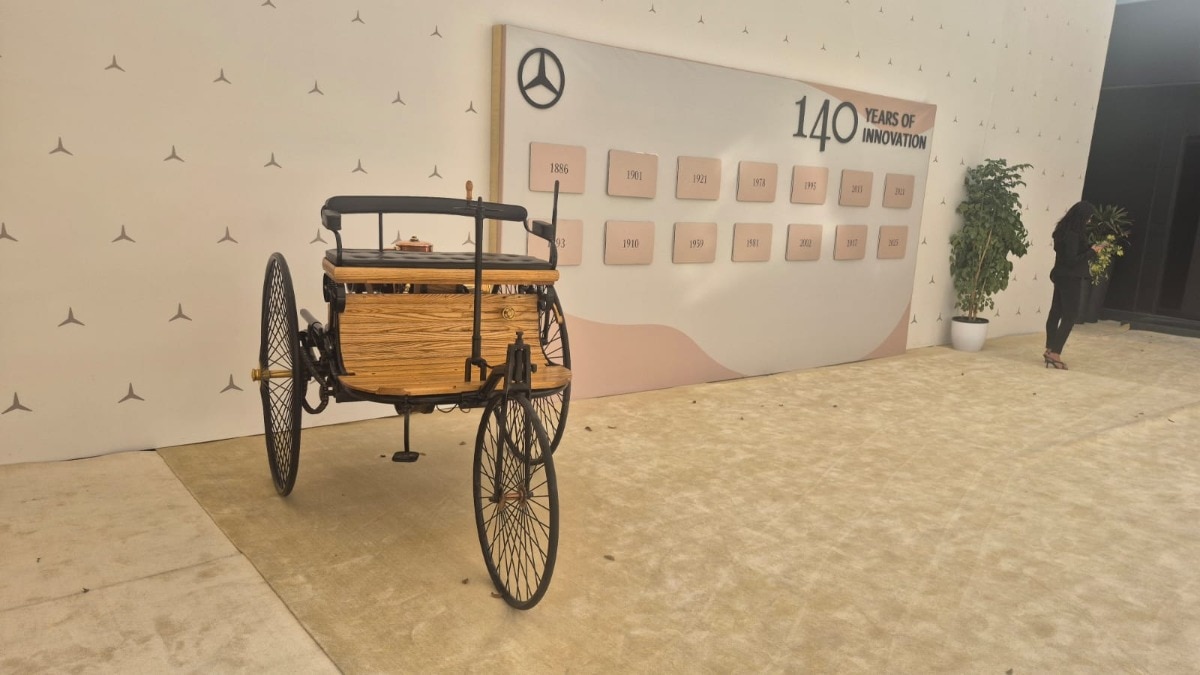
Imagine standing on a road in Germany in 1886. There are no traffic lights, no petrol pumps, no number plates, no driving schools and certainly no cars. The roads belong to horses, carts and pedestrians. Then, one day, something strange appears.
It has three wheels. It has a wooden bench instead of a proper car seat. A thin metal frame holds together what looks like a bicycle, a carriage and a machine from a workshop. At the back sits a small, exposed engine. There is no steering wheel. There is barely enough power to outrun a briskly walking horse. Yet this strange contraption is about to change the world.
It is the Benz Patent-Motorwagen, created by German engineer Carl Benz, and it is widely regarded as the world's first practical automobile powered by an internal-combustion engine. More than 140 years later, almost every petrol- or diesel-powered car on the planet can trace part of its ancestry back to the ideas packed into this remarkably primitive three-wheeler.Before the car, there was an idea
Carl Benz did not simply take a horse carriage and replace the horse with an engine. That distinction is important. During the 19th century, inventors had already experimented with steam-powered road vehicles. Engines existed, bicycles existed and horse-drawn carriages were highly developed. What Benz attempted was different: he wanted to create a self-propelled road vehicle designed around an internal-combustion engine.
Benz had already been working on engines for years. In 1879, his first stationary petrol engine successfully ran. Its commercial success gave him the financial freedom to pursue a much more ambitious idea: a lightweight vehicle in which the engine, chassis and drivetrain were conceived as one system. The problem was that almost none of the supporting technology existed.
There was no automotive industry to supply him with components. There was no established formula for steering a motor vehicle. There was no petrol station network. There were no automotive suppliers, no spark-plug manufacturers and no repair garages. Benz had to invent much of the car while simultaneously trying to invent the car industry.Why three wheels?
One of Benz's biggest problems was steering. A four-wheeled vehicle sounds obvious today, but steering four wheels accurately was a significant engineering challenge in the 1880s. Benz therefore chose a three-wheel layout, similar in broad concept to a motorised tricycle.
The Motorwagen had two driven wheels at the rear and a single steerable wheel at the front. A long steering lever connected the front wheel to the driver. There was no steering wheel as we know it today. The arrangement was not merely quirky. It was a practical solution to an engineering problem Benz had not yet solved. His later development of double-pivot steering, patented in 1893, would finally provide a more sophisticated solution for four-wheeled vehicles.Built in 1885, patented in 1886 The first Motorwagen was completed in 1885. On January 29, 1886, Benz submitted his patent application for a "vehicle powered by a gas engine". The patent, DRP 37435, is often described as the automobile's birth certificate. It was subsequently granted on November 2, 1886, with retroactive effect to the January filing date.
This distinction explains why you will see both 1885 and 1886 associated with the Motorwagen. The machine itself was built and tested in 1885. The historic patent was filed in 1886. The first public outing followed on July 3, 1886, when Benz demonstrated the three-wheeler in Mannheim. The world had technically just witnessed the arrival of the automobile.
The world, however, wasn't particularly impressed. It didn't look like a car Today, the Motorwagen looks almost comically primitive. There is a lightweight tubular steel frame, three large wire-spoked wheels, a small two-seat bench and a large flywheel. Behind the seats is the engine, surrounded by pipes, rods and mechanical components. There are no doors. No roof. No windscreen. No suspension system resembling what we know today. No conventional gearbox. No accelerator pedal. No steering wheel. And certainly no electronic aids.
But beneath that strange appearance was an astonishing amount of engineering. Benz had created not just a vehicle, but a complete propulsion system.The engine: less than one horsepower
At the heart of the original Motorwagen was a single-cylinder, four-stroke petrol engine mounted horizontally at the rear. The original specification is generally given as around 954cc, producing approximately 0.75bhp. Some museum specifications for the vehicle give 984cc and 0.88hp, reflecting later/improved versions or differences between surviving specifications.
A modern entry-level Indian hatchback can produce more than 80hp. A modern performance car can produce 500, 600 or even more than 1,000bhp. The Motorwagen had less than one horsepower. And yet that tiny engine was enough to make history.
Its maximum speed was roughly 12–16kmph, depending on the version and specification being referred to. The Deutsches Museum lists approximately 12kmph for its Motorwagen, while Mercedes-Benz's historical material gives 16kmph for the original development.
It weighed approximately 265kg. Its claimed fuel consumption was around 10 litres per 100km. By modern standards, those numbers are almost absurd. By 1886 standards, they were revolutionary.But how did it actually work?
This is perhaps the most fascinating part of the Motorwagen. The engine was a four-stroke internal-combustion engine, meaning it broadly followed the same four stages used by petrol engines more than a century later. A mixture of fuel and air entered the cylinder. The piston compressed it. An ignition system ignited the mixture, forcing the piston down. The exhaust gases were then expelled. The basic principle is remarkably familiar.
The difference was that almost everything surrounding that principle had to be invented from scratch. The engine used a high-voltage electrical vibrator ignition system and spark plug, along with an automatic intake slide and controlled exhaust valve. Benz also developed a carburettor-like fuel system to mix the liquid fuel with air. The engine's power was transferred mechanically to a countershaft. From there, chains drove the rear wheels. And there was another remarkably modern idea hidden inside the primitive machine.A differential
Benz incorporated a differential into the drivetrain. That meant the two rear wheels could rotate at different speeds while turning a corner. Think about how easy it is to take a differential for granted today. Every conventional car has one. Benz had to figure out why the wheels needed to turn at different speeds in the first place.What did it run on?
There was no petrol station waiting around the corner. The Motorwagen ran on ligroin, a petroleum-based solvent similar to the light petroleum products that were available at the time. It could be obtained from chemists and pharmacies. This would become extremely important during the most famous journey in the Motorwagen's history. But fuel was only one problem. The machine had plenty of others.Keeping the engine cool
Modern engines have elaborate cooling systems involving radiators, pumps, coolant and fans. Benz's Motorwagen had none of that. It used water-based evaporation/thermosiphon cooling. Heat generated by the engine had to be managed using a comparatively simple system of water and evaporation. It was crude, but it worked. At least most of the time.The car that kept breaking down
The Motorwagen was not a finished modern automobile waiting for someone to drive it. It was an experiment that happened to move. Benz spent years refining the machine. Fuel delivery was a major challenge. Ignition had to be made reliable. The engine needed better cooling. The drivetrain needed improvement. The steering system was primitive. Even the vehicle's public acceptance was a problem. People were accustomed to horses. Horses were familiar, predictable and understood by society. Benz's machine was noisy, smoky, mechanical and strange. More importantly, there was no obvious reason for people to buy it. Benz had invented a product before there was a market for the product.
The Deutsches Museum notes that the Motorwagen initially attracted little attention and that an automobile market had to be created almost from scratch.And then came Bertha. The woman who proved the car worked Bertha Benz and her sons Eugen and Richard during their historic long-distance journey in August 1888. (Photo: Mercedes-Benz)
If Carl Benz invented the automobile, Bertha Benz helped prove that it was useful.
Bertha was not merely Carl Benz's wife. She was an important financial and intellectual supporter of his work and one of the earliest believers in the potential of his invention. By 1888, Benz had developed an improved version of the Motorwagen, commonly associated with the Patent-Motorwagen No. 3. But the public still had doubts.
So Bertha did something extraordinary. On August 5, 1888, she took her sons Eugen and Richard and set off from Mannheim towards Pforzheim, her birthplace, without telling Carl in advance. It was not a short demonstration run. It was a journey of roughly 100km each way, with the total route including detours reaching around 180km.
There was no roadside assistance. No mobile phone. No Google Maps. No fuel stations. No mechanic network. And no convenient way to call her husband if something went wrong. Things did go wrong. Repeatedly.The world's first roadside repairs
Bertha effectively became the world's first automotive troubleshooter. When the fuel line became blocked, she used a hat pin to clear it. When an electrical problem developed, she reportedly used her garter as insulating material. A shoemaker was enlisted to repair a worn drive-chain component. Water had to be obtained along the route for cooling. Fuel had to be sourced from a pharmacy in Wiesloch, where ligroin was available. The journey wasn't just a road trip. It was a live engineering test.
And Bertha was effectively the mechanic, fuel planner and recovery team all rolled into one. The journey demonstrated something Carl Benz's workshop tests could not: the automobile could leave the laboratory, travel between towns and return under its own power. That was the moment the Motorwagen began to become more than an invention. It became a form of transportation.
The German Patent and Trade Mark Office describes Bertha's 1888 journey as the first longer automobile journey and credits it with helping demonstrate the practical potential of the invention.And then came the upgrade
The original Motorwagen was only the beginning. Benz continuously developed the concept. Later versions received more powerful engines, improved steering and other changes. The Benz Patent-Motorwagen Victoria was the first vehicle with Carl Benz’s double-pivot steering, patented in 1893. (Photo: Mercedes-Benz)
The biggest breakthrough in steering came in 1893, when Benz patented a double-pivot steering system. This made four-wheel automobile designs much more practical. In 1894 came the Benz Velo, which Mercedes-Benz describes as the world's first production car, with approximately 1,200 examples built. That is another important distinction. The 1894 Benz Velo was the world’s first series-produced automobile. (Photo: Mercedes-Benz)
The Motorwagen is remembered as the first automobile, but it was the Velo that demonstrated how the automobile could become a mass-produced commercial product. The strangest part: Benz wasn't alone There is an interesting twist to the story. Carl Benz was not the only person working on motorised transportation.From less than one horsepower to an entire industry
The Benz Motorwagen did not immediately conquer the world. In fact, that is one of the most fascinating aspects of its story. For thousands of years, humans had depended on animals, wind, water and muscle to move themselves and their goods. Now, for the first time, a practical road vehicle could carry its own source of power. The horse no longer had to provide the horsepower. The machine could do it. That idea would eventually transform cities, industries, economies, warfare, logistics and personal mobility.
The Motorwagen wasn't revolutionary because it was fast. It was revolutionary because it moved without a horse. It transformed the idea of the automobile from a fantasy into an engineered machine. Carl Benz didn't build the world's fastest vehicle. He built something much more important. He built the beginning of the modern car. And somewhere between that first sputtering engine in 1885 and the countless cars filling roads around the world today lies one of the greatest technological transformations in human history. It all began with three wheels.