A Hippo Attacked My Husband on Our Honeymoon. I Punched It To Save His Life - Newsweek
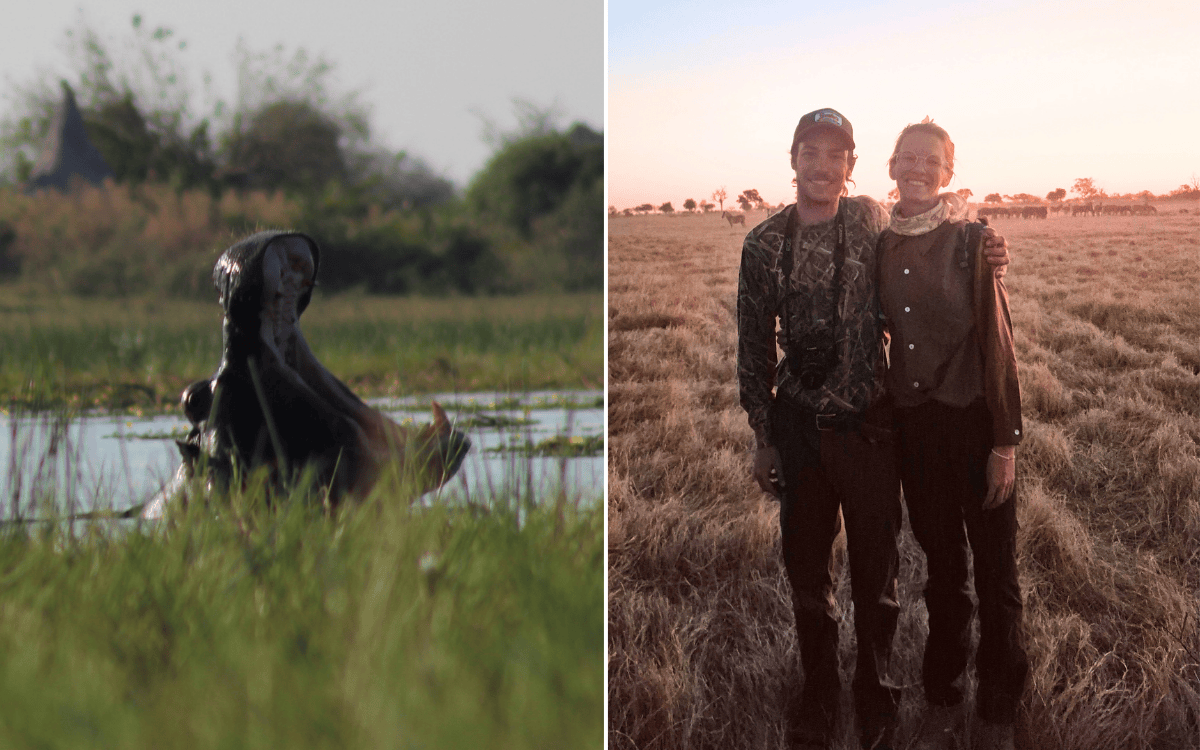
In 2025, Sam and Anna McKee were on safari in Botswana on their honeymoon when Sam was attacked by a hippo. The next 24 hours would change their life and their marriage forever.
Sam McKee: Anna and I first met when we were 15 and started dating when we were 17. We've been together for more than 14 years.
Adventure has always been a big part of our relationship. We got engaged while snowboarding on the slopes of the Andes in Chile and got married in Portugal. For our honeymoon, we wanted to do something unforgettable, so we booked a trip to Botswana.
In our first few days there, we'd already seen elephants, lions, zebras, giraffes, hyenas, wild dogs and hippos. Then we were offered the chance to go out on a mokoro, a traditional dugout canoe used to travel through the Okavango Delta.
Before we set off, the guides pointed out a mother hippo and her calves in the distance and they warned us of the danger and said we would be avoiding that area.
Anna McKee: From where we were you could see a mom hippo and her two babies there. She had her mouth wide open, and the guides told us she was displaying aggression and not to go anywhere near that area. I remember Sam took a picture of her.
We were supposed to be looking at plants in the lagoon, but at some point our mokoro drifted away from the rest of the group. It was just me, Sam and our guide. The water got deeper, and suddenly we were much closer to the area we had been warned about.
Sam: We were moving through the reeds when I heard this explosion of splashing behind me. I turned around and saw a hippo charging straight at the boat with its mouth open. I still remember the look on our guide's face.
Everything happened in a split second. My only thought was not to fall out of the mokoro. I grabbed both sides of the canoe as the guide tried to move us away.
Then the hippo hit. It grabbed me around the torso and pinned me to the bottom of the swamp. I wasn't really feeling pain yet. What I remember most was the force. It was more force than I'd ever experienced in my life.
For a moment I felt its grip loosen, then it clamped down again lower on my body. A few seconds later it was gone. I stood up out of the water and looked at Anna. When I tried to take a step, my left leg wouldn't respond.
Anna: I was thrown from the mokoro by the impact. It was like being hit by a car. When I surfaced, the first thing I saw was Sam lying sideways in the hippo's mouth.
My brain couldn't process it. We had just got married 10 days earlier. This was my husband, my best friend, the person I'd spent most of my life with. I genuinely thought I was watching him die.
I started screaming, making this noise that, to this day, I can’t repeat and running toward the hippo.
The water was waist-deep and everything felt like slow motion. I didn't have a weapon. I just remember clenching my fist and punching the hippo. For whatever reason, it let go.
I still don't know why. Looking back, it makes no sense. But it released Sam and moved away.
Sam: Once I was out of the water, I started feeling pain in my back.
I looked down and realized my intestines were hanging out.
The only way I can describe it is as a dark red, purplish bulge protruding from my back. I reached down and grabbed it. It felt strangely smooth.
Basically, I ended up holding my own intestines in place while putting my other arm around Anna and trying to walk out of the swamp.
Anna: By then, the water around us was turning red.
All I could think about was getting Sam out. The hippo might come back and there were definitely crocodiles in the area. I remember scanning the water as we walked, looking for anything moving.
I was completely locked in. Fear wasn't really part of it yet. My brain had switched into survival mode.
As we made our way toward the other boats, everyone seemed frozen. I remembered learning about the bystander effect and started calling one of the guides by name, begging him to help us.
When we reached his mokoro, he seemed to snap out of the shock.
Sam: By that point I was running entirely on adrenaline.
Somehow I managed to pull myself into the canoe with only a little help from Anna. The guide took us back to shore, where we transferred into a boat.
I laid face down on a pile of life jackets.
Anna: That's when I saw the full extent of Sam's injuries.
His intestines were protruding from his back. It looked like something out of a horror movie.
Up until then, I'd convinced myself that if we could just get help, everything would be okay. But when I saw that, I honestly thought there was no way he could survive.
I just remember Sam looking at me and saying, "I need you to be strong for me, Anna."
As much as I wanted to break down, I knew I couldn't.
The first thing he told me to do was take off his belt and use it as a tourniquet on his leg. We later learned the hippo had missed a major artery in his leg by just one millimeter and another in his arm by two millimeters.
I tightened the belt around his leg and used a handkerchief around his arm. A retired dentist who was on the tour came over and asked how he could help, so together we focused on controlling the bleeding.
But we were deep in the bush. There was no cell service, only radios, and all we could do was wait.
The pain had really started by then. I knew I wasn't going to be able to do much more to help myself physically, so I focused on staying calm.
I remembered a quote I'd heard: "If I can control my breath, I can control everything."
I started box breathing and tried to concentrate on that instead of everything else happening around me.
The thought of dying definitely crossed my mind. I understood how badly I was hurt.
But every time that thought came up, I'd get angry.
We had just got married. All I could think about was wanting more time with my wife and all the things we still planned to do together. I focused on that.
Anna: The attack happened a little after 5 p.m., and by sunset Sam was soaked, losing blood and becoming dangerously cold.
Mosquitoes were everywhere. I was trying to keep them off him while we waited.
At one point the retired dentist helping us asked the staff to set up lights so a helicopter could find us. That's when we were told the helicopter wasn't coming that night.
The staff brought over a stretcher and wanted to roll Sam onto his back because they were worried he might have a spinal injury.
I remember arguing with them. His intestines were coming out of his back. Putting him on his back simply wasn't an option.
Sam: I told them, "I walked out of the swamp. I'm not paralyzed. Put me on my stomach."
They finally agreed and loaded me face down into a safari truck.
The ride back to camp felt endless. They tried to take a smoother route, but every bump sent pain shooting through my body.
Eventually they carried me into a tent at camp and laid me on a bed.
Anna: Once we got back, I got access to Wi-Fi and started calling family.
I called Sam's mom and told her we needed a medical evacuation. Then I called my dad and said, "I'm giving you an impossible mission. Sam's going to die if we can't get help."
Our families, friends and the U.S. Embassy all started trying to coordinate an evacuation. A huge network of people went into action trying to find a way to get Sam to a trauma center.
At one point we thought we'd secured a flight out, only to learn we wouldn't be able to leave until morning. Our families connected us with medical professionals who looked at Sam’s injuries over video call. They told me there was a good chance he wouldn’t survive the night.
Sam: People kept saying, "If those are really his intestines, there's no way he's going to make it."
I understood their logic. But I wasn't willing to accept it.
I just kept focusing on my breathing.
Time felt completely distorted. I'd think 30 minutes had passed and then discover it had only been three.
I kept telling myself: I'm not going to die here.
Anna: We began making calls to friends and family. People were urging him to fight but also finding a way to say goodbye.
Eventually, around 2 a.m., emergency medical personnel arrived with limited supplies after running into delays trying to reach us.
By then we'd been awake for almost an entire day.
Everyone was trying to make the best decisions possible with very limited resources. We knew that if Sam could just hold on until sunrise, we had a chance.
Then, just after first light, we heard helicopter blades.
For a moment we weren't even sure if we were hallucinating.
Sam: The helicopter finally took us to an airport where a medical jet was waiting.
That was when I received pain medication for the first time, more than 13 hours after the attack.
From there, we were flown to a major trauma center in Johannesburg, South Africa.
Anna: Sam went straight into surgery. When he came out, he was sedated, on a ventilator and connected to feeding tubes. Doctors told us it could take days for him to wake up.
Instead, he woke up within hours. The first thing he wrote, on a pad, was simply: “Work.”
I had to have a transverse colostomy and received 20 staples in my belly from a laparotomy. I suffered cracked ribs, a cracked vertebra, damage to multiple organs and a wound in my back bigger than a softball. There were lacerations across my body and significant damage to my left leg.
Recovery was hard. At first, I could only barely walk a few steps and needed help getting out of bed. I had to undergo physical therapy. Even now, I'm missing muscle in my back and left leg. My back can spasm, and my leg sometimes gives way because of the damage. I also lived with a colostomy bag for nine months.
The doctors said one reason I survived may have been because I'd always been active. I grew up skateboarding, surfing and rock climbing, and they believed my fitness helped me withstand the trauma.
Being stuck at home during recovery was difficult. But one thing that helped was pottery. Anna got us a membership at a local studio, and making art gave me an outlet when I couldn't do the physical activities I loved.
What's strange is that the day before the attack, I'd been journaling about how lucky I felt. I'd just got married, I had people I loved all around me, and I kept thinking about how I should do more to give back.
I wrote down an idea called Liberty's Charity, named after a friend who introduced me to skateboarding and gave me my first surfboard. He always carried an extra skateboard in his car so he could give one to a kid who didn't have one.
After everything that happened, that idea took on a lot more meaning.
I talk about something I call Soulshine. It's the feeling you get when you're so grateful and happy that it feels like it's radiating out of you. Surviving the attack made me appreciate that feeling more than ever.
Today, I'm working on an initiative called Simple Soulshine, using pottery sales to help fund Liberty's Charity and buy skateboards for kids who otherwise wouldn't have access to them. I'm charting that journey on my Instagram @simple_ripple_wrangler.
Anna: Looking back it’s all quite remarkable. Sam didn't lose a limb. He wasn't paralyzed. He survived for hours with his intestines outside his body.
From a medical perspective, there wasn't really a clear explanation for how he made it through.
We've both spoken to counselors about what happened and were diagnosed with acute stress disorder. There are moments we'll never forget. I still don’t know how I was able to react in the way I did. Why I chose to fight.
My counselor talked about something called hysterical strength, where people in life-or-death situations can do things they normally wouldn't be capable of. Looking back, I don't remember making conscious decisions. I was just focused on keeping Sam alive.
Sam: When I thought I was going to die, I wasn't thinking about heaven or hell. I was thinking about the people I love, especially my wife. I was upset about not getting more time with them.
That's probably the biggest thing I took away from all of this. It's easier now to prioritize the people and experiences that matter most and not take any of it for granted.