'A life dedicated to helping others': The journey of the Denis Hurley Centre's Raymond Perrier - IOL
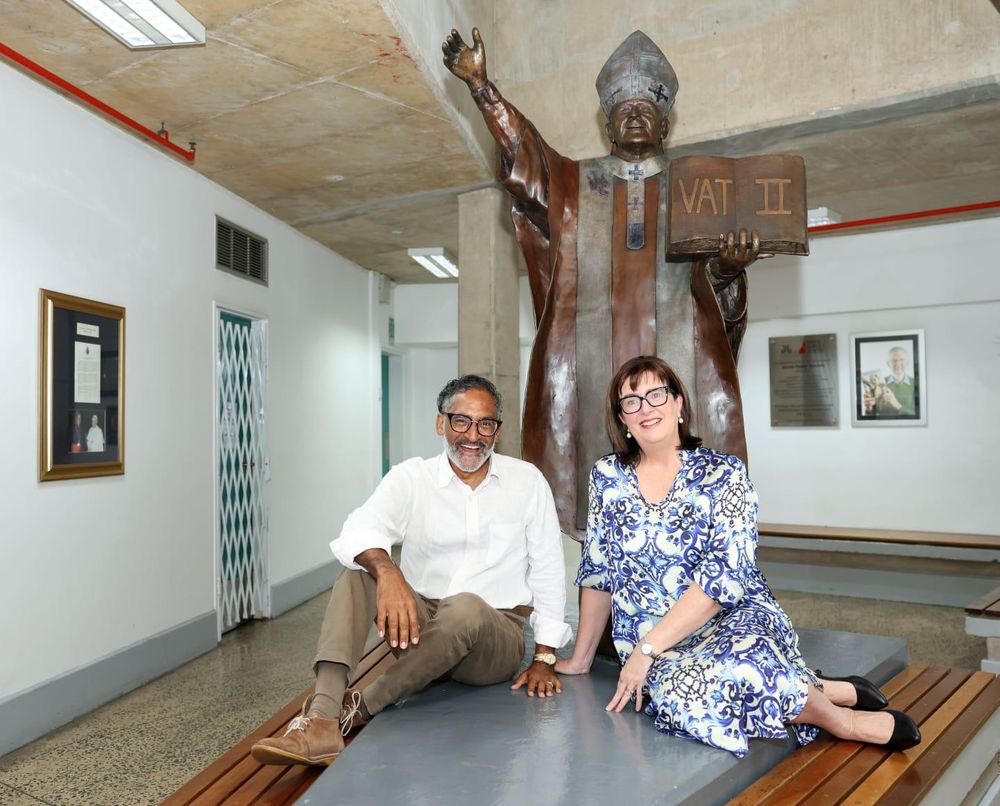
Raymond Perrier, the first director of the Denis Hurley Centre, with the incoming centre director, Bridget Ward, in front of the statue of Archbishop Denis Hurley.
HE HAS worked with refugees who fled war, taught children in some of Britain’s poorest communities and helped people living on the streets both abroad and local.
Now, after 12 years, Raymond Perrier, the director of the Denis Hurley Centre in Durban, is preparing to step down from the organisation he helped build.
The 60-year-old of North Beach said his journey has been shaped by faith, music, theatre, human rights and a desire to make a difference.
Perrier was born in Chelmsford in the United Kingdom (UK).
His parents, Winston Perrier (now late) and Phil, were both from Catholic families and were born in India. His dad hailed from Delhi and his mother from Bombay (now Mumbai).
“They met while in college. My father later got a job in the UK, and he asked my mother to join him and his mother, Winnie. She agreed. Had she stayed in India, she would have joined her four sisters who were nuns,” said Perrier.
They married and had their first child, Gordon (now late), and Perrier was born a year later.
A young Perrier (carried) with his father Winston Perrier (now late), his mother, Phil, and elder brother Gordon (now late) outside their home in Chelmsford in the UK.
His mom and grandmother were primary school teachers, and his dad, an engineer by education, worked in market research.
“He (dad) loved to fiddle with things and was an analyst and thinker. I have those traits.”
Perrier said his grandmother was deeply religious and he could still recite the Latin prayers she taught him at age five.
He said his family never missed a day of church and attending was part of their cultural identity.
At a young age, Perrier developed a love for performance, and he and his brother began ballroom dancing.
He said his mom was a seamstress, and the parents of the girls attending ballroom classes asked her to sew their dresses.
“She thought it would be wonderful if we joined so she could make our outfits. I was serious about it, and at age 11, I received the highest award in ballroom dancing, the Alex Moore Award from the Imperial Society of Teachers of Dancing.”
He attended two catholic primary schools between Infant 1 and Junior 4, and thereafter, after passing the British “eleven-plus” examination at age 11, he attended the elite King Edward VI Grammar School.
Eleven plus is a selective entrance examination taken by children during their final year of primary school to gain admission to academically focused grammar schools.
Perrier said that when he arrived at the school, he was drawn to a list of names of those pupils who later attended either Oxford or Cambridge universities.
While he achieved great academic results, music and drama captured his attention.
He was also involved in the school’s drama department.
“I won't forget our drama teacher taking us by train to London, about half an hour away, to go to the theatre. At just 11 and 12 years old, I was watching Shakespeare and a seven-hour Greek tragedy, as well as attending the opera. It was an extraordinary experience.”
With the founder of the centre, Paddy Kearney (now late).
In 1984, Perrier attended Oxford University, initially studying French and Italian before switching to theology and philosophy.
His initial dream was to be either a theatre director or a bishop.
“At age seven, I wrote an essay that I would become the pope one day, so there was no lack of ambition. I also knew that if I wanted to become a priest, I could study theology at a later stage, so I decided to pursue my other passion which was languages.”
In his first year, he realised this entailed a lot of reading in different languages and he was unable to do the things he loved, which were music and drama, so he switched to theology and philosophy the following year.
“I also realised I no longer wanted to be a priest as I became more consciously aware of being gay. I did not want to be one of those gay people who hide in the church. But I still pursued my studies in theology.”
In 1987, he graduated with a Bachelor of Arts degree in theology and philosophy, which was later upgraded to a Master’s degree by the university.
He later completed a Master’s degree in philosophy at the University of London, a Master of Science degree in human rights at the London School of Economics, and a PhD in Christian history at the University of KwaZulu-Natal.
At the Rhino Camp in Uganda in 2004 with a Southern Sudanese refugee returning to his home.
While studying, he got his first part-time job at Interbrand, a branding and marketing company, initially doing admin work.
After completing his studies, Perrier remained at the business until he decided what to do next.
“What was meant to be temporary turned into 14 years. Before I left, I ran the office in New York with 160 people working for me.”
His corporate career eventually brought him to South Africa during the 1990s.
“At the time, Interbrand had an office in Johannesburg. A well-known businessman, Johann Rupert, read my book on branding and reached out to our office to meet with me. After much convincing, I came to South Africa. During this time I visited several places such as the Garden Route and Drakensberg, which made me fall in love with the country.”
Perrier said despite enjoying a successful corporate career, his priorities began to change.
At age 33, a female friend who wanted to become a mother approached Perrier and his male partner about having a child.
“She said we could raise the child together. I needed to think about it, and decided to go on a retreat to a monastery in London. As I arrived, a voice in my head said, ‘If you become a father (parent), you can never become a father (priest)’.
“I hadn’t thought about priesthood since I was 20. It appeared that over those 13 years there was a seed that hadn’t died and just popped up,” he said.
Perrier then began volunteering at a homeless charity.
“I was living in the same city but had no idea there was a completely different aspect. I thought volunteering for a week and giving money was not enough. I wanted to make a change, and because I was religious, I was going to do it in that context, and become a priest. I also realised that becoming a parent would not allow me to do that, so I had to decline.”
He was then transferred to run the office in New York, and met Catholic priests from the Jesuits (Society of Jesus), a revolutionary part of the Catholic church, and realised he wanted to join them.
“As a Jesuit, you take three vows - poverty, chastity and obedience. It was dramatically different from the life I was living. I then decided to move back to the UK, which meant giving up the job, the money, and the boyfriend, and I started training as a Jesuit.”
This exposed him to communities facing poverty and disadvantage.
“I was sent to work in an inner-city primary school. Here I was, with 14 years of international business experience, sitting on a little plastic stool teaching eight-year-olds maths or playing games. I also did prison visits, worked at homeless charities, and in a refugee camp, known as Rhino Camp, in Uganda, which changed my life.”
He said for two years he lived in an area where there was no running water, electricity, or roads, and about 60 000 South Sudanese refugees who had fled from their homes due to the war at the time.
“A group of five of us lived in the camp, and we ran educational and adult literacy programmes, and skills training in a school. I had never seen such extreme poverty. But the refugees were happy because they survived. They had seen their loved ones shot right beside them.”
Perrier eventually left the Jesuits but remained committed to working in a faith-based environment.
In 2010, he got a call from the Jesuits in Johannesburg that they were setting up an institute and required his help.
“The initial memories of being in South Africa in the 1990s came flooding back. I agreed, but said it would be for just two years, and then I would return to the UK.”
In 2014, Perrier was approached to assist at the Denis Hurley Centre.
“I often came to Durban to lecture and met the now late Paddy Kearney (anti-apartheid activist). We met for dinner, and he said they were starting the centre and were looking for a director.
“What interested me was not just what Catholics were doing, but how Catholics worked with other people; Anglicans, Methodists, Hindus, Muslims and Jews. I thought ‘wow, this is interesting’, so I said okay. I said I would help set up the centre, but for two years. Twelve years later, I am finally handing it over.”
The centre provides food, healthcare and skills training to help people turn their lives around.
Perrier recalled a man who smoked whoonga and lived on the street, walking into his office one day, fresh-faced and dressed in new clothing.
“He told me about the rehabilitation programme and his subsequent job. I thought to myself, ‘We really are making a difference’. Unfortunately, there is still a lot to do.”
In 2020, Perrier played a role in Durban’s emergency response to homelessness during the Covid-19 lockdown.
As chairperson of the eThekwini Task Team on homelessness, he helped bring government, businesses and civil society together.
“Within three hours of the announcement of a lockdown, we met with key governmental agencies and businesses to figure out how we are going to keep 15 000 homeless people in Durban safe. We managed to set up shelters within four days and kept people safe and fed.”
He said the response demonstrated the strength of cooperation between religious communities.
With his husband, Ockert Fourie, on their wedding day.
The centre also runs a Street Lit project to help homeless and formerly homeless individuals earn a basic income by selling donated second-hand books.
Perrier said the initiative shifted people’s perceptions of what homeless people are capable of.
He is also one of the founders and former chairperson of the National Homeless Network.
Perrier said it was now time to hand over the organisation to a new director.
He said he told the board two years ago that his decision to leave was for the health of the organisation.
Bridget Ward will take over as director at the end of the year.
Perrier, a research fellow at the Centre for Faith and Community at the University of Pretoria, plans to write his fourth book.
“With November marking 20 years since same-sex marriage has been legal in South Africa, the book will centre around religious institutions' response to it.”
He and his husband, Ockert Fourie, a dentist, enjoy the theatre and art galleries. Perrier is still fond of opera.
However, he said he was not ready to retire and intended to continue the fight against injustice.