A monk, a mathematician, and a problem that waited two decades
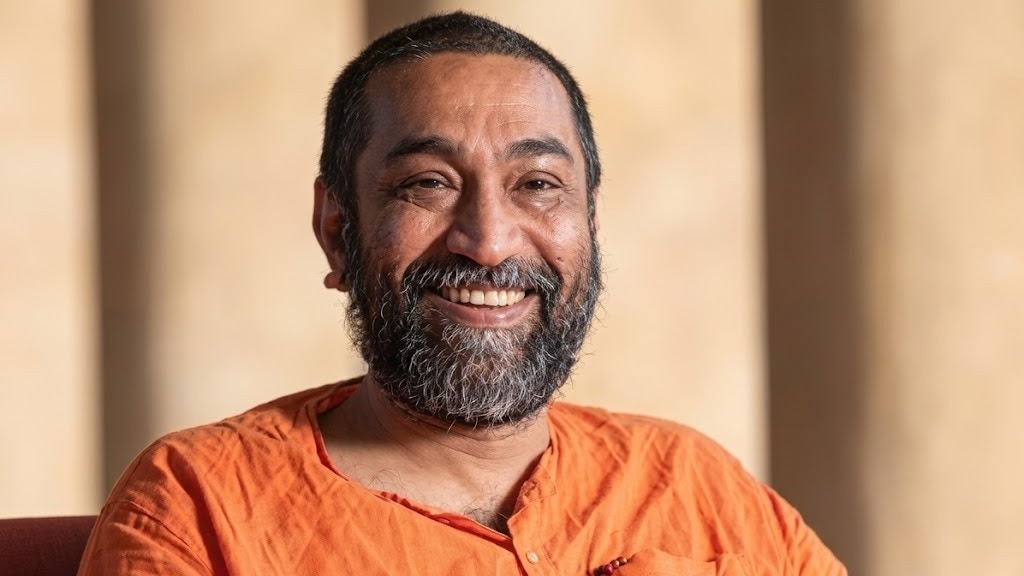
Mahan Mj gave up research mathematics for six years to become a monk. When he returned, almost by accident, he answered a question that had stood since the early 1980s.
In early 1998, a freshly minted Berkeley PhD walked away from research mathematics. Mahan Mj, who had just finished a doctorate on a problem about chaos and symmetry, had decided to become a monk of the Ramakrishna Order. For the next six years, he did no research mathematics at all.
The problem he would later solve is, at heart, a question about order and disorder. Picture a globe being pushed and turned in infinitely many ways at once. Somewhere on its surface, the motion becomes wildly unpredictable, and mathematicians wanted to know whether that chaos could be mapped and tamed.
In 2004, the Internet gave him a reason to look back. Out of what he calls "moderately idle curiosity," he searched for work done in his absence and found two new papers by Bowditch and McMullen. He set out to reprove and generalise them using the framework from his thesis. New ideas began to emerge, and they eventually led to a solution of a problem posed by William Thurston in the early 1980s. Prof. Mahan Maharaj was conferred the Vigyan Shri Puraskar 2025 by President of India, Droupadi Murmu (IIT Kanpur)
Mj, now a professor at TIFR, the winner of the Sloan Research Fellowship and the Shanti Swarup Bhatnagar Prize, and an invited speaker at the 2018 International Congress of Mathematicians, does not tell the story as one of ambition.
"In hindsight, it was almost as if the mathematics and the structure behind it was leading one by the nose," he says.
"This convinces me that the best and most satisfying mathematics 'happens' and is not really 'done' in the usual sense that we understand these words."
Asked what made him build an academic career in India, he says: "I did not choose to build an academic career at all. It happened and I got lucky."A DETOUR THROUGH ENGINEERING
Mj, born in West Bengal in 1968, liked mathematics best at school. Yet, he says, "social conditioning" nudged him into electrical engineering at IIT Kanpur. By the third semester, he had seen enough.
"The mathematical content in engineering was both sparse and not of a fundamental kind," he recalls.
He applied to switch to mathematics, a semester later than the norm. Help came from unexpected quarters.
"We fortunately had a Dean of Academics there who was sympathetic to the fundamental sciences," he says, and faculty in mathematics and physics backed him. "It all worked out."
The switch put him in the path of Prof. Shobha Madan, whose two topology courses, he says, fired his imagination.
"She was an incredibly inspiring and dedicated teacher and made the subject come alive."
He also remembers the company of batchmates whose "commitment to their respective subjects was absolutely transparent," among them Rajesh Gopakumar, T Senthil and Anurag Singh. Mahan Mj while receiving the Infosys Prize 2015 for Mathematical Sciences (IIT Kanpur) TAMING CHAOS ON A SPHERE
The problem that made his name is easier to picture than to solve. Imagine, Mj suggests, an infinite collection of symmetries of a sphere, like the surface of a globe.
"Because there are infinitely many symmetries involved, there is a region on the sphere where the dynamics is completely chaotic."
The Cannon–Thurston map is a precise way of taming that chaos. Thurston and Jim Cannon proved the test case in 1985, and Yair Minsky generalised it in the early 1990s. Mj found a new proof during his PhD, extending it to groups with negative curvature, a structure discovered by Gromov.
When he returned to the problem in 2004, he spent two years carving off special cases.
Then he realised that the most general of them looked as if it should cover everything Thurston had asked. Minsky and his collaborators, Brock and Canary, had already built a model for the general case.
What remained was to show that the model met the conditions of his special case. It did, and Thurston's question was answered in the affirmative.
His taste in mathematics, he says, is "the visual and intuitive kind dealing with shapes, symmetries, and movement on shapes." He likens schools of mathematical thought to the gharanas of Hindustani classical music, and names Thurston, Gromov and Dennis Sullivan as constant inspirations.DOORS IN AN EMPTY FIELD
Mj does not see his monastic life and his mathematics as separate compartments.
"One does not live in disjoint compartments," he says. The practical gain, as he describes it, is that money and recognition matter less.
"This leaves more mental space to get back to the basic point of doing mathematics: the curiosity that drives it, the sheer joy one gets out of it, and the joy one gets out of sharing that knowledge with others."
That detachment shows in his reaction after receiving the KRS Sastry Prize, the first time the award has been given. He is grateful, he says, but also sees it as a chance to spend more time at IISc, where three of his collaborators work. "I hope to visit IISc more and this is a really good excuse."
It also shapes how he sees the future. Asked what he would tell a student unsure where mathematics can lead, Mj turns to artificial intelligence. Human mathematical intuition versus computational shortcuts (AI-generated)
A "dust storm" of claims is under way, he says, with AI said to be solving mathematical problems. "This is only partly true. The key reasons behind the pursuit of mathematics as a human endeavor for the last 2500 years are largely untouched by the AI revolution."
Those reasons, he argues, are clarity and understanding. A precise question is a door into a room of ideas. "Removing the conceptual motivation and retaining only the binary questions is like having a bunch of doors in an empty field leading nowhere."
His advice to students is to hold on to the "very human aspiration for clarity and understanding." The danger, he warns, is real: "The AI system poses the very real danger of short-circuiting this. One needs to avoid these deceptive short-cuts."- Ends
Mridusmita Deka is Chief Sub Editor on the Education & Jobs desk at India Today Digital. She was born and brought up in Dibrugarh, Assam. She completed her Master's in Mass Communication from Dibrugarh University. She has previously worked with NDTV Education, Careers360 and The Indian Express. Her work spans higher education, competitive exams, scholarships, admissions, skilling, and jobs.