A pathetic lie still lingers over Australian cricket: It’s time for sandpaper’s truth commission
Sandpapergate began with a pathetic lie, Cam Bancroft’s assertion that the offending item was a length of yellow tape roughened with dirt from the pitch. That day to this, no one or body has told the entire truth.
Usman Khawaja’s newly published memoir has ripped off the scabs again eight years later, but even he says it is “my truth”. Its force is that it is as plausible insight as we’ve yet had, but without the names of the two players who he says rejected collective responsibility, for instance, it is not the whole truth and nothing but the truth.
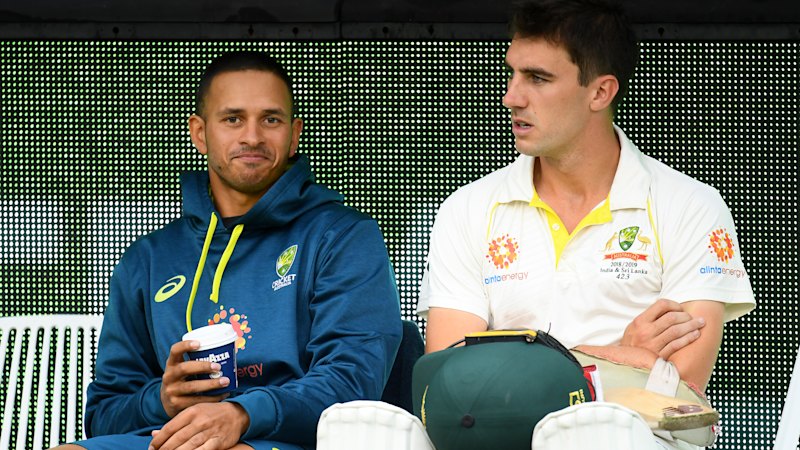
Long-time teammates Usman Khawaja with Pat Cummins back in 2018.Getty ImagesPat Cummins delivered his version in an admirably poised and patient media appearance on Friday. He was speaking as the Australian captain now, but he was at the time a relatively junior, having played just 12 Tests. He gave us a bit more insight into the team dynamics then and now – and his distaste for its snarly disposition in that era – but he left us little the wiser about the origins of the scandal, the chain of command then or the sequence of events.
He repeatedly called Khawaja’s account “casual”, an adjective often used about degrees of regard for the truth. “He’s [Khawaja is] wrong,” he said. The only certain truth now is that there is a wedge between Cummins and Khawaja, and probably between Cummins and David Warner, too. That is sad.
Lying and its cousins, deflection, obfuscation, rationalisation and omission, have scored this saga throughout.
The original investigation was rushed, too rushed, rushed as a broom sweeping under a carpet might be rushed. Yes, some urgency was necessary, for another Test was due days later, and if there were to be sanctions, they had to be resolved by then. But surely, at very least, every playing member and every coach had to be quizzed. Too few were asked then and no one since. Nor have any volunteered themselves, not even confidentially, despite an open invitation.
Doubtlessly, some were afraid of the consequences, for their reputations and their positions, which is understandable.
In 2021, Bancroft did speak up for a minute, telling The Guardian it was “self-explanatory” that the bowlers must have known about the tampering. He has never been picked for Australia since.
The 2018 report was never made public, which was and is another form of masking of the truth.
Cricket Australia dusted their hands; perhaps they should have been fingerprinted while they were at it.
And so the years passed and the reverberations never quite stopped. CA always feared Warner’s book, but it never appeared (or at least not yet). Now there may be no need.
They may not have seen the Khawaja book coming, and yet they may have, for in the last and most fruitful part of his career, Khawaja was a maverick. He did not endear himself to a segment of Australian society who prefer their sportspeople to rock only other boats, not their own. As Andrew Wu wrote in these pages, some critics have played the man rather than the ball.
Steve Smith has still to speak his truth. He is in the most invidious position of all. Deposed as captain and exiled in 2018, he has as much of an axe to grind as Khawaja and Warner, but unlike them, he is still bound by team solidarity. Cummins says it is important that everyone feels free to tell their own story, but can Smith? Will he? Stay tuned.
It is possible and indeed probable that there are multiple versions of the truth. No one is all-seeing and all-hearing, a point Cummins stressed. It beggars belief that the bowlers did not know that something was afoot, and Cummins is not claiming this. Ball management, aka tampering, was the hot, albeit unofficial, topic in world cricket at the time.
It also stands to reason that the idea of applying sandpaper, which was and is patently and blatantly illegal, was kept on a need-to-know basis, which is why Cummins objects to the implication of all the bowlers in it. But who did know? We still don’t.
At the start of that 2018 series, Australia asked for the stump mics to be turned down, tacitly announcing that they were not going to play nice. That rubber unfolded in such a febrile atmosphere that it is little wonder perspective was lost, mistakes were made and panic set in when they were exposed.
The air is clearer now. The statute of limitations has expired; the vogue formulation is that we’ve “moved on”. Five of that team are retired from Test cricket and most of the administration are gone, too. CA has ruled out a new or re-opened inquiry.
But as the week has demonstrated, these bygones cannot quite be left to be bygones. Australians invest an almost naive amount of hope and trust in their national cricket teams. Like shareholders, they wanted answers at the time. Like shareholders, they’re still waiting.
So here’s an idea: why not have a form of truth-telling commission? It’s happening by default anyway, so why not formalise it? Some kind of catharsis is necessary. Release the investigators’ report. Let those who made mistakes own them. Let the innocents have their vindication.
It’s improbable that a nice, tidy agreed set of facts will emerge, neatly bound with a bow on top. But now that some stories have been heard, it’s important that they all are.
Otherwise, this is a sleeping dog that won’t ever be left to lie.
You have reached your maximum number of saved items.
Remove items from your saved list to add more.
You've used all of your gift articles. 3 more will become available on the 1st of every month.