A war-fatigued and anxious Russia picks a new parliament
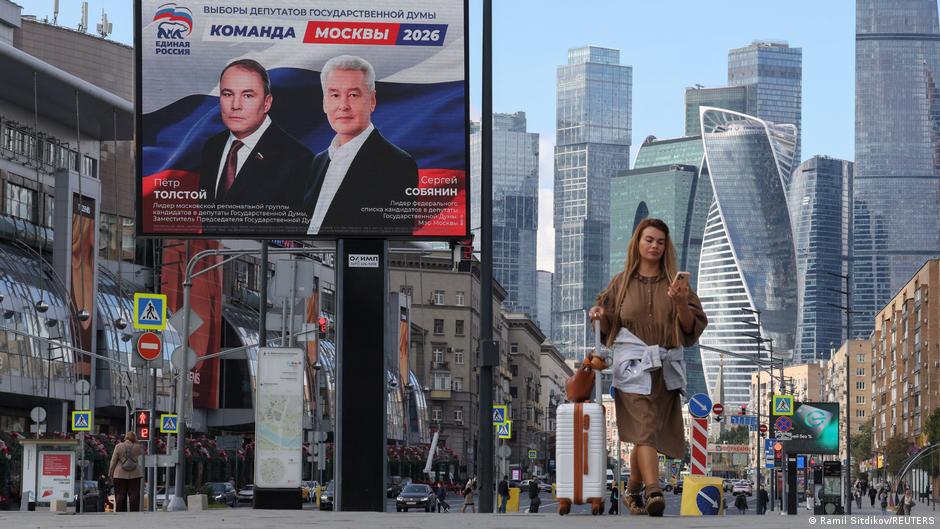
The upcoming Duma elections are hard to miss when you walk down Moscow's streetsImage: Ramil Sitdikov/REUTERSAdvertisementRussians are increasingly anxious. Nearly half of those surveyed by state pollster FOM say a sense of alarm is the prevailing mood among the people around them.
According to data by independent pollster ExtremeScan, 60% of Russians believe that the war against Ukraine has had negative consequences for their day-to-day lives.
"Anxiety and war fatigue are driven by increasing uncertainty," Margarita Zavadskaya, a sociologist and senior research fellow at the Finnish Institute of International Affairs in Helsinki, told DW.
She says this year has seen a shift in public opinion. Rising prices, internet crackdowns, fuel shortages caused by Ukrainian strikes on oil refineries and rumors of another mobilization drive are making it harder for Russians to plan for the future. Some are even leaving the country, afraid they could be drafted after the elections.
Sociologist and the founder of ExtremeScan Elena Koneva said people were starting to ask the question: "How much does this war cost me and my family? And am I ready to pay this price? "
That could pose a problem for the Kremlin.
From September 18 to 20, Russians are voting for a new parliament (the State Duma) for the first time since 2022. It's the first parliamentary election to take place in Russia during the Ukraine war. And although there are unlikely to be any surprises in the official results, the Kremlin will be closely monitoring turnout.
"The Kremlin is confident it can fabricate whatever figures it needs. The question is how high of a price it will have to pay," said Zavadskaya.
Although elections in authoritarian systems like that of Russian President Vladimir Putin have little to do with democratic change, they still serve an important purpose. They are a reality check on whether the population remains loyal. And for Putin, that is especially important right now.
"They are crucial for him because they demonstrate that the majority supports the main party, the party of war, and that he has legitimacy for further escalation and the continuation of this war," Russian opposition politician in exile Ilya Yashin told DW.
In the fifth year of the war in Ukraine, there is little sign the Kremlin is willing to end the conflict. United Russia, a party de facto led by Putin, is campaigning on a platform that lists victory in the war among its priorities. Its candidate list is headed by people presented as veterans of the war against Ukraine.
But many Russians appear to want the opposite.
"The silent majority just wants the war to end," opposition politician Yulia Galyamina, who still lives in Russia, said in a recent interview with online media-outlet Bereg. Most of these people still support Putin, but they are becoming increasingly anti-war, she said.
That mood is also reflected in polling. Six in 10 Russians favor peace negotiations with Ukraine, according to independent pollster Levada Center. Recent Kremlin hints at a new round of peace talks in October may be a tactic to calm the electorate, Zavadskaya said.
One party has sought to capitalize on this anti-war sentiment: Yabloko.
The liberal opposition party is the only registered political force opposing the war in Ukraine.
Although its rating was below 5% in July, the party has seen a surge in popularity since then. Many people, especially younger Russians, are joining Yabloko and volunteering.
According to the independent pollster ExtremeScan, 18% of Russians would have voted for Yabloko. But they will not be able to: In a recent court decision, Yabloko was barred from running in the parliamentary elections.
"This support for Yabloko is, in fact, a demonstration of people's attitude toward the war," Koneva told DW.
Now, with Yabloko out of the race, are there still ways for Russians to express that attitude?
Yulia Navalnaya, the widow of Alexei Navalny, and opposition politician in exile Maxim Katz are urging supporters to back any party except United Russia in an effort to reduce the ruling party's result in the election.
Yabloko has taken a different approach, encouraging voters to spoil their ballots.
Yashin says neither choice matters. What matters, he says, is showing up at polling stations at noon on Sept. 20.
"These queues will be a visible expression of public discontent," he said. "No need for flags, banners, or symbols. Everyone will know: the queues at noon are made up of people who do not want the war to continue."
DW Russian asked its readers anonymously whether they plan to vote in the upcoming election. Most of those who responded said they would follow Navalnaya's and Katz's advice.
"Elections have long become a farce and a political spectacle. But I will vote because I want to show that I have a position," one user said.
Others decided to stay away from the elections. One respondent wrote: "I don't want to legitimize Putin's regime."
Sergei Satanovskii contributed reporting.