A working streetlight: the new symbol of a 'caring' government in South Africa - IOL
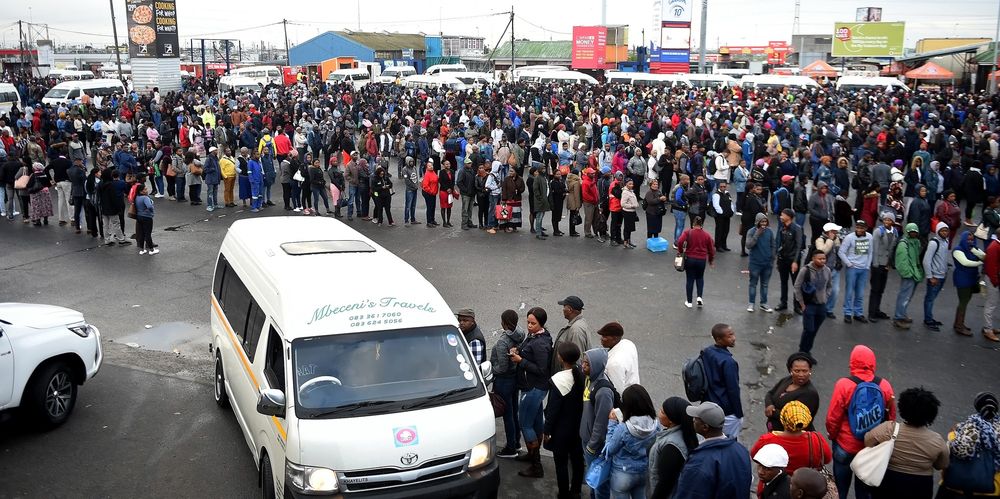
Thousands of Khayelitsha residents queue in line at the Kuwait taxi rank in Site C. Researcher Megan Mannion argues that the City of Cape Town cannot claim to be the best-run municipality in South Africa when inequality persists as 'wealthy residents can buy distance from public failure; poor residents cannot'.
I am a researcher, speechwriter and policy analyst for a political party. So let me concede the obvious: I have political commitments, and I am not pretending to write from some mythical position of perfect neutrality.
But political affiliation does not invalidate evidence. If anything, my work has made me more sceptical of the easy narratives we tell ourselves about governance.
I track crime statistics. I work with policy. My academic research has taken me into questions of violence, conflict and the state. The more closely I have examined Cape Town, the more difficult I have found its reputation as South Africa’s model city to defend.
The problem is not that Cape Town is incapable of functioning.
It is that we have come to define good governance through the experience of people who are best positioned to withstand bad governance.
If you own property in an affluent suburb, have a well-paying job, drive a car, use private healthcare and can afford private security, Cape Town can feel extraordinarily functional.
But that experience tells us as much about your purchasing power as it does about municipal performance.
A wealthy resident can buy distance from public failure.
And a woman cannot simply purchase her way out of a city whose public spaces, transport systems and neighbourhoods are structured around unequal exposure to violence.
That distinction should be at the centre of any serious assessment of the city.
Cape Town’s deepest problem is not necessarily visible in a municipal balance sheet.
The city remains profoundly shaped by apartheid’s spatial architecture. Wealth, employment, infrastructure and services are concentrated in particular areas, while poorer communities are disproportionately located further from economic opportunity.
This is not simply an argument made by political opponents.
In July 2026, the Constitutional Court handed down its judgment in the Tafelberg matter concerning the sale of the former school site in Sea Point. The Court found that the disposal was unlawful and reaffirmed that government’s constitutional obligations to address spatial inequality cannot be separated from the question of where housing is located.
It made clear that location is not a peripheral consideration in housing policy: it is integral to whether government is meaningfully realising the right to adequate housing and addressing the spatial inequalities inherited from apartheid.
That is a profound constitutional statement about the city.
The fact that apartheid created Cape Town’s geography does not mean that geography is now politically irrelevant. The constitutional project was not to preserve an unequal city more efficiently. It was to transform it.
The Tafelberg judgment matters precisely because it rejects the idea that the state can treat housing as a numbers game. Building housing somewhere is not necessarily sufficient when the location of that housing determines access to employment, transport, schools, healthcare, social networks and economic opportunity.
Housing policy is therefore not merely housing policy.
It is economic policy, transport policy, social policy and, ultimately, redistribution.
If affordable housing is consistently pushed towards the urban periphery while well-located public land remains inaccessible to lower-income households, the state can increase the number of houses while reproducing the geography of inequality.
It is the administrative reproduction of segregation.
This becomes even more serious when we consider violence.
I track crime statistics as part of my work. The concentration of violence across the Cape Flats is also one of the reasons I began my PhD research into gang violence and conflict management.
Statistics have a way of becoming abstract until you encounter the people behind them.
Then they become parents afraid for their children. Women planning journeys around daylight. Communities that know which roads are unsafe. Residents who understand that a broken streetlight is not simply a maintenance problem.
I never expected something as mundane as a streetlight to become political.
But when infrastructure affects whether someone can safely walk home, it becomes part of the distribution of risk.
And that risk is not evenly shared across Cape Town.
The province has recorded recent reductions in murders, which should be acknowledged. But levels of violent crime remain exceptionally high, with gang-related violence continuing to impose a disproportionate burden on particular communities.
The important point is not simply that violence exists.
It is that the capacity to avoid violence is unequally distributed.
A wealthy household can purchase private security. It can purchase a car. It can live in an area with comparatively reliable infrastructure. It can choose private healthcare and, in some circumstances, move away from neighbourhoods where insecurity is persistent.
A household without those resources is left negotiating the public environment as it exists.
This is where the conventional language of “crime” becomes insufficient.
Violence is not only something that happens to people. It also changes how people are able to use the city.
This is particularly important when we talk about gender-based violence.
GBV is often discussed as though it exists primarily in the private sphere: something that happens in homes, relationships or isolated incidents between individuals.
Women also experience the city through a constant negotiation of public and private risk.
Research on women’s safety in Cape Town has documented how structural conditions, urban space, state neglect and patriarchal norms interact to shape women’s experiences of safety and mobility.
Research focused specifically on the Cape Flats similarly identifies the intersection between gender, class, race and structural inequality in shaping vulnerability to violence.
A woman walking home after work does not experience a broken streetlight in the same way as someone who is able to get directly from a private car into a secure building.
A woman waiting for public transport after dark does not experience distance in the same way as someone who can drive from their workplace to their home.
A woman who has to walk through an unsafe area because she cannot afford alternative transport does not experience the city as someone who can purchase private mobility.
These are not merely individual inconveniences.
They are the spatial production of vulnerability.
This is why GBV cannot be separated entirely from questions of housing, transport, infrastructure and urban design.
A city that forces people to travel long distances between home and work creates conditions in which people spend more time in public spaces and transport systems. A city in which public transport is unreliable or unsafe creates additional exposure. A city in which poorly lit roads, isolated pedestrian routes and inadequate public infrastructure constrain women’s movement effectively imposes a gendered geography of fear.
Women do not simply calculate whether a destination is accessible.
They calculate whether they can safely get there, whether they can safely return, what time they need to leave, which route they can take, whether someone can accompany them and whether they can afford the alternative if the safest option is also the most expensive.
That is a profound restriction on freedom.
The question of whether a city is well governed therefore cannot be reduced to whether its roads are tarred or whether its financial statements are clean.
It must include whether people can actually move through the city with safety and dignity.
This is why the argument that Cape Town works perfectly well if you have a job and a car is so revealing.
Yes, having a car changes your experience of the city.
But if you need a car because you cannot afford to live near your workplace, the car is not evidence that the city has solved its spatial problem.
It is evidence that the individual has absorbed the cost of it.
You pay for the vehicle, fuel, insurance and maintenance.
And for women, private mobility can also function as a form of protection from public exposure. The ability to move directly from one secure location to another can reduce exposure to the unsafe spaces between them.
Those who cannot afford it remain dependent on the public environment.
This creates an extraordinary inversion of responsibility.
The state creates or perpetuates spatial conditions that make mobility costly and sometimes dangerous, and individuals are then expected to solve the problem through private consumption.
Live closer to work if you can afford the property prices.
The wealthier you are, the more opportunities you have to opt out of public failure.
The poorer you are, the more completely you are exposed to it.
What exactly do we mean by “well run”?
This is where the conversation about Cape Town needs to become considerably more intellectually serious.
There is nothing contradictory about a municipality being administratively competent while failing to transform structural inequality.
A city can have sound financial management, functioning institutions and well-maintained affluent neighbourhoods while remaining deeply unequal.
Those are different measures of governance.
But none of these, on their own, demonstrates social transformation.
The mistake is assuming that because one is true, the other must be.
Cape Town’s reputation for good governance rests heavily on this conflation.
The city’s institutional strengths are treated as proof of the quality of the city as a whole.
But the experience of governance is not evenly distributed.
For one resident, efficient municipal administration might mean a well-maintained road, reliable refuse collection and functioning infrastructure.
For another, governance is experienced as a three-hour daily commute, an unsafe walk to public transport, inadequate access to housing, exposure to violence and the constant calculation of whether it is safe to move through their own neighbourhood.
Both are experiences of the same city.
Only one tends to define its reputation.
Cape Town’s extraordinary beauty makes this conversation easier to avoid.
The mountains are magnificent. The wealthy suburbs are prosperous. Parts of the city are exceptionally well maintained.
And the experience of prosperity in one part of a metropolitan area cannot stand in for the experience of everyone who lives within it.
The uncomfortable reality is that Cape Town offers radically different versions of the state depending on your income and your postcode.
For some, the city provides proximity, mobility, security and choice.
For others, it provides distance, expensive commutes, exposure to violence and public infrastructure that too often determines the boundaries of their lives.
For women, those boundaries can become even more restrictive because the ability to move freely through the city is conditioned by the possibility of harassment, assault and gender-based violence.
This is not an argument that Cape Town is uniquely dysfunctional.
It is an argument that its governance should be judged against the constitutional and democratic obligations that South Africa actually imposed upon its cities.
The Tafelberg judgment makes the point unusually clearly.
The location of opportunity matters.
The distribution of public land matters.
The ability to access the city matters.
And therefore, the spatial distribution of safety matters too.
A city cannot claim to have meaningfully transformed apartheid geography while economic opportunity remains spatially concentrated and lower-income residents continue to be pushed towards the periphery.
Nor can it claim to have created genuinely safe communities if safety depends increasingly on the ability to purchase private alternatives.
The central failure is therefore not that Cape Town does not work.
It is that it works profoundly differently for different people.
That is a more uncomfortable critique because it cannot be dismissed simply by pointing to a balanced budget, a successful suburb or a functioning municipal service.
And so can the structural relationship between them.
A government should therefore be judged not only by how efficiently it administers the city it inherited, but by whether it is changing the conditions that determine who gets to experience that city fully.
That means asking where affordable housing is built, who can afford to live near employment, who spends hours commuting, which communities experience the greatest exposure to violent crime, which women are forced to navigate unsafe public spaces, where infrastructure fails and who has the resources to purchase private alternatives when it does.
Those outcomes tell us considerably more about the nature of a city than a slogan about hope ever could.
Perhaps the problem with Cape Town’s reputation is not that it is entirely false.
It is that it is only true from a particular vantage point.
From the affluent suburbs, Cape Town can look like a model of urban governance.
From the Cape Flats, from an overcrowded household waiting for housing, from the commuter standing at a taxi rank after dark, or from a woman calculating whether she can safely walk home, the city looks considerably more complicated.
A city should not be judged only by how well it functions for those who can afford to insulate themselves from its failures.
It should be judged by whether the people with the least power have the greatest reason to trust its institutions.
The measure of a city is not the view from the mountain.
It is what life looks like at the bottom of it.
* Megan Mannion is a PhD candidate researching peace-building and gang violence at Stellenbosch University.
** The views expressed do not necessarily reflect the views of IOL.