
Abdul El Sayed Targeted At Town Hall Over Response To Iran Leader’s Death - Newsweek
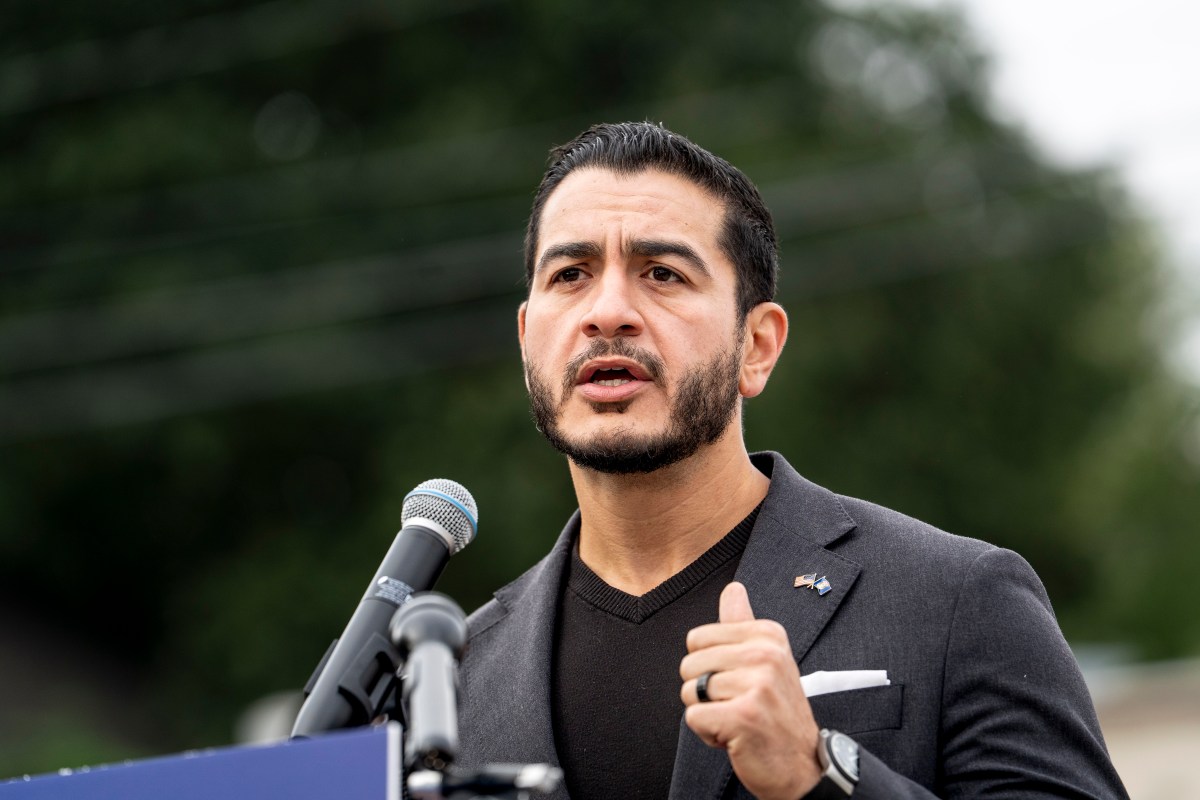
Abdul El-Sayed, the Democratic U.S. Senate candidate for Michigan, was challenged during a town hall over why he did not unequivocally condemn the Iranian regime and the Islamic Revolutionary Guard Corps (IRGC).
Iman Dashti, who identified himself as Persian, told El-Sayed during a town hall at the University of Michigan that his family had been persecuted by the regime in Tehran.
Dashti said he was dismayed when leaked audio emerged in which El Sayed did not want to comment on the death of former Iranian Supreme Leader Ayatollah Ali Khamenei following U.S. strikes on Iran because “there are a lot of people in Dearborn who are sad today.”
“That silence had a gaping hole in our community," said Dashti as he asked El-Sayed whether “you stand unequivocally against the IRGC?”
El-Sayed appeared to evade a direct criticism of the late Ayatollah, replying, “I will always stand for and with democratic movements" but that he opposed U.S. involvement in regime change.
Mike Rogers, his Republican rival for the Senate, criticized El-Sayed's reply, posting on X: "Abdul El-Sayed is looking a young man in the eyes and can’t even condemn a terrorist dictator murdering thousands of his own people. Pathetic."
Newsweek has contacted El-Sayed's office for comment.
The tense exchange took place at the Michigan Theater in Ann Arbor during a University of Michigan town hall event on Wednesday titled "Students vs. Billionaires."
It was part of a statewide campus tour organized by More Perfect University to engage voters across the state ahead of November's mid-term elections.
When asked if he regretted not denouncing the IRGC, El-Sayed criticized military intervention, telling the crowd that "for too long and too often, when we think about our role in the world, we have turned ourselves into the world's policeman."
"I will always stand for and with democratic movements, always," El-Sayed said before taking a swipe at the Trump administration's actions, adding, "I also don't believe that we were in the right to go to war to topple the government of Iran." He received some applause for his comments, but they prompted criticism among social media users.
The X account of Democrats for Mike Rogers posted: "Abdul can’t condemn Hamas, the IRGC, the Houthis, or the enemies of America. We deserve better." News anchor Harris Faulkner posted on X next to the clip, "you’ll notice Michigan candidate for US Senate Abdul EL-Sayed never condemned the IRGC. Why not?"
Ahead of the mid-term elections on November 3, the latest polling shows a very tight race in Michigan, with El-Sayed slightly ahead in the race for the Senate seat vacated by Democratic incumbent Gary Peters, who will not seek re-election.
The pair is competing in one of seven Senate races that the election handicapper Cook Political Report has called a “toss-up.” A Pollsmax average put the Democrat El-Sayed at 46.4 percent as of Thursday. 1.6 percentage points ahead of Republican Mike Rogers' 44.8 percent.
A poll released Monday by the Suffolk University Political Research Center gave El-Sayed a 7-point lead over Rogers, with four other candidates combined for 3 percent. Some 8 percent of voters were undecided.
Meanwhile, Emerson College polling between September 12 and September 14, which put El-Sayed two percentage points ahead of his GOP rival, highlighted how education shapes attitudes towards the Democrat.
Spencer Kimball, executive director of Emerson College Polling, said his firm's survey found that voters without a four-year degree favor Rogers, 48 percent to 45 percent, while college graduates backed the Democrat El-Sayed, 53 percent to 42 percent.
The GOP has a 53-47 majority in the U.S. Senate, including two independents who caucus with Democrats, and needs a net gain of four seats to take control of the upper house.
The Cook Political Report considers seven Senate contests as toss-ups, with Michigan among them. The others are Alaska, Iowa, Maine, Michigan, New Hampshire, Texas and Ohio. Five of the seven seats are held by Republicans and two by Democrats.
President Donald Trump carried Michigan 49.7 percent to 48.3 percent in the presidential election in 2024, and so after the Peters' departure, the state is tougher to defend than a reliably blue state.
El-Sayed is running on a progressive economic and social platform which includes Medicare for All, reducing corporate influence in politics and opposition to U.S. military support for Israel and abolishing ICE.
Former Vice President Kamala Harris campaigned with El-Sayed at a Detroit birth center on Tuesday in their first public appearance together since she endorsed him after his August primary win.
El-Sayed said that the race against the GOP candidate Rogers will determine whether there will be continued federal funding cuts hitting maternal care.
Newsweek’s reporters and editors used Martyn, our AI assistant, to produce this story. Learn more about Martyn here.
Contact Newsweek editors on this story: John Fitzpatrick and Gray R. Thomas


