
Abdul El-Sayed’s Lead in Michigan Polls Compared to Jocelyn Benson - Newsweek
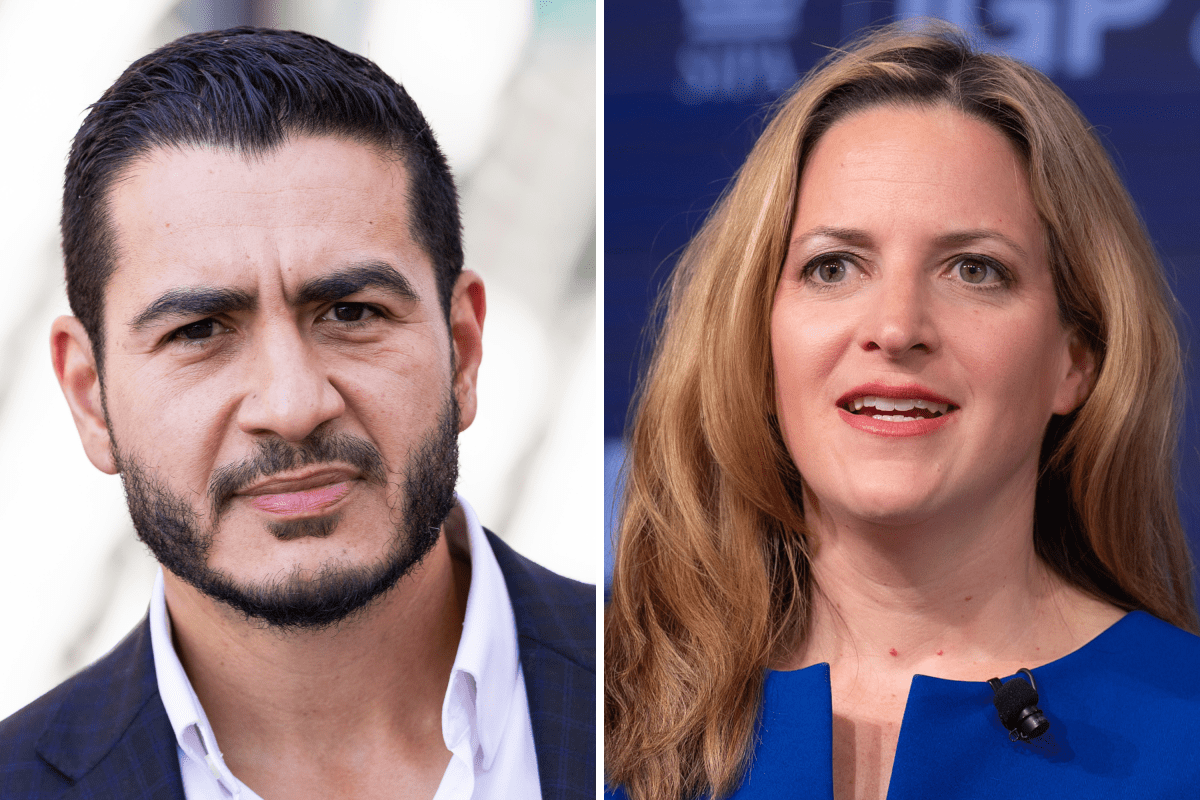
Democratic hopeful Abdul El-Sayed leads in two new polls of the Michigan Senate race released on Thursday, but he holds a slimmer lead than his Democratic counterpart in the governor's race, Jocelyn Benson.
The Senate race is one of the most competitive contests of the 2026 midterms and is Republicans' best chance to flip a Democratic seat. El-Sayed is running against Republican Mike Rogers, a former congressman, to succeed retiring Democratic Senator Gary Peters.
Although Democrats anticipate a strong national environment driven by President Donald Trump’s declining national approval rating, Republicans believe El-Sayed’s progressive record could alienate moderate voters who are key in the state that has backed the president in two of his three White House bids.
A Rogers victory could hinge on independent and moderate Democrats splitting their vote and backing him despite backing Benson in the gubernatorial race over Republican Representative John James. The two new polls from Emerson College and The Washington Post suggest some of these key voters could back Rogers, or are at least remain undecided, leaving the race competitive fewer than 50 days from Election Day.
Newsweek reached out to campaign contacts for Benson, El-Sayed, James and Rogers for comment via email.
El-Sayed held a 2-point lead in the Emerson poll and a 3-point lead in the poll from The Washington Post and George Mason University, while Benson held a 7-point lead in the Emerson poll and a 12-point lead in the poll from the Post.
In the Emerson poll, 48 percent of respondents said they would vote for El-Sayed, while 46 percent said they would cast their ballots for Rogers. At the same time, 49 percent said they were voting for Benson, while James’ support stood at about 42 percent.
Meanwhile, El-Sayed received 48 percent support and Rogers received 45 percent in the poll from The Washington Post. The pollster showed Benson with 53 percent, and James with 41 percent support.
The Emerson poll surveyed 1,000 likely voters from September 12 to September 14, 2026, and had a margin of error of plus or minus 3 percentage points. The Post poll surveyed 803 likely voters from September 10 to September 14, 2026, and had a margin of error of plus or minus 3.9 percentage points.
The polls could underscore concerns raised by some Democrats, who earlier asked about whether El-Sayed would be a strong candidate in a state that backed Trump in the 2024 election.
El-Sayed is progressive and has received support from top Democratic socialists, including independent Vermont Senator Bernie Sanders and Democratic New York Representative Alexandria Ocasio-Cortez. He is known for embracing progressive policies, including Medicare for All.
Some in the party have argued that a more moderate Democrat would have fared better in the state, and some of the party’s establishment rallied around Representative Haley Stevens, seen as the more moderate candidate, in the Democratic primary.
Electability was part of Stevens’ pitch to voters in the lead-up to the primary, but the state’s Democratic voters narrowly backed El-Sayed. Although polling leading into the primary showed El-Sayed with a comfortable lead over Stevens, he only won by about a point.
“MAGA Republicans are boosting my opponent because they know they can beat him in the general election. Today's poll showing Abdul losing to Mike Rogers confirms it. I'm the only candidate who can keep Michigan blue and help us flip the US Senate,” she wrote in an August 2 post on X.
El-Sayed has pushed back on electability concerns.
"It may just be that the better explanation is not that the state wants moderates: It's that it's so sick and tired of the establishment bought off by corporations on both sides of the political aisle that it was willing to hold its nose and vote for Donald Trump twice,” he told CBS News earlier this year.
Not all Michigan Democrats have backed El-Sayed.
Representative Hillary Scholten, a Democrat representing the Grand Rapids area, has declined to endorse El-Sayed because of his ties to Hasan Piker, a streamer who has become a lightning rod for controversy and criticism among establishment-aligned Democrats.
Rogers has been making a pitch to Democrats on the campaign trail after winning the Republican nomination.
“Michigan deserves a senator who will sit down, whether you voted for me or not, who will listen to you, will treat you with respect, who will represent everybody,” he said during a campaign event in August, according to WEMU.
He has received support from some Democrats, including state Representative Karen Whitsett, who declined to support El-Sayed over his support for a single-payer health care system.
Polling still suggests that a majority of Democrats are planning to vote for El-Sayed.
In the Emerson poll, 89 percent of Democratic respondents said they would be voting for their party’s nominee. At the same time, 88 percent of Republicans said they would be voting for Rogers.
Benson does perform better among Democrats, winning 92 percent of them. She also held a larger lead among independents, winning them by about 7 points, while El-Sayed won them by less than 3 points, according to the poll.
Benson’s campaign has not drawn as much attention among Democrats, and she does have the advantage of already being a well-known figure who spent two terms serving as Michigan's secretary of state. She has a strong electoral record, winning reelection by nearly 14 points in 2022.
Earlier polls similarly showed Benson running ahead of El-Sayed in Michigan.
El-Sayed had a 3-point lead in a CNN/SSRS poll released earlier in September, 47 percent to 44 percent. At the same time, Benson led by 9 points, 50 percent to 41 percent. It surveyed 843 likely voters from August 31 to September 6, 2026.
A poll from The Detroit News and Glengariff Group showed Rogers with a narrow lead, 45.8 percent to 44 percent. Meanwhile, Benson led 4 points, 47 percent to 43 percent. It surveyed 600 likely general election voters in Michigan from August 31 to September 3.
An EPIC-MRA poll, however, showed the two Democrats running about even. El-Sayed led by 4 points, 47 percent to 43 percent. Benson was also up 4 points, 45 percent to 41 percent. It surveyed 600 likely voters from August 22 to 28, 2026.
Michigan has become one of the most competitive electoral battlegrounds over the past decade.
Former President Barack Obama won the state twice, by more than 16 points in 2008 and by just under 10 points in 2012. But Trump flipped it in 2016, carrying it by less than half a percentage point.
Trump made gains across the state because of his strong showing among white voters in rural areas who backed Obama.
He lost ground in the suburbs around Detroit and parts of Western Michigan around cities like Grand Rapids, but rural gains made up for that loss. Democrats struggled to win back those rural voters in significant numbers in recent cycles, but continued to make gains in the suburbs.
Michigan flipped back to Democrats in 2020, when Biden carried it by just under 2 points. But Trump won it again in 2024 by about 1.4 points—the strongest showing for a Republican presidential candidate since 1988.
Michigan last elected a Republican senator in 1994, so Democrats have been on a decades-long winning streak in Senate races. But it has been willing to vote for Republican governors. Although Governor Gretchen Whitmer, a Democrat, won by large margins in 2018 and 2022, the state elected a Republican governor as recently as 2014.
Michigan is going to be closely watched over the coming weeks and months ahead of the November 3 midterms due to its status as an evenly divided battleground. The Senate race is classified as a tossup by the Cook Political Report and Sabato’s Crystal Ball, while both forecasters put the governor’s race in the Leans Democratic column.
Contact Newsweek editors on this story: Gabe Whisnant and Geoffrey Rowland.


