
Activist Involved in ‘Noah’s Ark’ Search Vows to Rewrite Evolution Narrative - Newsweek
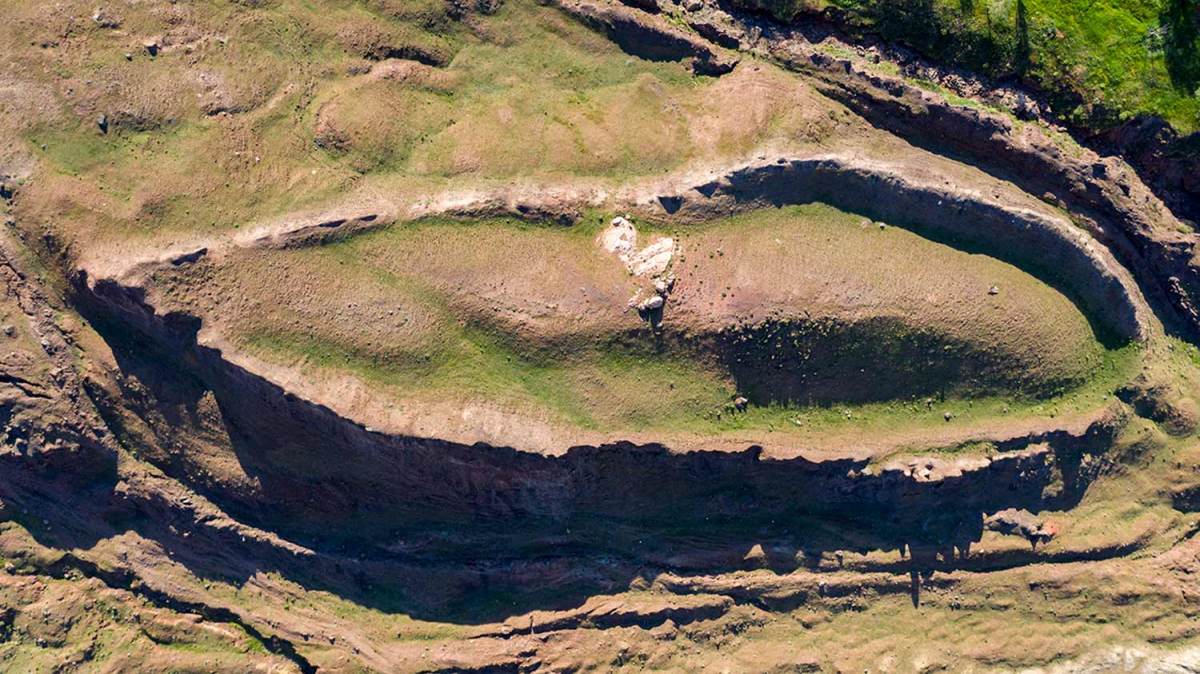
A Christian activist involved in a project investigating whether Turkey’s Durupınar Formation contains remains of Noah’s Ark said finding the vessel would, in her view, be a “direct challenge of evolution.”
U.S.-based group Noah’s Ark Scans is working with others, including Bakhtar Research and Engineering, to investigate whether the approximately 515-foot-long, boat-shaped formation contains remains of the biblical vessel. The team says it is testing core samples for evidence of wood. It has not established that the formation contains a vessel.
Fundraising director at Noah’s Ark Scans, Lauren Witzke, has said the project is about more than finding the ship, but about challenging the theory of evolution.
“Irrefutable proof of Noah’s Ark and the great flood is a direct challenge of evolution,” she told Newsweek. “It is the true point at which all of mankind’s history began anew and creation was reborn.”
The National Academies of Sciences, Engineering, and Medicine says the “ideas of evolution by natural selection remain foundational to modern scientific inquiry” and cites conclusions from multiple independent scientific disciplines.
Referring to the biblical story of Noah’s Ark, in which God gives humanity a chance to begin again after a devastating flood, Witzke said, “Noah’s Ark dismantles the idea that we are all just a product of evolving species over millions of years, and instead shows that we were a beloved creation, preserved and given a second chance less than 5,000 years ago.”
She went on to say that the team would will go after schools and educators that focused curricula on evolution if the team proves Noah’s Ark is inside the Durupınar Formation.
“We will not stop until school curriculums are rewritten and every professor who failed Christians for rejecting evolution as the account of human origins is ‘re-educated’ or fired,” Witzke said.
The comments come as Noah’s Ark Scans founder Andrew Jones said he believes he has already found evidence of the boat in Turkey, including the same dimensions described in the Bible's Book of Genesis. He cites a preliminary report by Khosrow Bakhtar, of Bakhtar Research and Engineering, which interprets radar data as indicating a human-made structure beneath the surface.
The team's preliminary report has not yet been peer-reviewed.
Bakhtar said processed imagery shows what he described as “organized patterns, corridors, chambers, and hallways lying inside the 515-foot boat-shaped Formation in the Mountains of Ararat.”
“Whatever the object is beneath the surface is extraordinary,” he said. “In forty years of this work, I have never seen anything like it. It could be a ship. It could be a spaceship. What I can say from the radar is that it is organized, it is structural, and a solid geological mass would not have returned such a strong signature.”
“If it was from geologic origin, we would have not seen it at all since we masked the subsurface geologic features” he continued.
Jones cited these findings in a Fox News interview this weekend, arguing that “organized patterns” could be parts of the Ark or a deck.
"No bedrock or solid limestone has so far been identified in the holes drilled inside the formation," Jones said previously. "These current findings challenge claims that this is simply a natural shape made of limestone or bedrock."
They have not identified any wood material either, Jones told Newsweek, as the team waits for lab-testing results. Newsweek has not reviewed the scans and cannot independently verify the team’s interpretation
Two researchers tried to answer this question in 1996, when geologist Lorence Gene Collins and Ark researcher David Franklin Fasold looked into “evidence from microscopic studies and photo analyses” and concluded, “It is a completely natural rock formation” and “cannot have been Noah's Ark nor even a man-made model.”
The researcher behind the 1996 study originally thought the Durupınar Formation could be the site of Noah’s Ark.
The current team looking into the formation say they are using techniques that were not available to researchers in 1996. It says it is using ground-penetrating radar, electrical resistivity tomography, lidar and core sampling. Earlier investigators also used radar and core drilling at the site.
Cores are being taken from depths of up to 18 meters (59 feet), Noah’s Ark Scans said in its announcement. The 1996 study is based on drilling that took place by investigators John Baumgardner and Salih Bayraktutan in the late 1980s, which reached around 10 meters (33 feet).
The 1996 study examined rock samples and geological relationships, as well as earlier claims about the formation’s internal structure. Its authors concluded that the supposed artifacts and boatlike features had natural explanations.
Witzke believes the team has already “proven that we have a man-made, boat-shaped structure beneath the surface that matches the exact same dimensions in Genesis, in the exact same location that the book of Genesis says.”
She told Newsweek the next step is to look at “ancient animal DNA,” adding that Noah’s Ark Scans is in talks with scientists to specialize in identifying ancient and extinct animal genomes from degraded material.
“We knew that once we confirmed that the Durupinar Formation was the resting place of a massive ship, that we were going to next have to prove that it is indeed Noah’s Ark,” she said. “Of course, for some atheists and evolutionists, no amount of proof will ever be enough and they will continue to scoff and laugh.. But here’s the thing, they laughed at Noah too, until it started to rain.”
The structure, which has attracted people hoping to find Noah’s Ark since its outline was identified in 1959, lies south of Mount Ararat in eastern Turkey, a region referenced in the biblical account of the Ark. Genesis (8:4) says that, as floodwaters receded, “the ark came to rest on the mountains of Ararat.”
Its ship-like outline has made it a focus for some searchers of the vessel, including Jones, who said previously, “We believe the Durupınar Formation is the remains of Noah’s Ark, and that is exactly why we want to put it through the strongest scientific testing we can.”
Others disagree, with the 1996 study calling the theory that the structure contained the ark’s remains “bogus.”
The study concluded that the formation "has been misidentified as Noah's Ark." The researchers said microscopic studies proved that materials which had been presented as man-made were actually all naturally occurring.
Contact Newsweek editors on this story: Ben Kelly and Geoff Rowland.

:quality(30):format(webp):focal(0.5x0.5:0.5x0.5)/pekanbaru/foto/bank/originals/Soal-UTS-Bahasa-Inggris-Kelas-10-Semester-1-Kurikulum-Merdeka.jpg)