AfD makes gains in state elections, but has no government options
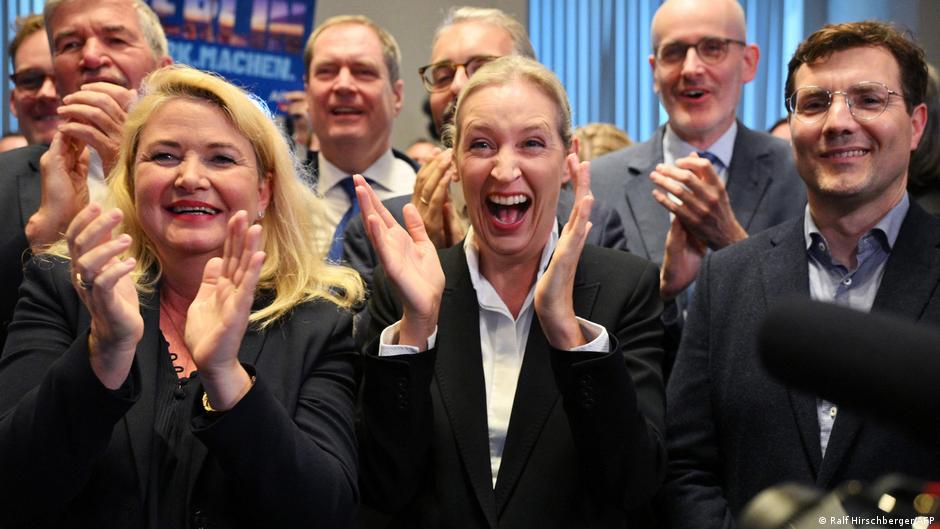
AfD co-leader Alice Weidel (m) was jubilant following her party's good showing in state elections in Berlin and Mecklenburg-Western PomeraniaImage: Ralf Hirschberger/AFPAdvertisementThe Alternative for Germany (AfD) made significant gains in the elections in northeastern Germany and in the capital, Berlin, but is likely to remain in the opposition in both states.
The Alternative for Germany (AfD) scored another election victory on Sunday evening, becoming the strongest party in Mecklenburg-Western Pomerania with 37.9% of the vote, according to an exit poll by the polling firm infratest-dimap on election night.
That put the far-right party just ahead of the Social Democrats (SPD), whose dramatic comeback in the last few weeks, led by incumbent State Premier Manuela Schwesig, fell just short, with 35.7% of the vote on Sunday evening. The final results may vary as votes are counted.
The AfD was not short of confidence. Even before the first exit poll results were announced, AfD co-leader Tino Chrupalla told public TV network ARD, "We clearly have a mandate to govern here," before adding that the party would offer coalition talks to all the other parties.
Chrupalla also said he expected Chancellor Friedrich Merz to resign now. "That would truly be a relief for this country," he said.
The AfD also made gains in the Berlin House of Representatives — the state parliament of the German capital — but fell far short of its own expectations on election night. According to infratest-dimap, it took 16.2% of the vote, though it had been polling at 18% only last week.
With Merz's center-right Christian Democrats (CDU) suffering heavy losses in both state elections, AfD party co-leader Alice Weidel said she now sees her party as the successor to the CDU.
"We are the new people's party in Germany," Weidel pronounced to public broadcaster ZDF, before criticizing the Christian Democrats for refusing to entertain the possibility of entering into a coalition with AfD: "We are holding talks because we haven't erected any firewalls." But Weidel did not explain what the policy talks with other parties would look like.
After the AfD's triumph in the state of Saxony-Anhalt on September 6, it has become clear that the party — some of whose members are considered a threat to Germany's constitutional order by German domestic intelligence agencies — is struggling to find political allies.
In that election, the AfD narrowly missed securing an absolute majority of seats in the state parliament and thus cannot elect the state premier on its own. In the struggle to form a governing majority, no party currently appears willing to enter into a coalition with the AfD.
However, the AfD's leading candidate in Saxony-Anhalt, Ulrich Siegmund, had made it clear that he would only lead a "stable" AfD government, ruling out a minority government tolerated by representatives from other parties. During the election campaign, he had gone even further, repeatedly stating that he would only serve as state premier in a single-party AfD government.
Since then, it has been unclear exactly what the AfD is aiming for. The AfD's national leadership appears to have a strong interest in seeing form any kind of government. This was underscored by Weidel, who said after the elections in Berlin and Mecklenburg-Western Pomerania that the AfD could take power "even in a minority government."
Weidel herself is said to have ambitions to succeed Merz as chancellor. She was already her party's chancellor candidate in the last federal election in 2025, and many top AfD officials also see her as the chancellor candidate next time round. A successfully formed AfD state government could potentially give those ambitions a boost.
However, the party's rise has also been accompanied by growing protests. In the elections in Mecklenburg-Western Pomerania and Berlin, it was evident that many voters mobilized to keep the AfD's votes in check.
The party also made several negative headlines during the election campaigns: In Mecklenburg-Western Pomerania, one AfD candidate had to pull out of the race when it emerged that he was a convicted bank robber. Another candidate withdrew his candidacy for the state parliament when it was revealed he had a DUI conviction and could no longer hold a driver's license.
In Berlin, meanwhile, drugs and Nazi memorabilia were found in the possession of a staff member of the party's lead candidate.
In the past, AfD politicians have repeatedly drawn criticism for making positive allusions to the Nazi era. One AfD European Parliament member posed with his hand on his heart in front of Adolf Hitler's "Führer Bunker" in Berlin, while one Bundestag member described himself as the "friendly face of National Socialism."
The influential AfD state leader in Thuringia, Björn Höcke, was twice fined for using a slogan of the notorious Sturmabteilung (SA), the paramilitary organization of Adolf Hitler's NSDAP party.
This article was translated from German.