
After Neuer: Who will be Germany's new No. 1 goalkeeper?
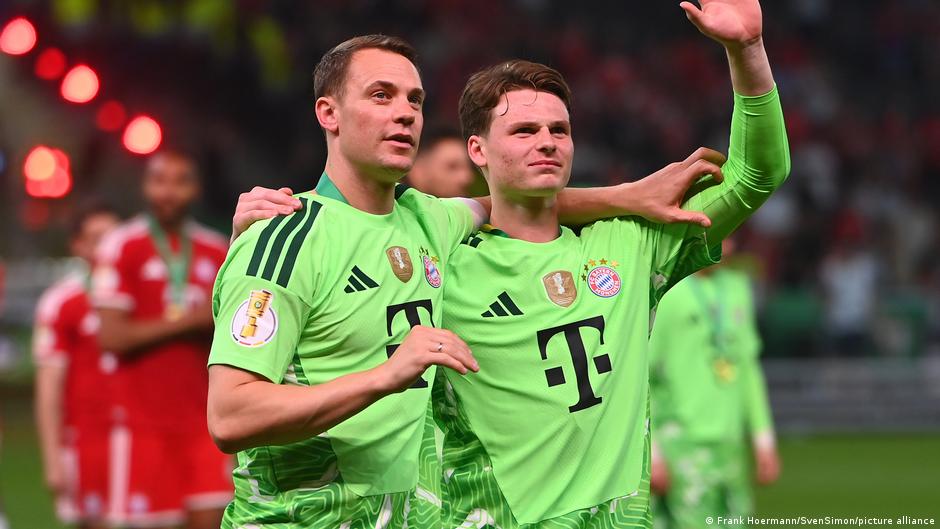
Many believe Jonas Urbig (right) is the natural successor to Manuel Neuer (left)Image: Frank Hoermann/SvenSimon/picture allianceAdvertisementAfter Germany's early exit from the 2026 World Cup, Manuel Neuer retired from international duty, opening the door for a new number one.
Jonas Urbig appears the obvious choice, but Neuer is still number one at Bayern Munich, which severely limits Urbig's playing time. If the 23-year-old was Bayern's first choice, he would likely be Germany's number one too. As it stands, though, it appears doubtful that Germany's new coach Jürgen Klopp will even call him up to his first squad. On September 17, he will announce his squad for four UEFA Nations League games against the Netherlands, Greece, and Serbia. And no position in the current Germany team is more up for grabs than goalkeeper.
Oliver Baumann represents exactly that kind of selfless number two that could be the next number one. The Hoffenheim goalkeeper even commendably dealt with the humiliation of being replaced by Neuer just before the World Cup.
However, Klopp isn’t just tasked with celebrating short-term success with Germany. His remit is to bring about lasting change, making Germany favorites for a World Cup and a Euros once again. Oliver Baumann turned 36 this summer. The Bundesliga veteran will be 38 at the next Euros, 40 by the 2030 World Cup. His age might count against a sustainable rebirth of the Germany team.
The Hoffenheim goalkeeper, who has 13 caps, spoke to Bild in the days leading up to the squad announcement about his exchange with Klopp: "Yes, I was in contact with him. He'll say everything else on Thursday. We'll see about the rest—that’s for him to handle."
Since Klopp prefers a highly attacking style of play in which all players press high up the field, he might opt for a goalkeeper who can also take on the duties of a field player. Marc-André ter Stegen would fit this profile better than Baumann. Ter Stegen is also two years younger than his competitor, though his career has been hampered by injuries.
After several serious injuries and a legal dispute with Barcelona, ter Stegen has gone on loan to Ajax, improving his chances of returning between the posts for Germany.
"As far as ter Stegen is concerned, I assume he’ll definitely be in the mix," Lothar Matthäus recently wrote for Sky. "If he continues to perform well in Amsterdam, he's a candidate for the number one spot."
Alexander Nübel was Germany's third-string goalkeeper at the World Cup. He had been consistent at Stuttgart but moved to Besiktas this summer, where he has made a strong start. However, former national team goalkeeper Toni Schumacher sees the move as a disadvantage for the 29-year-old.
"His move to Turkey has taken him out of the spotlight," Schumacher, who also played for Fenerbahce for three years during his playing days, told Bild. "It simply has a positive effect when you play in your own country week after week and thrill the fans with your saves."
A goalkeeper who has never been called up to the Germany team but shares a history with Jürgen Klopp is Loris Karius.
Karius, who has been at Schalke since January 2025, was at times Klopp’s number one at Liverpool. However, he made two critical mistakes in the 2018 Champions League final against Real Madrid and was subsequently dropped.
Back in the Bundesliga aged 33, Karius is now delivering consistent performances and may have played his way back into the spotlight.
"When people associate me with that, it's a testament to the performance I’m putting in. That's great," Karius said recently in an interview with Sky.
If none of the obvious candidates get selected, there are also a number of other good goalkeepers who might be considered. First among them is Noah Atubolu. The 24-year-old Eintracht Frankfurt keeper, who has Nigerian heritage, was the number one for Germany's U21s from 2022 to 2025, and was called up to the senior squad once last October.
Freiburg's Mio Backhaus is another promising talent. The 22-year-old’s mother is from Japan, meaning Backhaus is also eligible to play for Japan. He even played for the Japanese U15 team, but has since progressed through Germany's youth teams up to the U21 level.
In addition to Atubolu and Backhaus, there are also Augsburg's Finn Dahmen (28), Stuttgart's Dennis Seimen (20), and Diant Ramaj (24), who left recently relegated Heidenheim to join Copenhagen.
If Klopp wants to rely on one of the five, it might be worth playing them sooner rather than later in a competitive game. After all, just like Atubolu and Backhaus, the other three are also eligible to play for another country due to their heritage. Dahmen could also play for England, Seimen for Romania, and Ramaj for Kosovo.
"I think they need to develop a young goalkeeper as the number one right now," Andreas Köpke, the goalkeeper on Germany's 1996 European championship team, told Bild.
Germany's former goalkeeping coach pointed to Bayern's backup goalkeeper Urbig alongside Backhaus and Atubolu—though only as and when Urbig plays regulary at club level.
And given his standing at Bayern, that's bound to come down to how long Manuel Neuer choses to continue to play.
This article was adapted from German.
