AI is ‘better informed’ than doctors, US health secretary Kennedy says
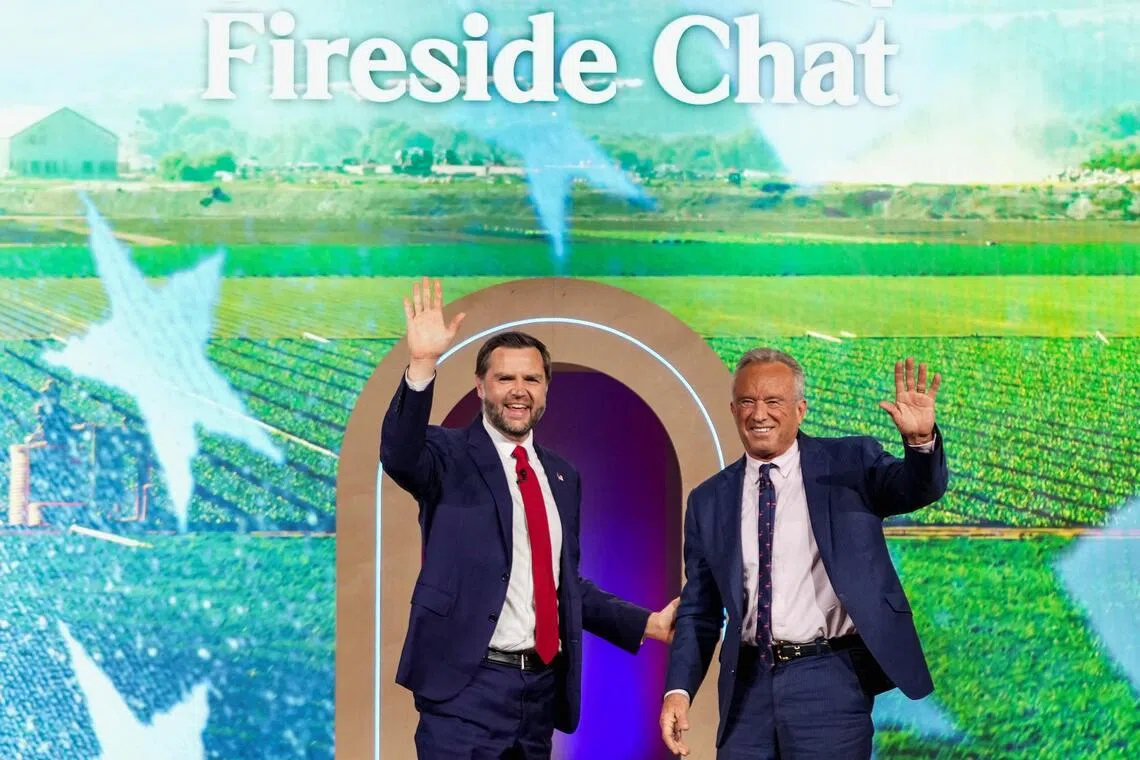
US Vice-President J.D. Vance and US Secretary of Health and Human Services Robert F. Kennedy Jr. at a Make America Healthy Again summit in Washington on Sept 29.
US Health Secretary Robert F. Kennedy Jr., who has frequently advised Americans not to trust medical experts, said this week that artificial intelligence could offer patients “a second opinion that is much better informed than any doctor in the country” and had the power to “free us from medical tyranny”.
Kennedy made the comments on Sept 29 during a “fireside chat” with Vice-President J.D. Vance at a Make America Healthy Again (MAHA) conference sponsored by companies that have business before his department, as well as AI companies, such as Anthropic and OpenAI.
Kennedy said OpenAI chief executive Sam Altman told him during a recent visit to his office that it would be “malpractice for a doctor to make a diagnosis or to make a prescription without at least checking AI”. Kennedy apparently agreed.
The health secretary’s wholehearted endorsement of AI comes as the Trump administration is facing mounting pressure to do more to regulate the technology. Kennedy’s own department has faced some criticism for moving too rapidly to fund AI projects in healthcare.
“One of the things that is going to change is that we’re never ever again going to be able to be dominated by public officials who tell us, ‘Trust the experts,’” Kennedy said during the Sept 29 session.
“If somebody tells you, ‘Masks work, trust the experts,’ AI may tell you otherwise,” he added. “If somebody tells you, ‘Social distancing works, trust the experts,’ AI may correct that. And if somebody tells you that a vaccine will prevent transmission and infection, or you need to take it to protect your grandmother, AI may say it actually doesn’t do that.”
When it was finally Vance’s turn to speak, he cracked a joke: “I guess I’m in the wrong summit. I thought this was about weight loss and acid, not AI.”
The MAHA Summit, at the Waldorf Astoria in Washington, did indeed address other topics, including some of Kennedy’s core issues: the promise of psychedelic drugs, healthy eating and chronic disease prevention.
Kennedy and other administration officials were not involved in planning the conference; they were invited speakers. But so many appeared – including Agriculture Secretary Brooke Rollins; Lee Zeldin, who heads the Environmental Protection Agency; and Mehmet Oz, who runs Medicare and Medicaid – that at times it looked like a corporate advertisement with a government imprimatur.
The conference’s tilt towards business, and its sponsorship by companies such as Walmart and Grail, which has an application for a cancer screening blood test pending before the Food and Drug Administration, generated a backlash from some longtime Kennedy supporters.
“It’s all a grift,” said Dr Robert Malone, a critic of mRNA Covid-19 vaccines. Malone served briefly as vice-chair of a vaccine advisory committee appointed by Kennedy, but resigned in March after a judge ruled that he and other committee members lacked essential qualifications.
“Why were none of the founding women of the movement involved?” asked Alex Clark, a podcaster with the conservative group Turning Point USA, referring to the so-called MAHA Moms. One of them, Vani Hari, who calls herself “the Food Babe” and has worked closely with Kennedy, attended as a guest but was not on the programme.
Stefanie Spear, Kennedy’s closest adviser, moderated a session that included Jonathan Neman, a founder of the salad chain Sweetgreen, who marvelled at how Kennedy has changed the conversation around food. Neman said that in 2015, his company briefly promoted an initiative it called Make America Healthy Again.
Coming just five weeks before the midterm elections, the conference shed light on how the MAHA movement has fractured since 2024, when it rallied behind Kennedy and helped power US President Donald Trump’s election victory.
In effect, there are now two MAHAs: corporate, Trump-aligned MAHA, including the conference organisers, and grassroots unaffiliated MAHA, which Democrats are now trying to court. In Michigan on Sept 29, Abdul El-Sayed, the Democratic candidate for Senate, announced a Build a Healthier America agenda.
“Any MAHA anything that is brought to you by Walmart Corporation and the health insurance companies tells you everything you need to know,” El-Sayed, a former public health official in Detroit, said in an interview Monday night.
El-Sayed’s agenda includes plans to address many of the issues that have galvanized MAHA followers: getting toxic substances out of foods, clean water, improving the health of school meals and eliminating pesticides from farming. But he said he did not support Kennedy’s push to discourage childhood vaccination.
The topic of vaccines, central to Kennedy’s work for decades, was conspicuously absent from the conference agenda. So was Dr Jay Bhattacharya, director of the National Institutes of Health, who has been tangling with the White House over its plan to assert political control over his agency’s grant-making decisions.
Bhattacharya, who was initially scheduled to moderate a panel discussion, disappeared from the final agenda. A spokesperson would not say why.
Journalists were excluded from the conference for the most part, although it was streamed online. Major news outlets that applied for press credentials, including The New York Times, were denied them. In an e-mail, conference organisers said they had “limited space”. But the press section inside the hotel ballroom was empty.
“I cannot understand why the MAHA Summit denied so many press credentials, especially with so many US govt officials on stage,” Helena Bottemiller Evich, founder of an influential newsletter, Food Fix, wrote on the social platform X. She added that while she was granted credentials, “the press area was largely empty and our movement was restricted so I left”.
Reporters and conference guests instead mingled in the grand lobby and restaurant of the hotel, which Trump owned from 2012 to 2022. Among those spotted there was entrepreneur Mark Cuban, whose company Cost Plus Drugs teamed up with Trump on TrumpRx, the president’s plan to reduce the cost of drugs.
Cuban, dressed in a teal T-shirt and dining alone, said he had no idea the MAHA Summit was taking place and had no interest in attending. He was in town for another meeting.
Kennedy’s supporters, including Tony Lyons, who oversees a constellation of MAHA-themed non-profits, including the organiser of the conference, defended the secretary. The MAHA Center, which hosted the conference, said on its website that it did not “coordinate with any government entity” in planning the event.
“People have been going after Bobby Kennedy for many, many years now,” Lyons said during a conversation that included Calley Means, a top Kennedy adviser; Zeldin; and Kyle Diamantas, the acting FDA commissioner.
“They’re going after Bobby Kennedy because they say he’s dangerous,” Lyons added, “and we know what he’s a danger to. He’s a danger to the people who are roadblocks: The people, the companies, the deep-state actors who are roadblocks to real progress.”
The Sept 29 conference came on the heels of another MAHA event, focused on healthcare data, hosted on Sept 28 by the MAHA Institute, another organisation affiliated with Lyons. Kennedy mingled with guests at a private reception Monday night.
One of them, Jeffrey Tucker, who runs the Brownstone Institute, a free-market policy organisation that grew out of a backlash to Covid-19 restrictions, described the scene on X. “Guy at reception last night in DC, confusing me with someone important, started pitching his new medical product that is being considered by the FDA,” Tucker wrote.
“The conversation was not particularly welcomed by me,” he added, “so I said the following: ‘It doesn’t matter if it works or not. All that matters is whether you have the money. Pay the needed millions and it is approved. Pay nothing and it is not approved. That’s how it works.’ To my amazement he said: ‘Yes, that’s it exactly.’” NYTIMES