AI vulnpocalypse has hit banks and grounded flights, experts say outages have one thing in common
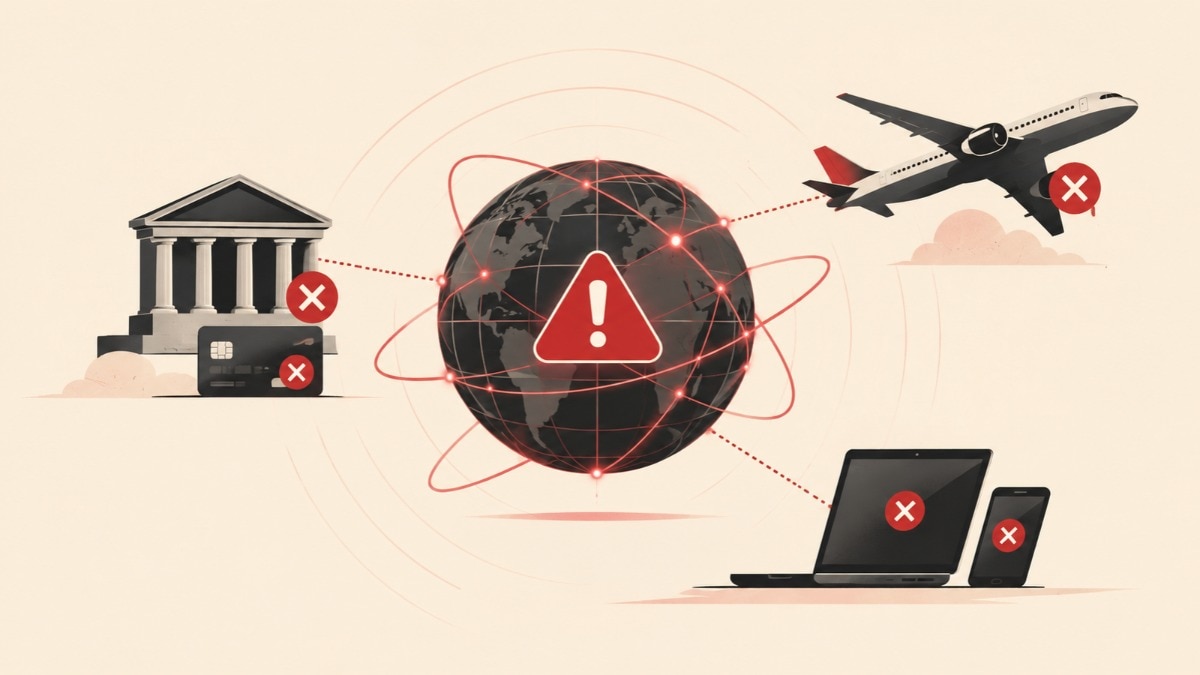
November 16 was supposed to be an ordinary Monday. But in the US things took a turn for the worse. Thousands of users noticed that they could no longer access their bank accounts. From making online transactions to using an ATM, customers of major US banks were reporting disruptions across the board. Later, JPMorgan Chase, the largest bank in the US, confirmed that the issue had stemmed from a software bug in its systems. This bug impacted Chase and other banks that made transactions with it.
While Chase resolved the issue after a few years, the incident sparked uncertainty amongst users. Just days earlier, Microsoft’s 365 suite of apps including Outlook went down for millions of users globally after a server update for nearly 36 hours, impacting governments, businesses, and airlines. At the same time, the US Federal Aviation Administration (FAA) was forced to cancel over 10,000 flights following a router update.
Combine all of this with other incidents such as the $6.3 billion Binance breach, and the situation may feel alarming. So much so that the internet has coined the term AI vulnpocalypse for it. AI is finding flaws at breakneck speed and humans are scurrying to fix them as soon as possible. The mad rush to strengthen our defenses is breaking systems. Experts say one thing connects them all: technology dependency.
Microsoft, JPMorgan Chase, and the FAA have given separate reasons for their respective events. But according to Mitigata CTO Mayank Morya, there is a lesson to take. “What connects these incidents is not the cause, but the underlying vulnerability: concentration of technology dependencies,” he tells India Today Tech.
Most businesses today rely on Software as a Service, or SaaS, for developing many of their tools in everyday operations. Meanwhile, cloud providers like AWS or Microsoft’s Azure give businesses the platform to host their tools.
Saakar S Yadav, founder of Lexlegis.ai, believes that while the system has advanced economic growth, it has also increased the risk of disruptions. “A small number of cloud, identity and payment providers now carry most of the world’s digital load, so one faulty change travels everywhere in minutes,” Yadav tells India Today Tech.
To give you an example, Microsoft's 365 outage affected users in 74 countries. Airlines in India including IndiGo and SpiceJet faced disruptions in certain operations.Is AI to blame?
Airlines across the US faced bigger problems though, after the FAA was forced to order the longest grounding of flights since 9/11. Over 10,000 flights were cancelled with many more being delayed. At first, there were concerns if AI was used in a cyberattack. Later, US Transport Secretary Sean Duffy confirmed that the incident had no “AI link.” Rather, it was a router update that caused the mayhem. Later United Airlines suffered a separate technical issue too.
But the fears around AI are not new. Ever since Anthropic’s Claude Mythos came to the scene in April this year, businesses and governments across the world have been alarmed of any potential misuse. While leading labs like Anthropic and OpenAI have put strong safeguards, risks persist.
Mandar Patil, executive VP at Cyble, says that AI may allow hackers to conduct attacks without needing human oversight. “Autonomous agents interact with APIs, databases, and enterprise applications and carry out complex operations with limited human control,” he tells India Today Tech.
And we are also seeing it happen. Google’s Threat Intelligence Group recently warned that hackers had created an AI framework that could now scan security patches to find flaws in older versions. The AI can then plan and execute attacks in older versions of that software all by itself.
Such developments seem to have put companies on alert. AI tools can be quick, and to mitigate risks, companies need to be quicker. But faster updates do not guarantee fixes.
“The concern is that when the volume and speed of changes increase, but testing and deployment processes remain the same, things will break,” Mayank Morya adds. “A rushed patch or configuration change can introduce fresh problems even when the intention is to strengthen security.”
There have been cases like this in the past. In 2024, the infamous blue screen outage impacted millions of Windows machines globally. The outage was linked to a Crowdstrike update.What should companies do?
To avoid such cases, Mandar Patil believes companies need to maintain a fine line between bringing fast and reliable fixes. “The main difficulty here is being able to fix threats without breaking systems,” he says. “Firms need to be careful and implement gradual rollouts, innovative deployments, tests of their operations, and versioning of the changes.”
How does a company manage this though? According to Sunil Peter, VP at Maveric Systems, the first step would be to develop fallback mechanisms. “Companies should test their fallback mechanisms to confirm that they work independently of their primary systems,” he tells India Today Tech.
Such a system would ensure that even if an outage impacts the company's main systems, it can use the backup infrastructure to continue its operations. Another element, Peter says, is the need for crisis management communication.
As he puts it, “IT, incident response and executive leadership teams should be able to coordinate through platforms, such as independent encrypted messaging tools.” This would ensure that the organisation can communicate and manage an outage effectively even while mainstream channels are disrupted.
Professor Himanshu Joshi from IMI Delhi concurs. “This is not only about avoiding attacks or failures, but about making sure that businesses can keep operating when something does go wrong,” he tells India Today Tech.
This does not mean that we are going to see a rise in such incidents. Joshi explains that there have been technical failures in the past, but the impact has become more noticeable today. "Technology systems have failed in the past, and outages are nothing new, but their impact is becoming much greater and more concentrated as almost everything is interconnected,” he notes. “Considering the scale of online operations, these events are still exceptions.”- EndsAlso Read | AI vulnpocalypse causing tech outages and flight disruptions, experts sayAlso Read | Nightmare November for tech: Microsoft, banks, airlines and more hit by outagesAlso Read | AI is exposing internet flaws and causing mayhem, but there may be a silver lining in Black October
Armaan loves to keep an eye on everything happening in the world of tech and AI. You will find him testing new gadgets, exploring the latest LLMs and making sense of the emerging tech. When not working around tech, he will be exploring new music or catching up on motorsport or aviation.