All MOE kindergartens to provide full-day programme by 2030; pilot to start at 2 centres in 2027 - The Straits Times
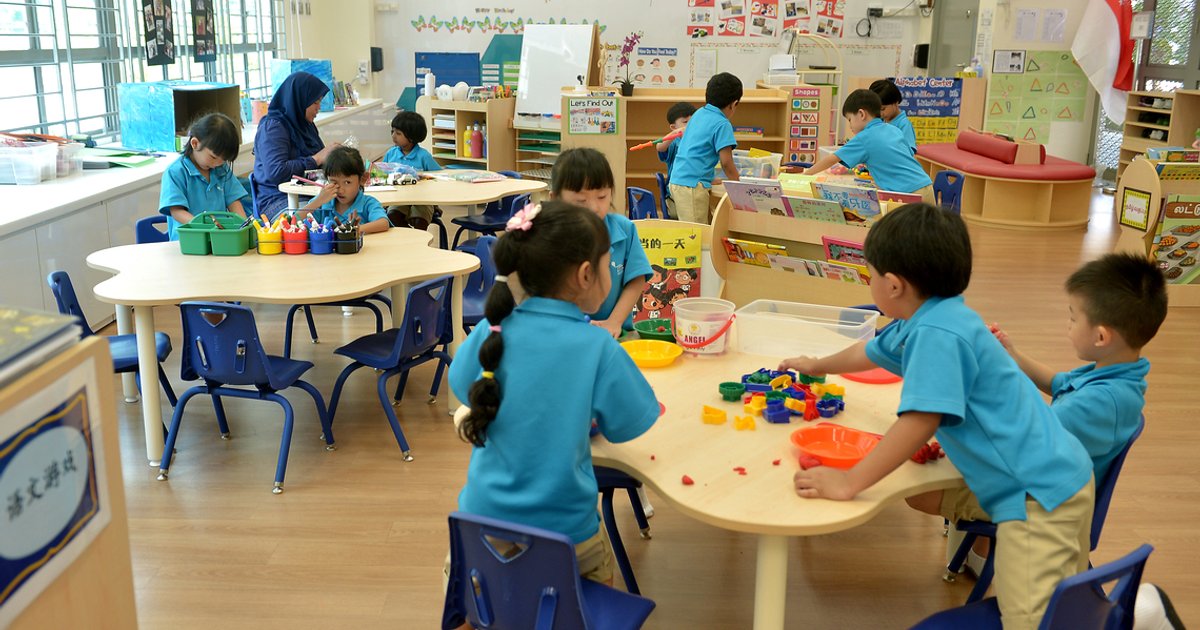
Currently, MOE operates 56 kindergartens offering four-hour programmes for Kindergarten 1 and 2 children aged five and six.
SINGAPORE – By 2030, all Ministry of Education (MOE) Kindergartens will offer a new full-day model with learning, play and care for children from 7am to 7pm.
The new model will be piloted in 2027 at two kindergartens – MK@Rivervale and MK@West View – before it is rolled out across all centres between 2028 and 2030, the ministry said on Oct 28.
Currently, MOE operates 56 centres offering four-hour programmes for Kindergarten 1 and 2 children aged five and six.
Parents requiring a full-day service can opt for Kindergarten Care (KCare), which is after-school care provided by external operators appointed by MOE.
Under the new model, education, play and care will be integrated into a single programme run by MOE Kindergarten educators.
They will be supported by MK programme officers employed by the ministry. MOE said MK educators will remain primarily responsible for delivering the curriculum, while programme officers will support children’s care and supervision, including during meals and other daily routines.
Speaking to the media on Oct 28, Senior Parliamentary Secretary for Education Syed Harun Alhabsyi said the changes were driven by feedback from parents and MK educators, as well as evolving needs in the pre-school sector.
The integrated model would allow educators to better understand children’s needs and provide more targeted support, he added.
MOE said in a briefing on Oct 28 that many parents said they require a full-day service. It said it will hire more staff, and the number of educators and programme officers deployed to each kindergarten will depend on enrolment. There are around 1,100 MK teachers now.
Existing KCare employees may be recruited as programme officers if found suitable.
The kindergartens will operate from 7am to 7pm on weekdays during school terms and holidays, excluding public holidays, designated school holidays and centre closure days.
Parents who do not need full-day service can opt for a half-day programme, from 7am to 12.30pm.
MOE said the change would provide children with greater continuity in learning and more sustained interactions with staff, allowing them to build stronger relationships. Those from disadvantaged backgrounds would also benefit from a more seamless and supportive learning environment, it added.
MOE said about 65 per cent of around 8,000 children attending MKs currently use KCare.
The new model will introduce more experiences, including exploring play in mother tongue languages, where children can take greater ownership of their learning; outdoor play using materials such as planks and tyres; and holiday activities involving science, technology, engineering and mathematics, drama and visual arts.
Parents will also pay a single fee to MOE Kindergartens, instead of separate fees for kindergarten and KCare.
At the two pilot kindergartens, monthly full-day fees for Singaporean children will range from $3 to $425 after applicable subsidies, compared with $1 to $160 for the half-day programme. Before subsidies, the monthly fees will be $665 and $310 respectively.
MOE said the out-of-pocket fees would be comparable with existing combined MK and KCare fees, as well as fees at anchor operator full-day childcare centres.
Currently, Singaporean children pay $160 a month for MK before means-tested subsidies, and KCare fees of up to $275 a month after a basic subsidy.
Fees for the centres coming on board later will be shared when available, MOE said. The list of kindergartens adopting the new model each year will be announced during the preceding year’s MK registration exercise in March.
MOE said it would work with kindergartens, schools and KCare operators to ensure a smooth transition to the full-day model.
The changes follow Prime Minister Lawrence Wong’s announcement at August’s National Day Rally that the Government aims to lower full-day childcare fees at government-supported pre-schools to $150 a month by 2030.
This is part of efforts to ensure quality affordable pre-school education is within reach for all families.
The existing outsourced KCare arrangement came under scrutiny earlier in 2026 after MOE terminated its contracts with student care operator Little Professors Learning Centre in February over contractual breaches, including unpaid staff salaries.
Around 1,800 children across eight primary schools were affected, including children attending KCare at six of the schools.
MOE later tightened financial checks on operators and introduced additional safeguards.
Syed Harun said the move to the full-day model was not prompted by the case. “This review was done even before the Little Professors incident,” he said.
The ministry said discussions about moving towards an integrated full-day model began several years before the incident, in response to feedback from parents who wanted a more seamless experience for their children.
Some parents had found it confusing to navigate separate MK and KCare providers, particularly when trying to determine which programme their child was attending when an incident occurred.
One parent, who wanted to be known only as Fung, said a full-day model will benefit her K1 daughter, who has developed a good relationship with her teachers at MK@West View.
Fung, who works full-time as an administrative officer, said: “Knowing they are being cared for by familiar faces after noon gives me peace of mind.”
Fung, 38, also welcomed the prospect of easier communication with the kindergarten. Under the current arrangement, she has to inform both MK and KCare separately if her daughter is unwell.
MOE said the MK teachers’ daily working hours will remain unchanged under the new model. They will work earlier or later shifts.
Currently, their workdays run from 6.45am to 4pm, or 7.45am to 5pm. After teaching ends at noon, they attend to lesson planning or administrative duties.
MOE added that the amount of time teachers spend interacting directly with children is expected to remain largely unchanged, but will be spread throughout the day instead of concentrated in the current four-hour programme.
Teachers will also retain their protected vacation time during school holidays, but will have to take turns going on leave to allow MKs to remain open. For instance, during the four-week June holidays, teachers will still have two weeks of protected vacation time, but may take them during different weeks.
Sherilyn Pua, a 33-year-old senior teacher (child development) at MK@West View, said that the full-day model will give teachers more opportunities and time to provide children more targeted support, such as practising fine motor skills.
Nur Jannah Fatin, 35, a Malay-language senior teacher at the same centre, said having more avenues to use their mother tongue during play would help children gain confidence in speaking the language.
On educators’ workloads, MK@West View centre head Shereen Low, 40, said teachers’ contact hours with children would remain unchanged at about five hours under the new model, but would be spread throughout the day.
One teacher, who previously worked in full-day childcare, said she had joined an MOE kindergarten for “its shorter, fixed working hours and better work-life balance”.
The childcare sector’s rotating shifts are “exhausting and unsustainable” in the long run, with teachers falling sick often, said the teacher, who spoke to ST on condition of anonymity.
She is also concerned about losing time during school holidays for lesson preparation, training and rest.
While she believes the changes would benefit children, more manpower is needed to support the transition, added the teacher, who is in her mid-30s.
Addressing concerns over teachers’ workloads, Syed Harun said: “We are studying how best we can support their workload as they educate our young ones.”
He said MOE also aims to further strengthen professional development for them.
“Because the better we take care of our MK educators, the more our students continue to benefit, and learn well in our schools.”