America’s Most Popular GOP Governor Trails Democratic Rival: Latest Polls
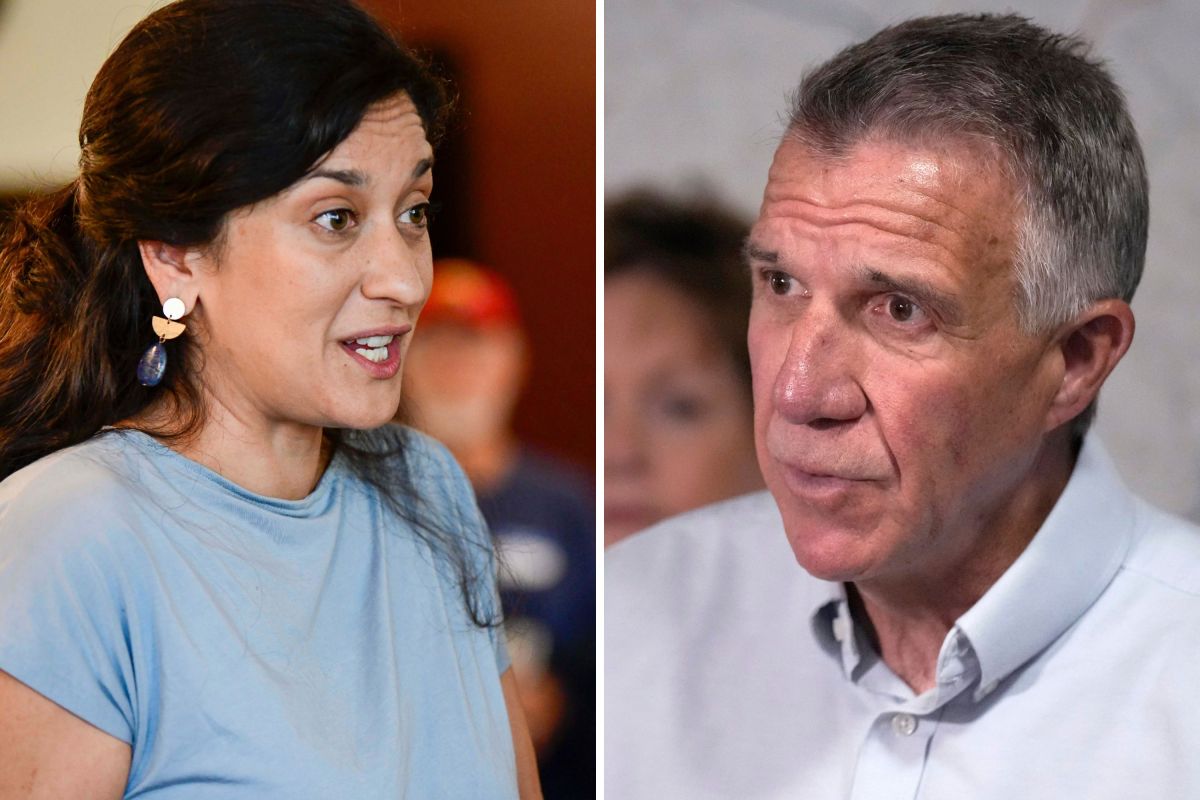
For most governors who have topped popularity rankings for more than three years, reelection would look like a safe bet. But for Vermont Governor Phil Scott, holding on to his seat is becoming more difficult, according to a new poll.
A new University of New Hampshire Green Mountain State Poll, released Thursday, found the Republican governor trailing Democrat Amanda Janoo by 6 percentage points. Janoo had 49 percent support among likely voters to 43 percent for Scott.
“Democratic nominee for Governor Amanda Janoo has increased her support significantly since winning the Democratic primary last month and is now in a statistical tie with Republican incumbent Phil Scott. Scott’s job approval rating has been declining in recent months,” the survey’s press release said.
The poll surveyed 882 Vermont residents online September 17-21, including 835 likely general election voters. The margin of error for likely voters is plus or minus 3.4 percentage points.
Newsweek reached out to both campaigns for comment on Friday.
Scott has comfortably navigated politics in what is considered a deep-blue state, winning reelection in recent years and consistently ranking among the nation’s most popular governors. But the outcome of the Democratic primary has become his biggest challenge yet to retain the seat.
“For Scott to be able to survive, he certainly has a bit of a hill to climb,” said Sean McKinley, University of New Hampshire (UNH) Survey Center project director.
The partisan breakdown shows where Scott's support has shifted. He wins 89 percent of Republicans and 53 percent of independents, but among Democrats, only 20 percent back him, while 73 percent support Janoo.
In Vermont, trade appears to be one factor. The poll was conducted after President Donald Trump's trade negotiations with Canada broke down and both countries imposed tariffs. Seventy-one percent of Vermonters disapprove of how Trump has handled the talks, while 77 percent say they are concerned about the impact on the state.
“There are concerns that trade conflict with Canada may disproportionately impact New England,” the poll’s press release reads.
As the November midterm elections approach, partisan divisions are becoming more noticeable. Scott’s approval among Republicans has increased to 77 percent, up from 60 percent in July to its highest level. Among Democrats, however, his approval has dropped to 35 percent, the lowest recorded level.
The Cook Political Report, widely considered the industry standard for nonpartisan race ratings, still rates the Vermont governor’s race as Solid Republican.
“After a massive 52-point victory in 2024, Republican Gov. Phil Scott should easily win another two-year term in 2026,” Cook states.
Sabato’s Crystal Ball, Nate Silver’s Silver Bulletin and Race to the WH also rate the race as Likely Republican.
Earlier rounds of the same poll showed Scott comfortably ahead. In June, he led Janoo 42 percent to 27 percent, with 26 percent undecided. In July, he led 44 percent to 33 percent.
But after Janoo secured the party's nomination, the race shifted. In the August 11 primary, Janoo won 49.1 percent of the vote to 46.6 percent for Aly Richards, the former head of the childcare advocacy group Let’s Grow Kids.
Janoo’s victory helped close the gap with Scott by 17 points in about two months.
Democratic leaders had originally hoped for a more established candidate. The party tried to recruit Attorney General Charity Clark, Secretary of State Sarah Copeland Hanzas and Treasurer Mike Pieciak to take on Scott, but all three decided to seek reelection to their current offices.
The poll sits awkwardly alongside Scott’s national reputation. In Morning Consult’s governor approval tracker, based on surveys of registered voters conducted from October through December 2025, Scott had a 74 percent approval rating.
That made him the most popular governor in the country for the 14th consecutive quarter. Just 19 percent of Vermonters disapproved of his performance in that survey.
But the latest UNH poll offers a more recent snapshot. When asked to compare Scott with his New England counterparts, Vermont voters gave him a lower approval rating than Democratic Massachusetts Governor Maura Healey, Republican New Hampshire Governor Kelly Ayotte and Democratic Connecticut Governor Ned Lamont.
He still ranked ahead of Democratic Maine Governor Janet Mills and well ahead of Democratic Rhode Island Governor Dan McKee.
Scott has kept his distance from Trump. He has opposed the White House on several major issues, including its tariff policies and the deployment of the National Guard to cities across the country. Yet the poll suggests that distance may not be enough for Democrats who are voting against the Republican Party as a whole.
That would be a sharp break from 2024, when Vermonters split their tickets on a large scale. Vice President Kamala Harris carried the state with 63.8 percent of the vote to Trump's 32.3 percent. On the same ballot, Scott won reelection with 73.4 percent to 21.8 percent for Democrat Esther Charlestin. Scott carried every county, including many towns that voted for Harris.
His vote share was about 41 points higher than Trump's.
Trade with Canada, Vermont's largest trading partner and its northern neighbor, is the clearest concern. After Trump's negotiations with Ottawa broke down this month and both countries imposed tariffs, 71 percent of Vermonters said they disapprove of the president's handling of the talks, including 68 percent who strongly disapprove. Only 18 percent approve.
Crime linked to drug use is another concern. The poll asked about a proposed safe injection site in Burlington, and 45 percent of residents said such sites increase crime in nearby areas. Only 12 percent said they reduce it. Sixty-two percent doubt the sites do much to cut drug use, even though a majority believe they help prevent overdose deaths.
Cost pressures appear throughout the poll. Seventy-eight percent of residents support taxing homes that are not their owners' primary residence, a proposal lawmakers are reportedly discussing as housing prices squeeze year-round residents. Voters are more divided on how to control education costs: 49 percent support Scott's plan to consolidate school districts and possibly close schools, while 39 percent oppose it.
Those concerns tend to divide along party lines, which is a problem for Scott. The worries Democrats voice most, especially trade, are tied to Trump and the national Republican Party.
The Vermont results line up with a broader shift toward Democrats six weeks before the midterms. An Emerson College national poll conducted September 21-22 found Democrats leading Republicans 53 percent to 42 percent on the generic congressional ballot.
An NPR/PBS News/Marist poll found Democrats ahead 53 percent to 41 percent, with Trump's approval at 39 percent and his disapproval at 53 percent. Pollster Nate Silver's generic ballot average had Democrats up 8.1 points, the party's best position of the cycle.
The same pattern shows up further down the ballot. Former Lieutenant Governor Molly Gray, a Democrat, leads Republican Lieutenant Governor John Rodgers 54 percent to 35 percent. Democratic Representative Becca Balint leads Republican Gerald Malloy 66 percent to 30 percent for the state's at-large House seat.
Contact Newsweek editors on this story: Jason Lemon and Dave Siminoff.