Amy Sherald Would Rather Walk Away Than Water Down Her Art - Time Magazine
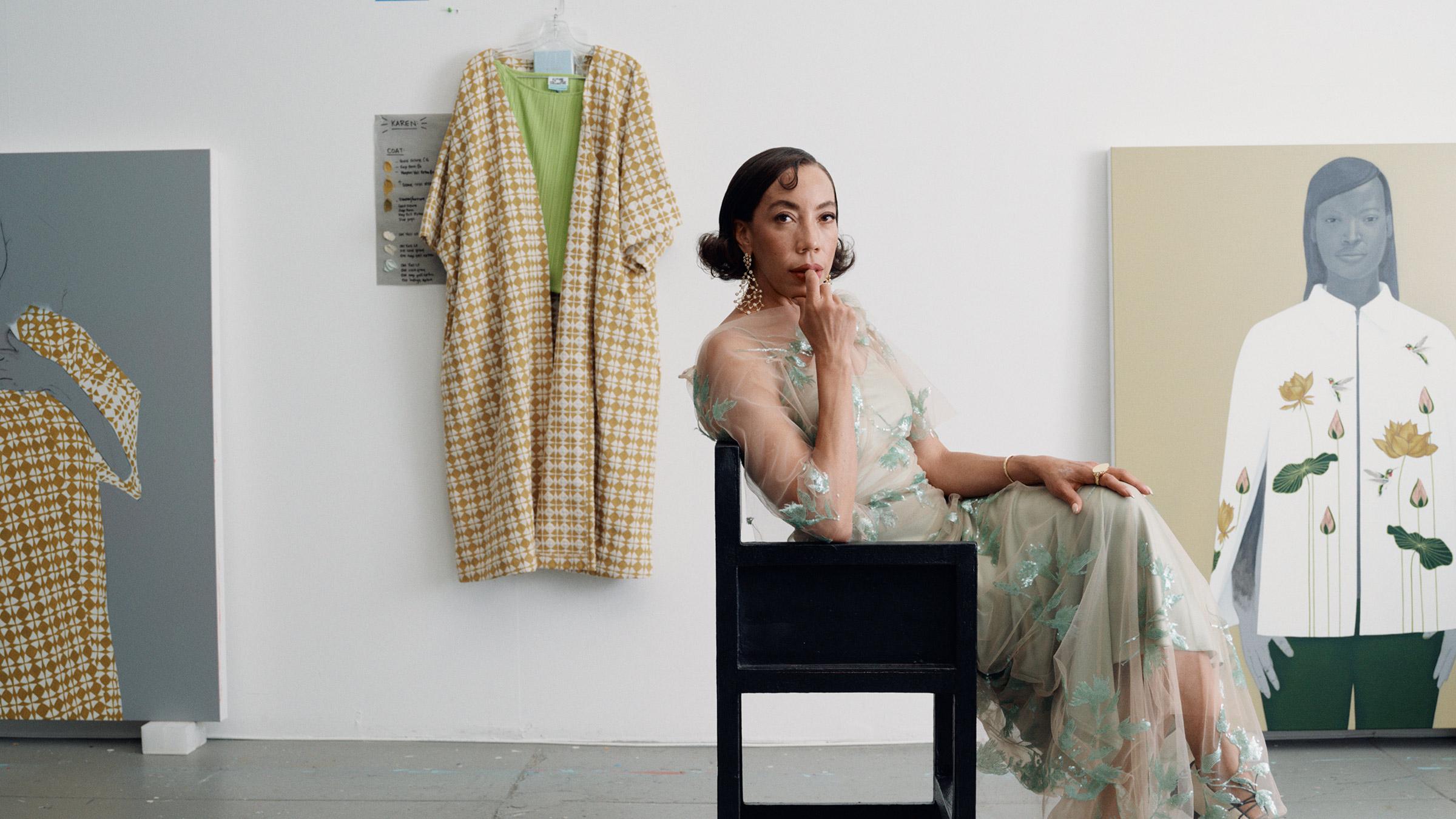
Nobody knows in advance the moment that will change everything, but some of Amy Sherald’s friends sensed something was up. The artist had been called to meet Barack and Michelle Obama as they decided who would paint their official portraits. Her best friend’s mother insisted on taking her to MaxMara and buying her a taupe sheath and kitten heels. When she walked into the Oval Office, both the President and the First Lady were wearing the same color. The President quipped that she must have gotten the memo. Sherald did not get the joke. But she did get the job that changed her life: the portrait of Michelle Obama that is the highlight of “American Sublime,” the blockbuster show of Sherald’s work that is just finishing an almost two-year, four-museum national tour.
Color has always been important to Sherald, as anyone with even a brief acquaintance with her paintings can tell. She paints all her canvases red before she paints them gray. “I think color lives whether you can see it or not,” she says in her Jersey City, N.J., studio, a few feet from a giant pegboard filled with hundreds of paint tubes held up by bulldog clips. “So I consider the red kind of like the blood behind the figures there.” Maybe that’s why, even though she paints everyone in gray tones, Sherald’s people pulse with life. Sometimes they float off dirt bikes, or balance on tractors, or hold a doll or a baby or an outsize teacup, but mostly they command attention, looking evenly at the viewer, wearing bright clothes in front of a vivid background. “Color is my natural language,” says Sherald, 53. “Using my voice is only the third best way that I communicate.”
Her inspirations for the color and the composition of her work come from paintings, she says. But the subject matter is mostly inspired by photography, because that is what she grew up seeing, in family portraits and encyclopedias. Once she finds a subject, she photographs them in an outfit she has preselected. Often the clothing is the starting point. (She’s in the early stages of a work inspired by a vintage Girl Scouts uniform.) Despite her most famous painting, she doesn’t call herself a portraitist. “Once I take the photograph, the model just becomes a character in the world that I'm trying to create,” she says. “This is now a part of this greater picture and this greater story.”
Successful artists are the product of their gifts, but as Sherald proves, they are also products of what they lacked. Sherald grew up in a home that followed the teachings of the Worldwide Church of God, which did not celebrate, among other things, birthdays, Halloween, movies, most dancing, and TV. Her home kept a Sabbath on Saturdays. Not that Sherald minded. “For me as a child who was self-conscious and introverted, I would choose to stay in and draw rather than go outside,” she says. “It was like a safe way to play that was not with other people.” Her father, a dentist, was diagnosed with Parkinson's when she was 7. She would often just sit with him. “When you have a parent that doesn't communicate well and they're also going through something they want to hide from you, it kind of opens up another way of learning about emotion and communication.”
Famously, it was on a school trip that Sherald saw Bo Bartlett’s painting Object Permanence, centered on a Black man in a tool belt, which inspired her to depict Black people as she saw them. “It was just about looking. Looking back at our history and painting the things that I didn't see,” she says. “Art history tells me that I'm elevating my people, but I'm not. That's just the story that's projected onto my storytelling. They're already there.” She and Bartlett are now friends.
Recognition for Sherald’s work came slowly, then all at once. Just before she had her heart transplant, at 39, after she stopped waitressing to look after her brother, she sold a painting for $3,000. Her friends set up a GoFundMe page for her medical costs. “I'm sure some people were like, ‘Poor Amy, she wants to be an artist,’” she says. “‘She's still working at this restaurant, like it's obvious it's not gonna happen.’” In 2019, a year after the Obama portrait was unveiled, her work Innocent You, Innocent Me sold for $350,000 at Christie’s. A mere 18 months later, The Bathers netted $4.26 million at auction. She found the sudden uptick in wealth and fame difficult. “People don't think you've earned it,” she says. “And there's pressure to do more because you have this success.”
The heart transplant has made Sherald, who has books about overcoming anxiety in her office, even more cautious. She wanted to take up cycling but realized a fall could hurt her hand. She no longer rides roller coasters. She lost her father when she was 27 and brother to lung cancer when he was 38. Her sister also recently had a heart transplant. But if those health crises have made her wary, they did not make her scared. In 2025, after officials at the Smithsonian's National Portrait Gallery, the same institution that commissioned the Obama portrait, got skittish about exhibiting her painting Trans Forming Liberty, which features a trans woman, she pulled the show. “‘American Sublime’ has its own narrative,” she says. “Deviating from that narrative would be deviating from the core person of who I am and why the work exists in the world, and I just wasn't willing to do that.” The exhibition was snapped up by the Baltimore Museum of Art, where it broke attendance records.
Sherald, to quote the old gospel song, wouldn’t take nothing for her journey now. “There's only one person I've ever been envious of in my life, and that was Oprah Winfrey when she was giving away cars to people,” she says. “I want to be able to do that. I want someone to give me enough money that I can set up a big foundation where there's rolling grants for artists for medical care, for housing, for studios. Because that's all we need to become who we want to be: time and money.” In the meantime, she’s delighted by the life she has been given. “I think,” she says, “art definitely chose me.”
Set by Nicole Roosien; Hair by Nikki Nelms at The Only Agency; Makeup by Joseph Carrillo; Styling: Law Roach at The Only Agency; Cover look: Bora Aksu; Studio environmental: Erdem; Blue background: JW Anderson; Videos: Roksanda dress, Alexis Bittar jewels.