“An Improbable Combination”: Why Some 2022 Macron Voters Are Preparing to Vote Le Pen in 2027 - Le Figaro
Pour sauvegarder un article vous devez être connecté, vous pourrez ainsi les consulter sur tous vos appareils.
Nine years after promising to curb extremism, the French president is seeing a portion of his base shift to the far-right Rassemblement National.
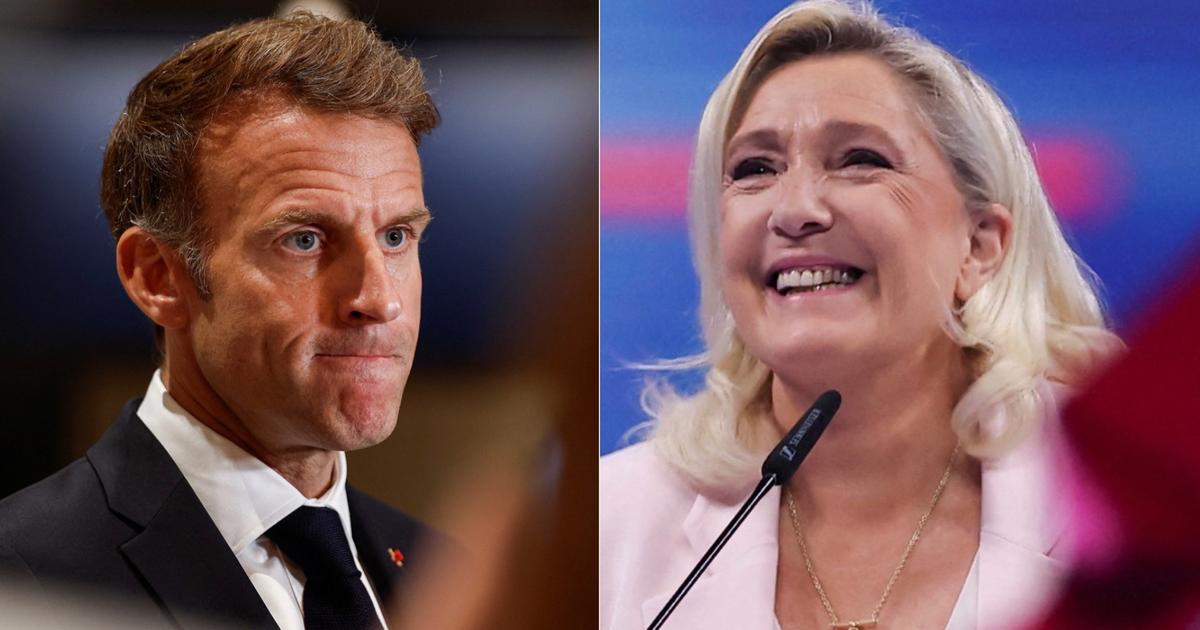
The phenomenon is not widespread, but it is by no means anecdotal. Five and a half months ahead of the French presidential election, several polls reveal an unprecedented shift: A portion of voters who chose President Emmanuel Macron in 2022 plan to choose far-right Rassemblement National (RN) candidate Marine Le Pen in the first round of the 2027 election. Such a trend would have been almost unimaginable just a few years ago among the two voting blocs, which faced off in the last two runoffs and which are “by definition, highly antagonistic,” said Frédéric Dabi, managing director of Ifop’s opinion department. In his view, this is a sign that once rigid political boundaries have become “fluid,” in a political landscape that has been evolving since Macron’s 2017 election and the weakening of the left-right divide.
“On paper, it is a completely improbable combination,” said Bruno Cautrès, a CNRS researcher at the Center for Political Research at Sciences Po (CEVIPOF). And yet, three recent polls confirm the trend. Between 16% and 19% of 2022 Macron voters would support Le Pen, according to the latest Ifop-Fiducial poll (for LCI, Le Figaro and Sud Radio). The figure ranges from 12% to 15% in the Toluna Harris Interactive poll (M6, RTL) and from 11% to 14% in the Ipsos BVA poll (Le Parisien, Cesi).
In concrete terms, based on the highest estimate, approximately 4 to 5 percentage points of the 27.8% Macron obtained in the first round of the 2022 presidential election could go to the RN five years later. In a memo, Jean-Daniel Lévy, deputy director of Toluna Harris Interactive, noted that these voters are not decisive in Le Pen’s core voter base, which is now projected to exceed 30%, well above the 23.15% she received in the first round in 2022. But this support, which has risen sharply since spring, is one factor enabling her to cross the symbolic 30% threshold.
This trend was identified early on by several political scientists, including Antoine Bristielle, director of the Jean Jaurès Foundation’s Opinion Observatory. In a study published in May, he noted that because Macron — in his second five-year term as president — could not run for re-election, his electorate would fragment. In fact, only 35% of his 2022 voters remained loyal to the centrist bloc, while 27% were already “tempted by the right.” Among the latter group, the average likelihood of voting for the RN reached 6.7 out of 10, higher than for Horizons (5.7) or Renaissance (5.5). “The shift is clear,” Bristielle noted. “Macron had managed to rally very different voter groups — from the center-left to the traditional right — around his name. Without him, sustaining this legacy is much more complicated.”
Who, exactly, are these defectors? Not disillusioned voters from the left but rather right-wing voters, most of whom have been loyal to Macron for the past nine years. According to the Toluna Harris Interactive report, they are distinguished less by age — averaging in their 50s — than by social status (lower education and income levels) and geographic location (the shift to the RN is twice as common in the northeast as in the Paris region). These voters — some of whom supported right-wing Les Républicains (LR) candidates François Fillon in 2017 and Valérie Pécresse in 2022 — are, as a result, “following the country’s shift to the right,” Dabi noted. The trend, he said, is accentuated by the “problem with LR’s positioning” and by Le Pen’s momentum.
The RN candidate “has broadened her base across all segments of the electorate,” Cautrès said.
Why are they switching sides? The shift is occurring “primarily on social issues,” Bristielle said. Immigration and security top the list — two themes reignited by the violence of October 17. “Ideologically, these issues loom larger in their minds than in the past,” Lévy said. The need for protection that had led them to Macron is now driving them elsewhere, even though they remain liberal on economic issues. Beyond these underlying motivations, the RN is also benefiting from its normalization. Thanks to a strategy of “dédiabolisation,” or “de-demonization,” Le Pen has acquired “presidential attributes that she lacked a few years ago,” Lévy said, to the point that “for these voters, voting for her has become a change in government like any other.”
She has managed to “reposition her party toward a more responsible right,” said Luc Rouban, CNRS research director emeritus.
She has also embraced the original promise of Macronism: “Who today proposes to move beyond the right and the left? Marine Le Pen, perceived as the best-positioned to break with the existing order,” Bristielle said.
The last driving force, and by no means the least, is the rejection of the far-left La France Insoumise (LFI). “These voters are no longer waiting for the second round to prevent Jean-Luc Mélenchon from being elected,” Lévy said.
For Dabi, it is “one of the strongest drivers of the campaign.” That reflex could turn into a “vote of elimination” in a Le Pen-Mélenchon runoff, with Ifop estimating that the RN candidate would garner 73% of voting intentions among former Macron voters. Even against the moderate left, the dam is partially breaking: Le Pen would win over 33% of these voters against former Socialist President François Hollande, and 29% against center-left candidate Raphaël Glucksmann.
It is hard to see these shifts in support as anything other than a rejection of Macron — the ultimate irony for someone who, backed each time by a strong “tactical vote,” positioned himself as a bulwark against Le Pen’s party in both 2017 and 2022, and promised, on the night of his first victory, to do everything in his power to ensure that the French people would “never have reason again to vote for extremes.”
“It is a failure,” Lévy said. The blow is all the harsher as the hemorrhage is affecting his own base. “Seeing part of his core base defect to Le Pen is even more cruel” than the prospect of handing the Élysée over to her, Cautrès said.
Taking a stronger stance, Rouban sees the failure of the Macronist gamble: By seeking to transcend the left-right divide, the president has “erased the center” and polarized society.
The centrist bloc risks bearing the brunt of this exodus toward the RN, starting with Édouard Philippe — former prime minister to Macron and current mayor of Le Havre — who is now struggling. Predicted to be eliminated in the first round in all scenarios, the center-right Horizons candidate finds himself caught in “a vicious cycle,” where “the more his voting intentions drop, the less he appears to be the natural candidate to unite the center,” Bristielle said.
Yet the race remains wide open, Dabi said, as centrist voters are still searching for a figure capable of sparing them a “deadly” second round between LFI and the RN. Once that figure is found, “the tactical vote could be massive” and reshuffle the deck.