An oral history of the Ramones' legendary Toronto debut 50 years ago - Toronto Star
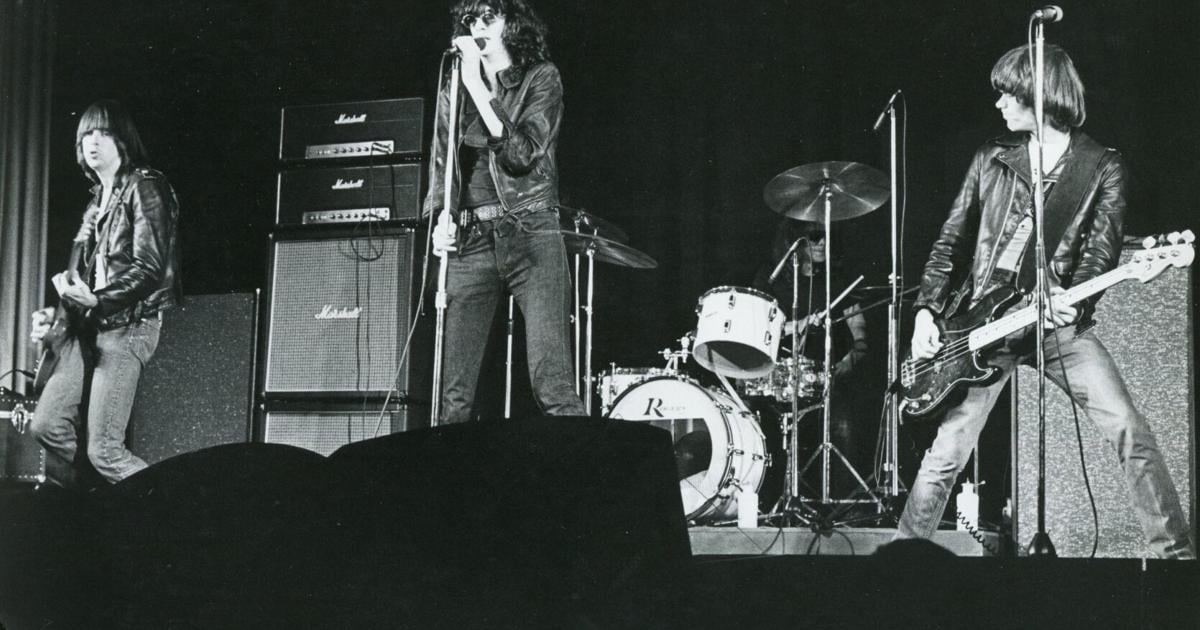
The New Yorker Theatre on Yonge Street hosted the New York City punk rockers, whose fiery performances inspired a new generation of musicians in the city.
The Ramones — Johnny, Joey, Tommy and Dee Dee — perform at Yonge Street’s New Yorker Theatre on Sept. 25, 1976.
The Ramones — four guys from Queens, N.Y., in ripped jeans and motorcycle jackets — stripped rock ’n’ roll down to its core.
The Ramones’ debut album was released in April 1976, five months before their first Canadian shows in Toronto.
On their self-titled debut album, released in April 1976, guitarist Johnny, singer Joey, bassist Dee Dee and drummer Tommy fired off short, fast, three-chord blasts such as “Blitzkrieg Bop,” “Beat on the Brat” and “Judy Is a Punk,” making them central to the punk scene emerging from the dingy club CBGB on Manhattan’s notorious Bowery.
Everywhere they went, they detonated like a cultural neutron bomb, with new music rising from the fallout. London, England, felt the blast in July 1976. Toronto was next.
Fifty years ago, on Sept. 24 and 25, 1976, the Ramones played three thunderous shows at the 562-seat New Yorker Theatre on Yonge Street — two on Friday, then a sold-out midnight set on Saturday. It gave a restless generation permission to make noise and launched Gary Topp and Gary Cormier as the Garys, the fearless concert-promoting duo who would redraw Toronto’s live-music map.
A 1976 New Yorker Theatre ad in the Toronto Star touts the Ramones concerts.
The distorted shock travelled from Yonge Street into basements, bars and bedrooms across the city. Bands formed. Old rules suddenly looked ridiculous. What followed would transform Toronto — and send ripples across Canada — but its origin story remains gloriously intimate: a darkened theatre, a deafening band and a roomful of converts who would never be the same.
This is how the weekend unfolded, as told by those who made it happen and those who witnessed it: impresarios Gary Topp, Jeff Silverman and Gary Cormier, who ran the New Yorker; filmmaker, TV producer and New Yorker manager Colin Brunton; illustrator John Pearson; musician, photographer and author Don Pyle; illustrator Al Runt; record seller Randy Johnston; Cynthia Ross, poet and co-founder of the Toronto punk band the ‘B’ Girls; Ramones tour manager Monte A. Melnick; and Mickey Leigh, Joey’s younger brother, Ramones roadie and musician; with archival appearances by Toronto Star music critic Peter Goddard and Ramones manager Danny Fields.
Gary Topp: For years the New Yorker was the leading art house in Toronto. Bennet Fode brought in foreign films. Fellini, Godard. “Easy Rider” — nobody wanted to distribute that film, but he did it, and it ran forever. It was the place to go to see movies that you couldn’t see anywhere else. But by the mid-’70s, it was dying.
Jeff Silverman: At that point he was playing a lot of soft-core porn. It was like that all over Yonge Street.
Topp: In 1975 Jeff and I decided to rent the New Yorker. I continued the same movie policy as (we’d had at) the Roxy, but the access to films was getting tougher.
Silverman: Gary had done this Marx Brothers festival, and it was really successful. We wanted to do it at the New Yorker but the studio wouldn’t book them. The Uptown, the big theatre across the street, had a lock on the films because (exhibitor Famous Players) didn’t want us to play them.
Topp: I wanted to start booking shows. I was sitting at the back of the theatre. We had watched “The Blank Generation,” Amos Poe’s film about CBGB, and I thought: I should build a stage and bring these bands to town.
The New Yorker box office sells $5.50 tickets for the Saturday gig.
Gary Cormier: Gary brought me into the theatre and showed me the stage. It was this big massive concrete structure that weighed as much as the building.
Topp: David Bluestein was the big booking agent in Toronto. Bluestein told me everything I needed to know about upgrading the venue and running shows. Then he said, “Who do you want?” He hadn’t heard of the Ramones.
Silverman: Booking a band was a lot more stressful than booking a movie.
Topp: Five thousand dollars for three shows. I’d never spent that kind of money before.
Monte A. Melnick: It was unusual for (the band) to play two shows on the same day. I guess that’s the way Gary booked it.
Cormier: My sister-in-law was (filmmaker) Mary Harron, who was doing Punk magazine in New York, so I’d already heard of the Ramones. Gary was looking at music the same way I did. It was our first collaboration.
Topp: John Pearson had done the posters at the Roxy. I asked him to design one for this show and he came up with the smashed sunglasses.
John Pearson: I got the idea when I was sitting in the box office. I had a pair of Ray-Ban sunglasses that my dad gave me. They were in my pocket, and I accidentally smashed one of the lenses.
An autographed poster for the New Yorker shows from Gary Topp’s collection.
Colin Brunton: I remember putting the poster up in the doors of the New Yorker. No sooner did (future Viletones lead singer) Stephen Leckie walk by and say, “I knew you guys would book them.” Like, very happy. So there was a real sense of excitement.
Don Pyle: I had only seen them in the pages of Rock Scene magazine. When their first album came out, I was in a record shop on Yonge Street, and something came on the PA. I remember getting goosebumps and knowing instantly: this is the Ramones.
Mickey Leigh: Me and Monte drove up the day before the show, we stopped at Niagara Falls. We had everything in a van with a trailer.
Melnick: At the time the Ramones were only playing clubs. This was a big theatre — they really weren’t used to that.
Brunton: On the Friday, I was there from 11 a.m. until after the last show. We started off the day with a three-paper hash-oil joint. Their truck came in from New York. We had cleaned up the furnace room to be a green room for the show.
Topp: I was f—king nervous that day. This was feeling like the start of a new career. I really didn’t have that much experience.
Don Pyle saved his ticket stub from the Friday shows.
Danny Fields (from Melody Maker, Oct. 23, 1976): Toronto is fabulous, big, clean, modern and everyone is young, well-dressed and nice. Especially nice are the people at the New Yorker Theatre, which is virtually inaugurating its rock policy with the Ramones.
Al Runt: I worked at the snack bar at the three shows. They hung out in the green room, but I was a kid — I was only 14 — and was intimidated. Dee Dee seemed to be the most boisterous of the bunch.
Leigh: I found an old usher uniform in the basement and I tried it on. It fit perfectly, I guess whoever wore it last had really long arms. Gary (Topp) gave it to me and I kept it for years. I wore it at shows with my own band.
Randy Johnston: I was working at the Records on Wheels just down the street and they came in on the Friday before their sound check. They didn’t linger. I think they wanted to see if their album was there.
Cynthia Ross: I’d been going to New York for some time, so I was friends with them. We mostly walked around the city. We went to Yorkville. Toronto seemed so clean to them, but they were excited to play that night.
Pyle: I saw the four of them walking down Yonge Street. My first feeling was like, Oh my god, it’s them! And they’re so unusual looking. One’s really tall, one’s really short. Dee Dee has sort of a stunned, but animated expression, very cartoonish. I asked them to sign my album. They barely acknowledged me; it seemed like Tommy was angry about something. They passed it to each other. Joey’s pen wasn’t working, so he took out a magic marker and traced over his signature very carefully.
Topp: Johnny Lovesin and his Invisible Band opened the show. I don’t think people understood why we booked him then, but he came in like this cocky solo act wanting to open for the Ramones.
Pyle: I thought he was terrible. It was not what I wanted to see or hear from this show. There were two wooden boxes on either side of the stage, and for his finale, two people slowly pushed up these Jimi Hendrix posters. Jimi Hendrix was already old to me when I was 14, you know?
Topp: In between acts we played movie trailers: Russ Meyer, “Texas Chain Saw Massacre.”
Pyle: Then the Ramones got on stage.
Brunton: They played every song so fast, you didn’t have time to breathe. It was like being on a train track and the train is a foot from your face and about to run you over.
Topp: It was like walking through the midway at the Ex.
Pyle: Everyone looked stunned. I took some photos. My friend Roger shot some footage with an 8 mm camera but it was so dark in the theatre. (The staff) said people could stay for the second show. Roger and I stayed. They played “California Sun” twice.
Leigh: It’s probably why I don’t think of it as two shows. It felt like two sets.
Pyle: Cynthia and the other women who started the B-Girls were some of the people that I do remember being there. I had seen them at other shows. I liked that they were really fabulously dressed, and that they were always going backstage.
The ‘B’ Girls — Marcy Saddy, Cynthia Ross, Lucasta Ross and Xenia Holiday — were one of many Toronto bands the Ramones inspired.
Topp: The Friday shows were at 50 per cent capacity, the midnight show on Saturday completely sold out. Word had gotten out.
Johnston: (On Saturday) I ran out of the theatre and threw up onto Yonge Street because it was just shaking me up physically.
Peter Goddard (from Toronto Star review, Sept. 27, 1976): It was too perfect, the four-count before each tune, the mindlessly simple crunch and roar of the music. … This quartet became something of a joke, not because they so obviously believed in their rather silly little tunes, but because the New Yorker audience felt there was a larger audience out there that would believe in them, too.
Ross: Seeing bands like the Ramones, and then bands in Toronto that were starting, like the Diodes, Viletones, the Ugly, Teenage Head from Hamilton, the Demics from London — people who couldn’t really play their instruments — were the main inspiration for me saying, “Why are we watching these guys who can’t play? We should start our own band.”
Teenage Head vocalist Frankie Venom, far right in Ramones shirt, with Jack Pedler, Gord Lewis and Steve Marshall.
Pyle: After we figured out how we were getting home that night, we talked about how we had to start a band. And a few months later, there were bands where there weren’t bands before. It really set the fire for people and inspired this new thing of opening up spaces in sh—ty basements or bars that were really run down. Not classy places.
Brunton: My friend and I were invited to the Chelsea Hotel after the show, where they were staying, but the party didn’t actually happen. I ended up just talking to their manager, Danny Fields. Talk about rock ’n’ roll royalty — he invited me to have breakfast with the Ramones the next morning. Danny took my picture with them in front of the hotel. I remember him saying, “Don’t smile.” The seed for my filmmaking career was planted at the Roxy, but that weekend proved to me that I could jump off a cliff and make it happen.
Topp: I interviewed Thelonious Monk when I was in high school. He said, “The only cats who are worth anything are those who take chances.” That sums up what the Ramones ended up proving that weekend.
Brunton: Later on, I started driving cabs. I picked up Joey, Johnny, Dee Dee and a couple girlfriends — they somehow all fit in the back of my cab. (Their) movie “Rock ’n’ Roll High School” had just come out. They wanted to go to a 7-Eleven and get a bag of chips. We only had one 7-Eleven in Toronto at the time, at the southeast corner of Coxwell and Gerrard, and they insisted on going there. So Joey gets out and goes in; he’s so tall, you could see that tall Joey Ramone head bouncing behind the aisles. Eventually it dawned on all the punks that the Ramones were at the 7-Eleven.
Topp: I gave Dee Dee a New Yorker T-shirt, which he wore on the cover of “Leave Home,” their second album. I thought that was a nice gesture.
Gary Cormier and Gary Topp with an autographed Ramones poster in 1988.
Pyle: In 1987, (my band) Shadowy Men on a Shadowy Planet opened for the Ramones and Gary Topp introduced us. Johnny was really chatty. We talked a little bit about baseball and music, and he knew who we were, which really surprised me. He said he liked us but had to go backstage, apologizing he couldn’t get to see us. It was very exciting that one of the Ramones liked our music.
Topp: Years later I took Joey Ramone to a Blue Jays game. Walking down the aisle with our hot dogs, not one person noticed who he was. At one point in the game, they played “Blitzkrieg Bop.” He liked that.
Eric Veillette is a Toronto-based journalist and author of the forthcoming book “In the Dark: A History of Moviegoing in Toronto” (ECW Press).