ANC, IEC battle another stress test for SA's electoral democracy - IOL
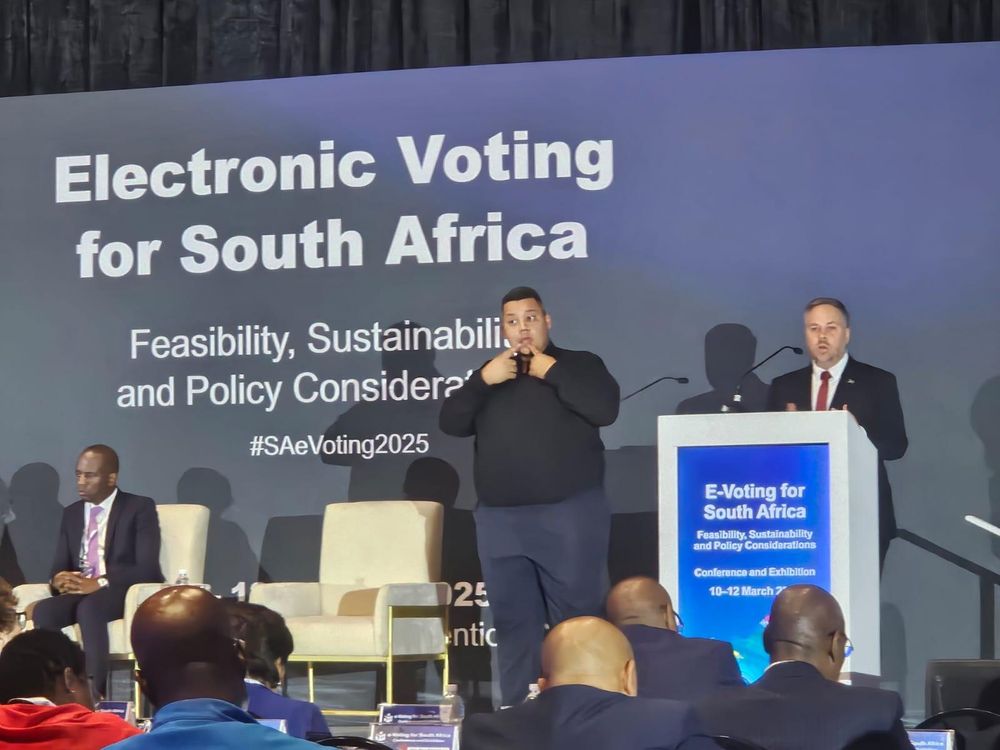
Home Affairs Minister, Dr Leon Schreiber delivering the keynote address at the launch of the Electoral Commission of South Africa (IEC) Green Paper on E-Voting held in Cape Town on March 10, 2025. As democratic processes become increasingly digital, we will need to keep thinking about whether the systems we build make participation easier, clearer, and more trustworthy, says the writer.
Democracy is ultimately a choice. Citizens choose representatives, political parties present candidates, electoral institutions administer the contest, and courts safeguard the constitutional and legal framework within which that contest takes place.
When these different parts work together, democracy acquires both legitimacy and meaning. The current Electoral Court matter involving the African National Congress and the Electoral Commission of South Africa (IEC) brings these relationships into sharp focus.
Because the matter is before the Court, its merits should properly be argued there. Public commentary should resist the temptation to conduct a parallel trial through headlines, political platforms or social media.
There is, however, a broader democratic conversation worth having.
South Africa is approaching another important local government election. More than three decades into our constitutional democracy, we should ask not only whether our electoral institutions are functioning, but also how they continue to evolve as society, technology, and political participation change.
Electoral administration cannot be understood merely as paperwork. Behind every nomination is a candidate, behind every candidate is a constituency, and behind every constituency are citizens seeking to exercise political choice.
The administrative machinery of an election therefore serves a purpose beyond processing information. It exists to make democratic participation possible while protecting the contest's integrity.
When democracy becomes digital, technology is becoming inseparable from modern governance. We register for public services online, submit information electronically and increasingly interact with public institutions through digital platforms. Electoral administration is inevitably part of this transformation.
Technology can make democratic administration faster, more efficient and more accessible. It can strengthen record-keeping, improve transparency and help institutions manage extraordinarily complex electoral processes. But digitisation also demands careful thought about design, accessibility and public confidence.
Technology should facilitate the exercise of democratic rights rather than create unnecessary distance between citizens and the institutions established to serve them. Put differently, technology must remain a tool of democracy. It should never become its gatekeeper. That principle extends far beyond South Africa.
Democracies worldwide are confronting questions about how technology interacts with established laws, institutions, and political rights. The challenge is not to resist technological change. It is to ensure that innovation remains anchored in constitutional purpose. Rules and participation must coexist.
This is why electoral administration requires a careful balance. Rules matter. Deadlines matter. Consistency matters. Political parties and candidates must understand and comply with electoral requirements. Without predictable rules, an election cannot command confidence.
Political organisations must therefore accept that administrative competence is part of democratic responsibility. At the same time, participation matters. Accessibility matters. Political choice matters.
An electoral system derives its legitimacy not only from the rules it enforces, but also from public confidence that those rules are administered consistently, fairly and transparently. These principles should not be pitted against one another. Strong democracies need both administrative certainty and meaningful political participation.
The Electoral Commission occupies a particularly important place in that architecture. South Africans have entrusted it with administering one of the most consequential acts in a democracy: the peaceful expression of political choice through elections. Its institutional credibility is therefore an important democratic asset and should be treated as such.
Respect for institutions also means respecting the constitutional mechanisms available when disagreements arise. Courts are not evidence that democracy has failed. They are part of the architecture through which a democracy manages disagreement.
A political party approaching a competent court for clarity on an electoral question is therefore participating in a constitutional process. The Commission is equally entitled to place its position before the Court. The judiciary must then determine the matter independently and without political pressure. That is how institutional democracy should work.
The ANC has been clear that it is not asking for new names to be added, for candidate lists to be changed or for an extension of the nomination period. It has approached the Electoral Court about information it says was on the Commission's system before the prescribed time. T
he Court must now determine the legal significance of those circumstances. Importantly, the principle of equal treatment must remain central. Electoral law cannot have one meaning for a large political party and another for a smaller one.
Whatever legal principle is ultimately established must be capable of consistent application to political parties in materially similar circumstances. That is not simply about political fairness. It is fundamental to confidence in elections.
As the legal process unfolds, political actors should exercise restraint. The Electoral Commission should not become a political opponent. The Court should not become another arena for campaign rhetoric.
Legitimate legal disagreement should not erode confidence in institutions that South Africans will need long after this dispute has passed. There will be time after the legal process for a broader conversation about what we can learn. That discussion should include political parties, electoral administrators, legislators, technology specialists and citizens.
As democratic processes become increasingly digital, we will need to keep thinking about whether the systems we build make participation easier, clearer, and more trustworthy.
This is not an argument for weaker electoral rules. It is an argument for stronger democratic administration. For now, the appropriate course is straightforward. Let the Electoral Commission perform its constitutional responsibilities. Let political parties exercise their rights within the law. Let the Electoral Court consider the matter independently. And when the Court has spoken, let its decision be respected.
South Africa's democracy has never depended on the absence of disagreement. Its strength has depended on our ability to resolve disagreement within a constitutional framework. This moment may illuminate the most important principle.
Electoral administration must provide certainty while enabling participation. Technology must strengthen democratic institutions rather than overshadow their purpose. Political competition must remain vigorous without diminishing respect for institutions.
Above all, the machinery of an election must continue to serve the citizen. Electoral administration must bridge people and their democratic choices, not block them.
* Lobe is a South African diplomat, published author of five books, as well as a contributing author to Women Before Us. She writes in her personal capacity.
** The views expressed do not necessarily reflect the views of the National Media Group.