Andrew Phillips: Carney’s handshake with Europe and the end of the ‘American age’ - Toronto Star
Countries around the world ARE taking their distance from the United States, making new alliances where they can, reducing their dependence on a superpower that is unreliable at best, hostile at worst. Canada and Europe are obvious.
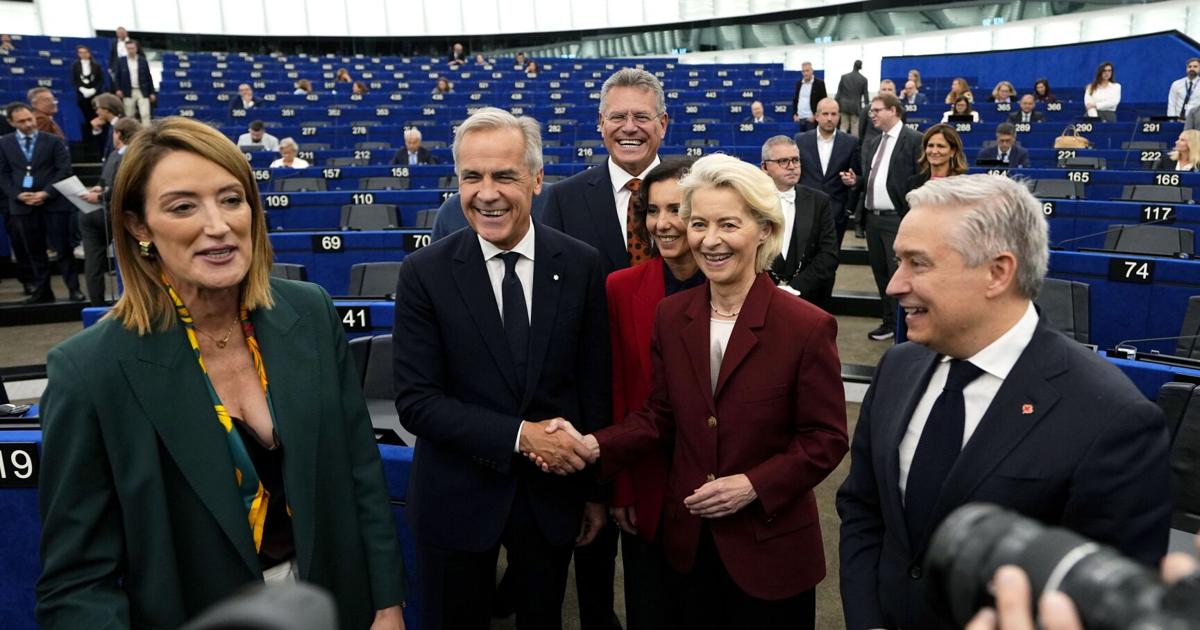
Prime Minister Mark Carney shakes hands with European Commission President Ursula von der Leyen as President of the European Parliament Roberta Metsola, left, and Canadian Minister of Finance and National Revenue Francois-Philippe Champagne look on, as he arrives to address the European Parliament in Strasbourg, France, on Thursday.
Andrew Phillips is a Toronto-based staff columnist for the Star’s Opinion page. Reach him via email: aphillips@thestar.ca
Trust U.S. President Donald Trump to prove Mark Carney’s point even before Carney made it. The prime minister hadn’t yet laid out his vision of greater co-operation with Europe to the European Parliament and Trump was already out trashing the idea as “laughable” and threatening yet more tariffs if he didn’t like the outcome.
A year ago I expect that would have been viewed with alarm. What kind of tariffs? How bad will they be? Can they be avoided? Etcetera, et cetera, ad nauseam.
This time Trump’s threat is a big yawn. More tariffs, you say? Whatever …
However tiresome, Trump’s contempt does underline the wisdom of Canada and Europe moving closer. The point of the exercise from the Canadian point of view, as the prime minister said, is to make this country more resilient “so that no one can control our open markets, impair our sovereignty, threaten our territorial integrity, or undermine our freedoms, our democracies, our rule of law.” For Europe, it’s essentially the same.
A lot of people are twisting themselves out of shape over the words used by European Commission President Ursula von der Leyen in inviting closer co-operation with Canada: “associate member.”
We shouldn’t get hung up on that. The obstacles to EU membership of any sort are so big and so obvious that it’s pretty much a non-starter. What’s much more likely is some form of what Carney laid out on Thursday in Strasbourg: “deep co-operation” with Europe in everything from energy and critical minerals to frontier research and financial services.
If things develop that way, it shouldn’t be seen as a failure because it falls short of Von der Leyen’s giddy enthusiasm for a friends-with-benefits relationship with Carney and Canada. The verdict will depend entirely on the concrete results that come from a closer alliance in the areas Carney mentioned.
Canadians naturally want to know what all this means for them, but let’s not lose sight of the bigger picture of which Carney-in-Strasbourg is just one smallish piece.
Zoom out and what do you see? Countries around the world taking their distance from the United States, making new alliances where they can, reducing their dependence on a superpower that is unreliable at best, hostile at worst.
Canada and Europe are obvious. But look to the Middle East, where the United States has been the unquestioned hegemon for more than half a century. Under Trump it’s now shown it can’t win a war with a third-tier power like Iran and can’t even protect small countries (like Bahrain) that sheltered under its security umbrella.
The result: regional powers are hedging their bets. Saudi Arabia, Turkey and Pakistan have signed their own security pact. In Asia, Trump has put a question mark over the 75-year American alliance with South Korea. Taiwan isn’t sure he would defend it against China.
American dominance is also in question on the economic front, despite Trump’s boast about having the “greatest economy actually ever.”
Financial markets are spooked by the U.S. government’s $40-trillion debt. Nervous investors are pushing yields on U.S. Treasury bonds over 5 per cent, the highest level in two decades.
Some are worried the dominance of the U.S. dollar as the global reserve currency is eroding. Others fear Trump’s use of financial sanctions for political ends makes it riskier to tie themselves into a financial system completely reliant on the dollar. A few countries are moving gold reserves out of the U.S.
The bottom line, according to an analysis in the New York Times this week, is that “the world economy is increasingly looking for ways to distance itself from America.”
Others go further. They’re proclaiming nothing short of the end of the “American age,” the period of almost a century when the United States dominated the so-called “free world” — and after the end of the Cold War the entire world.
No power in history has sustained such dominance forever. The American age was bound to come to an end at some point. What’s striking is that it’s the Americans — specifically Trump — who have accelerated that process.
In light of all this, the mutual embrace between Carney and Europe seems just part of a wider story. It’s the story of a superpower that still has remarkable strength but is in the process of throwing away its advantages, its leader making threats that fewer people take seriously.
No wonder Canada and Europe are holding hands. The only surprise is that it took so long.
Error! Sorry, there was an error processing your request.
There was a problem with the recaptcha. Please try again.
You may unsubscribe at any time. By signing up, you agree to our terms of use and privacy policy. This site is protected by reCAPTCHA and the Google privacy policy and terms of service apply.
Opinion articles are based on the author’s interpretations and judgments of facts, data and events. More details
Andrew Phillips is a Toronto-based staff columnist for the Star’s Opinion page. Reach him via email: aphillips@thestar.ca