Andrew Phillips: In the war with Donald Trump, Mark Carney shifts from defence to offence - Toronto Star
For Carney, the investment summit and Euro reach-out amount to going on the offensive. The government isn’t rushing back to trade talks. It’s charting its own path without flinching at every growl from the White House.
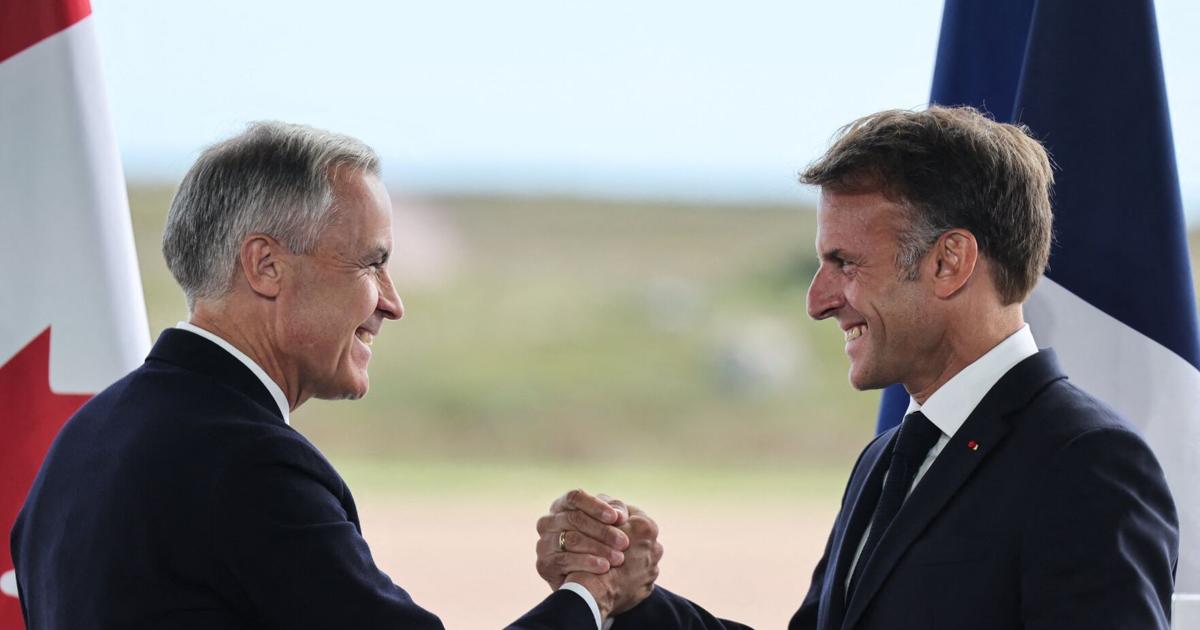
France’s President Emmanuel Macron (R) and Prime Minister Mark Carney (L) at a press conference in Saint-Pierre on Sunday. “For Carney, the investment summit and Euro reach-out amount to going on the offensive,” writes Andrew Phillips.
Andrew Phillips is a Toronto-based staff columnist for the Star’s Opinion page. Reach him via email: aphillips@thestar.ca
We’re in a war of sorts with Donald Trump’s United States, or so the prime minister tells us. So to understand where we are right now I turned to my well-thumbed copy of Carl von Clausewitz’s “Vom Kriege” (On War), the Urtext for people who think about such things.
Clausewitz, a Prussian general, was writing with the Napoleonic campaigns very much in mind, but two centuries later he still has much to say about different kinds of war — and the stages that mark any sort of conflict.
It does feel as though our current trade war reached a turning point of some kind last week, with the mega investment summit that Mark Carney hosted in Toronto and his triumphal trip to Strasbourg to kick off discussions towards some kind of new alliance with the European Union.
With Clausewitz in mind, I suggest the events of last week showed that Canada under Carney is moving from defence to offence in its conflict with Trump. It’s not a sudden break, of course, and the government must practice both forms of warfare depending on how events unfold. But there’s a definite shift in emphasis.
Until now, Canada’s been basically on the defensive, parrying the blows coming from Washington, trying to survive the initial onslaught, playing for time. That’s inevitable given that Trump started the war and the enormous power imbalance between the two countries.
What does Clausewitz tell us about defensive warfare? Quite lot, as it happens (see Book 6 of “On War”).
For one thing, and this is the good news, he makes the point that defence is inherently stronger than offence. It’s easier to preserve what you have than seize something from someone else. If you’re invaded, you know your own terrain better than your opponent and can use it to your advantage. Your supply lines are shorter. And time is on your side; your goal is to absorb the first blows and wait until the attacker expends vital reserves.
In actual war — as a conflict like the one between Ukraine and Russia has shown — public opinion plays a vital role. The defenders’ morale will be higher; others may come to their aid in the face of naked aggression.
All these factors have been very much at play in the first year and a half of the Great Canadian Trade War. The Carney government played defence. It tried to mollify Trump by staying calm and not lashing back at his insults; it addressed issues it could address (like defence spending and the border); when it did try an offensive move (like retaliatory tariffs) it quickly reversed itself.
Mostly, it ragged the puck and waited for negative consequences of the Trump offensive to take their toll in the U.S. itself (especially the cost of tariffs).
The thing about defensive warfare, though, as Clausewitz noted, is that it’s not enough. It’s about preservation, not winning. Therefore, he wrote, “we must only make use of it so long as our weakness compels us to do so.” We must go over to the offensive “as soon as we feel strong enough to aim at the positive object.”
It seems to me the Carney government feels this is the moment to transition to a strategy of less defence and more offence. Trump is weaker at home. His popularity is at a record low; the U.S. midterm elections may well loosen his grip on power; he’s flailing about in the Mideast; the world has grown tired of his endless aggression.
The Europeans are clearly fed up. They don’t have the gumption to stand up publicly to Trump but their open arms to Carney underline the shift in power dynamics. They, as much as the Canadians, want options to counter U.S. hostility.
For Carney, the investment summit and Euro reach-out amount to going on the offensive. The government isn’t rushing back to trade talks. It’s charting its own path without flinching at every growl from the White House. It isn’t about to roll back the latest retaliatory tariffs. Carney is even taking a few potshots at the sensitive president.
This isn’t open warfare of the kind that Clausewitz knew well, for sure. But the Prussian famously wrote that “war is the continuation of politics by other means” — suggesting all forms of contention between nations are driven by similar underlying dynamics.
I don’t know whether Carney has his own copy of “On War” at hand. But judging from how he’s shifting tactics, I wouldn’t be surprised.
Error! Sorry, there was an error processing your request.
There was a problem with the recaptcha. Please try again.
You may unsubscribe at any time. By signing up, you agree to our terms of use and privacy policy. This site is protected by reCAPTCHA and the Google privacy policy and terms of service apply.
Opinion articles are based on the author’s interpretations and judgments of facts, data and events. More details
Andrew Phillips is a Toronto-based staff columnist for the Star’s Opinion page. Reach him via email: aphillips@thestar.ca