Ann-Marie MacDonald returns to the stage in Canadian Stage’s riotous ‘Goodnight Desdemona’ - Toronto Star
‘Heated Rivalry,’ Elbows Up and AI jokes pepper Canadian Stage’s lively Shakespearean revival.
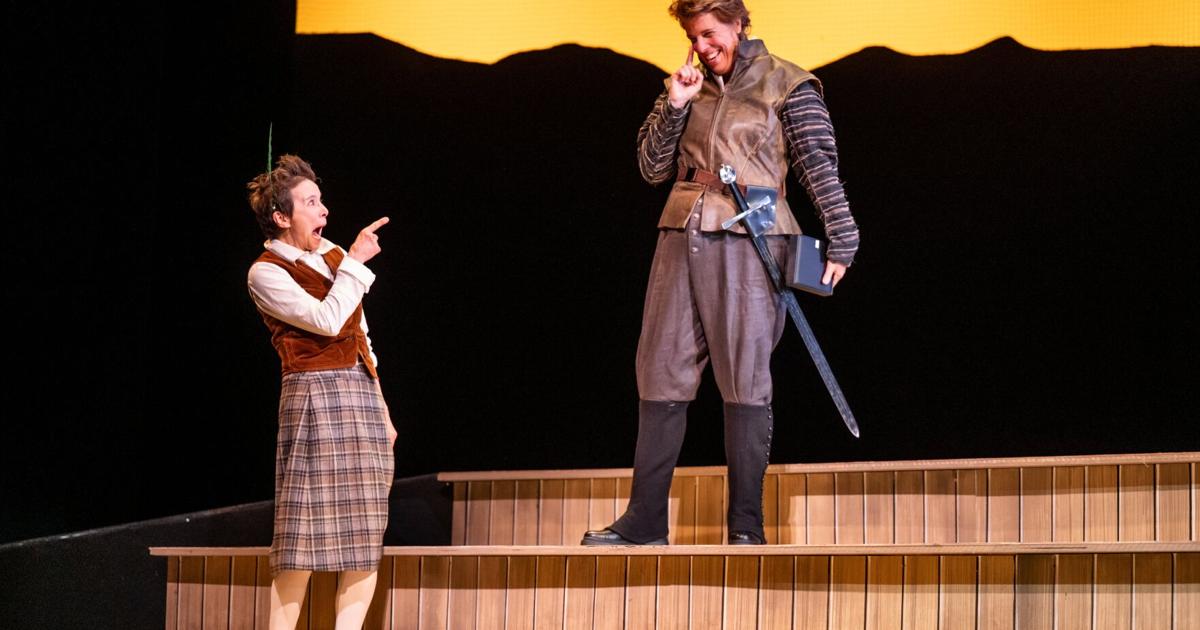
Ann-Marie MacDonald, left, as Constance Ledbelly and Carolyn Taylor as Claude Night in “Goodnight Desdemona (Good Morning Juliet).”
References to “Elbow’s Up,” “Heated Rivalry” and AI hallucinations obviously weren’t in the original version of Ann-Marie MacDonald’s classic Shakespearean romp “Goodnight Desdemona (Good Morning Juliet)” when it debuted in 1988.
But they are just a few of the amusing additions to the entertaining new Canadian Stage revival of the Governor General’s Award-winning play at the Bluma Appel.
As she did in the 2001 staging, MacDonald herself plays Constance Ledbelly, the overworked, under-appreciated assistant English professor who’s obsessed with the theory that Shakespeare’s tragedies “Othello” and “Romeo and Juliet” were originally conceived as comedies.
Constance believes that a “wise fool” figure was present in both plays but has been written out, and she thinks the key to the cover-up lies in something called the “Gustav manuscript.”
Jessica B. Hill as Desdemona in “Goodnight Desdemona (Good Morning Juliet).”
After throwing away her essay-in-progress — which even her mentor/boss/crush Claude Night (Carolyn Taylor) thinks is a waste of time — she somehow enters the worlds of both plays. And before you can say “All the world’s a stage and all the men and women merely players,” Constance is warning Othello about Iago and convincing Tybalt and Mercutio to put down their rapiers, forever altering the tragic trajectories of Desdemona and Juliet in their respective plays.
A rudimentary knowledge of these plays (and a few others) by the Bard will definitely help in appreciating the show, nimbly directed by Alisa Palmer. But the work amounts to more than Elizabethan cosplay or fan fiction.
MacDonald has serious things to say about how women have often been written out of art, and history, by men. As if to illustrate her point early on, we learn that the untenured Constance still ghostwrites Claude’s essays and speeches.
While the two-and-a-half hour play occasionally gets bogged down in repetition — somewhere you can hear Hamlet saying, “Words, words, words” — MacDonald’s enthusiasm for Shakespeare’s universe is palpable. For one thing, she’s written much of “Goodnight Desdemona” in blank verse, a lot of its imagery and wordplay drawn from the man’s oeuvre.
Carolyn Taylor as Claude Night, left, Ann-Marie MacDonald as Constance Ledbelly and Praneet Akilla as Romeo in “Goodnight Desdemona (Good Morning Juliet).”
Her love of the Bard extends to the casting. We all know that men played women’s roles in Shakespeare’s time. In this production, there’s a bit of tit-for-tat by casting Second City-alumna Taylor (best known for “Baroness Von Sketch Show”) as Othello, Tybalt and the pompous academic Claude, whose statement about being “an entitled, privileged cis white male” gets extra big laughs of recognition.
Toal, who recently played Viola in Canadian Stage’s “As You Like It,” makes a gloriously bratty Juliet, who’s looking for any excuse to off herself. And Jessica B. Hill, one of Stratford’s most accomplished Shakespearean actors, has great fun making Desdemona into a figure as powerful and jealous as her husband. (She also has a hoot playing an Italian clown cooing the song “Volare.”)
Meanwhile, Praneet Akilla, who actually played Romeo in Canadian Stage’s High Park staging in 2025, delivers a delightfully different take on the character here, especially when he mistakes Constance for “Constantine” and happily goes with it.
But it’s MacDonald, who rarely acts these days, who impresses the most as the energetic, verbally dexterous clown Constance. Clad in a vest and tweed skirt, an old-fashioned quill stuck in her spiky hair (Judith Bowden designed the colourful costumes), she navigates the various worlds of her play with passion, purpose and a sense of wonder.
(Bowden also designed the multi-tiered set, which works better in the shabby modern-day academic setting than it does in the Cypress and Verona segments.)
MacDonald has such a confident stage presence and persona that one of the play’s best jokes — prompted by the lusty Juliet — involves a discussion of whether Constance hails from the island of Lesbos. (MacDonald and Palmer have been partners since the late 1990s.)
“That,” says MacDonald, who knows a great line when she encounters it, “is just a rumour.”
Glenn Sumi is a Toronto-based freelance journalist who writes for the Star’s Culture section. Reach him via email: SoSumiContact@gmail.com