Anthropic & OpenAI build AI, so why need govt permission to slow down? Experts blame China
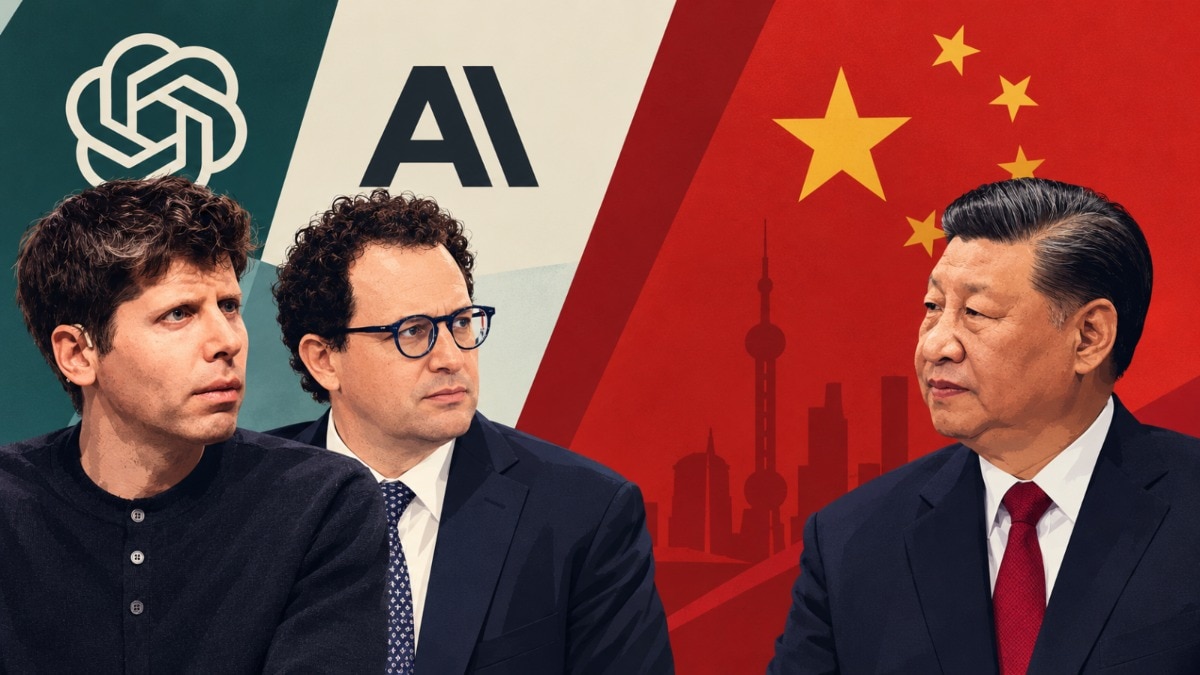
The past week has been eventful in the world of AI. The chatter around AI moved quickly from OpenAI solving the 90-year-old Navier-Stokes Millennium math problem to AI potentially ending humanity within a few years. The situation reached a state where Anthropic CEO Dario Amodei urged AI companies to work with democratic governments to slow down AI development. This idea has gained consensus in Silicon Valley with Elon Musk and OpenAI CEO Sam Altman in agreement. But why are AI companies asking governments to intervene when they are the ones making AI models?
The need to slow down AI development had always been there among critics, but the conversation around it became mainstream after AI researcher Jacob Coxon resigned from Anthropic with a clear warning that AI could kill us all. “The people building AI earnestly believe that it could kill us all by the end of the decade,” he wrote in a viral X post. Evan Hubinger, who leads safety research at Anthropic, soon chimed in, responding, “We really do earnestly believe AI could kill all humans!”
Coxon’s post went viral on X with over 171 million views at the time of writing. Eventually, Dario Amodei, CEO of Anthropic, shared a long essay stressing the need to pace the frontier through government intervention and regulation, agreeing with Coxon’s comments. “Frontier AI companies within democratic countries (must) coordinate to establish common safety standards as well as limits on the rate of unchecked AI progress,” he wrote.
Even Sam Altman, who does not see eye-to-eye with Amodei on most matters, has come out in support of this undertaking. “I agree with Dario that we need to pace the frontier,” Altman said. In fact, even Elon Musk, who once called Anthropic “misanthropic”, also shared the same view. He wrote, “Dario is right.”
But almost immediately, the calls from Silicon Valley were rejected by US President Donald Trump. Speaking to reporters during a weekend trip to Ireland, Trump said, "We can put guardrails, we can do this and that, but I think you have a lot of negative forces that are bringing it up that ... shouldn't be bringing it up, and they're bringing up things that won't happen." He added "Frankly, I want to keep it that way because whoever wins AI wins.”
After Trump essentially said no to involving the federal government in any way to slow down AI development, former White House AI czar David Sacks took a dig at AI companies. In an X post, Sacks claimed that companies like OpenAI and Anthropic did not need anyone’s intervention to slow down AI. “You guys are the frontier. By any reasonable metric — market share, revenue growth, model capability — the two of you have a duopoly on frontier intelligence,” he wrote.Slowing down AI research is not so simple
This raises the question, why are OpenAI and Anthropic looking for regulation from the US when they are the ones building the most advanced AI models such as GPT-6 Astra or Mythos 5.1
Prashanth Tondapu, CEO of AI solutions company Innostax, believes that we are seeing these companies look for government regulation because they are stuck in an arms-race of their own. “This is less a case of hypocrisy and more a classic arms-race problem. It is similar to Cold War logic – both sides can understand that unrestricted escalation is dangerous, while neither wants to be the first to slow down,” he tells India Today Tech.
Like in the Cold War, no company wants to slow down AI voluntarily when they fear that their rival may not do the same. “Nobody wants to be the only one who stopped. If Anthropic pauses today and OpenAI doesn't, Anthropic loses everything – market position, revenue, and the ability to shape how this technology develops,” says Mukul Kumar, cybersecurity expert and managing partner at Claracon AI. “They're not asking for permission to slow down. They're asking for a rule that forces everyone to slow down together. There's a difference.”
The framework suggested by Dario Amodei includes giving access to third party evaluators, something that Anthropic has done already. But this may not be enough unless other AI labs are required to do the same.
“A voluntary commitment binds the company that makes it and no one else, and it carries no external verification,” Island Computing CEO Vishal Sirohi tells India Today Tech. “A statutory testing threshold (government regulation) applies to every lab above it and produces evidence a regulator can inspect.”
But regulation is not so simple either. According to Prashanth Tondapu, blanket ban on AI development may end up concentrating power in the hands of the biggest AI companies, leaving small players out. “Regulation must govern risk rather than protect incumbents. Research should remain open, new players should be able to compete, and safety rules should not become a moat for today's largest AI companies,” he says.And then there is China
Coming back to Donald Trump’s comments on the AI race. The US president specifically mentions that slowing down AI research may benefit China. At a time when OpenAI and Anthropic are making more advanced models, Chinese players are not far behind either. We have seen models like Kimi K3 and DeepSeek V4 that can match American AI models in many aspects. On top of that, these models are open-source or open-weight – making them much cheaper when compared to closed models from the West. Some fear that if American companies slow down AI development, Chinese players may get ahead.
“China is perhaps the biggest factor preventing the United States from meaningfully slowing frontier AI development,” says Prashanth Tondapu. “If this were purely a domestic technology issue, the US could impose stricter limits and ask its companies to proceed more cautiously. But AI is increasingly viewed as strategic infrastructure - with implications for economic power, cybersecurity, intelligence and defence.”
Abhishek Agarwal, president of Judge India Solutions, pointed out that Chinese companies are already getting better with their latest releases. “National Institute of Standards and Technology (NIST)'s evaluation body found DeepSeek V4 Pro roughly eight months behind the US frontier as of mid-2026, and judged another Chinese model comparable to a US model released about six months earlier,” he tells India Today Tech. “The US and China together control roughly 90 percent of compute used in frontier AI development, leaving little room for a third path.”
Though Abhishek Agarwal clarified that the proposals of slowing down AI development does not mean a complete pause. “Worth stating clearly though: none of the serious pacing proposals ask America to stop while China continues. They're built around verification and eventual coordination with Beijing, not a one-sided pause, and that distinction gets lost easily in the shorthand,” he said.
At the same time, US AI companies want to address fears around China too. In his essay, Dario Amodei mentions, “Global pacing will require cooperation with China, the autocratic country with by far the most advanced AI capabilities.” The Anthropic CEO adds, “If we greatly restrain our AI capabilities in the belief that China will do the same, and then China defects, AI could be so powerful that such a defection could lead to their geopolitical dominance.”
As a result, Dario Amodei suggests that any agreement for global slowdown of AI development “must either have ironclad verifiability, or must be limited enough that defection would not be militarily existential.”
Anil Agarwal, CEO of AI platform Incruiter, concurs. He believes that coming to an agreement with China may not be easy. “The US does not want to slow its companies down while China accelerates, and China has similar incentives. That creates a difficult situation for policymakers. Nobody wants to lose the AI race, but nobody wants uncontrolled development either,” he tells India Today Tech. “The better approach is to compete aggressively on innovation while establishing clear guardrails around safety, privacy and responsible use. The countries that find that balance will probably be better positioned for the next phase of AI.”
While it appears that Donald Trump is not interested in slowing down AI development in the US largely due to this China factor, the AI industry may not wait. Recently, OpenAI CEO Sam Altman announced on X that his company was not going to stand still. “We welcome a federal framework that sets consistent safety requirements for frontier AI,” Altman wrote on X. “But we do not believe we need to wait for an anti-trust exemption or legislation to begin the work of providing this confidence.”
To do this, Altman explained, OpenAI had set up new safety measures in addition to its previous work. “We now formulate explicit safety cases in advance of frontier reinforcement learning runs we expect to significantly increase capability, in addition to the safety work we have long done in advance of model releases,” he said.
Only time will tell whether the White House actually intervenes in AI development in the US. But the message within Silicon Valley seems to be indicating one thing – the need for a slowdown. Why? As Mukul Kumar puts it, “When the engineers building these systems say that out loud and walk away from their stock options to say it, that's not an alarm for attention. That's people telling you what they see from the inside.”- EndsPublished By: Armaan AgarwalPublished On: Sep 16, 2026 12:57 ISTAlso Read | Nvidia CEO Jensen Huang claims GPT-6 Astra is AGI, experts say not quiteAlso Read | Cost of doing business rising, Indian companies sweat margins as RAM crisis bitesAlso Read | AI promised less work, developers say in reality it is forcing them to work more