As Trump’s trade war grinds on, Canada needs to ensure national pride doesn’t become national hubris - Toronto Star
Canadians want to satisfy their grievance against the U.S. — but they also don't want to risk incurring any real economic damage.
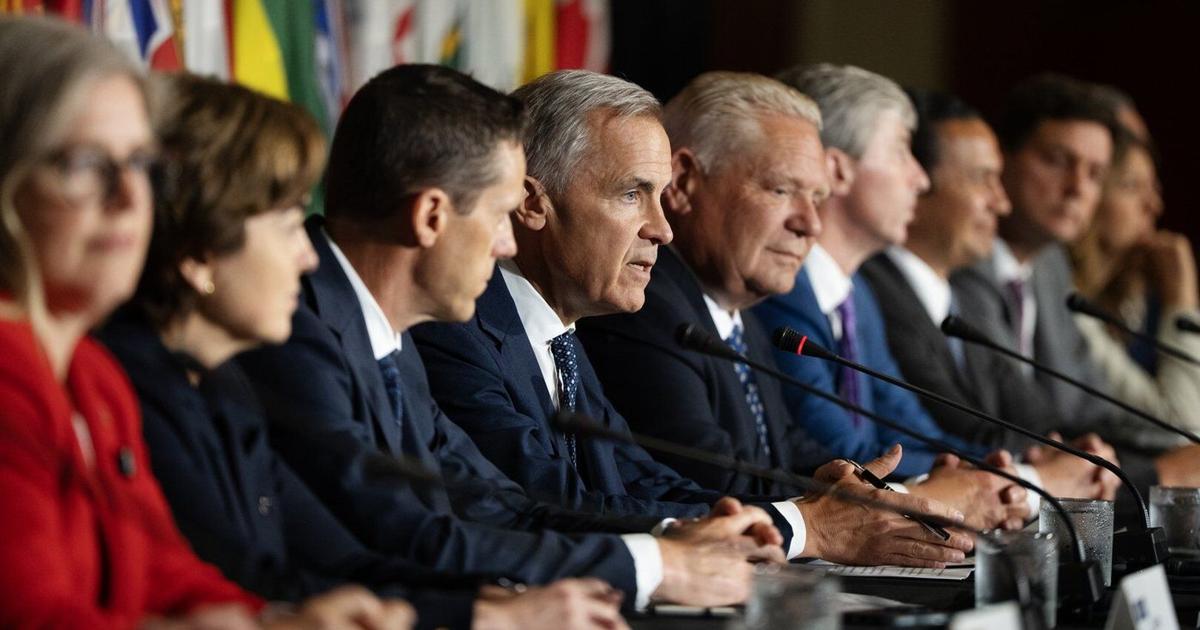
Prime Minister Mark Carney, centre, and Canada’s premiers hold a closing press conference at the First Ministers Meetings, in Charlottetown, on July 23, 2026.
David Polansky is a Toronto-based writer. Find him at Strange Frequencies or on X: @polanskydj
Reflecting on the political excitement over tariffs these past couple of weeks might lead one to conclude that someone holding the monkey’s paw had wished to see Canada reverse its Trudeau-era experiment with post-nationalism. We are witnessing a remarkable irruption of impassioned national sentiment in a formerly staid country.
This isn’t necessarily a bad thing, of course. Indeed, having a modicum of national pride is prerequisite to a country’s ongoing existence, and it was deeply foolish of Canada’s elites to make self-abasement a basic feature of our political rhetoric over the past decade.
Nationalism is a bit like Bruce Banner transforming into the Incredible Hulk: useful when you’re faced with a threat but not always able to be contained. To wit: last week, Canada opened a new front in what Prime Minister Mark Carney has termed a “trade war,” applying retaliatory tariffs to $28 billion in American goods. But for all the demonstrations of solidarity and (justifiable) irritation over U.S. President Donald Trump’s memetic antics, there has not been a corresponding level of interest in the policy decisions now affecting the lives and fortunes of millions of people.
Interestingly, Carney himself has claimed his latest move is not intended to be escalatory but merely to protect Canadians, whom early polling indicates have a limited willingness to bear personal costs in support of the policy. What all this suggests is a desire to satisfy the present grievance against the United States without incurring any real economic damage in the struggle.
This confusion over the tariff issue is unsurprising — it has, in fact, defined the entire business from the start, and not only on the Canadian side. Restoring clarity would, at minimum, require two things.
The first is to know what, exactly, prevented the two negotiating teams from reaching a compromise and justified the Canadian side’s decision to walk away from the table with no plans to resume talks. Carney’s continued lack of transparency on these questions, combined with the media’s refusal to press him for answers, should be unacceptable in a democratic country. And in light of the fact that the prime minister only recently misrepresented the details of the Gordie Howe International Bridge deal in order to cast Canadian concessions in a more favourable light, there is little reason to give his government the benefit of the doubt.
The second, given that Canada is the only country to have responded to Trump’s economic aggression with retaliatory tariffs, is to establish the costs and benefits to Canadians of these countermeasures in the wake of the failed negotiations. What all the “standing up to bullies” rhetoric can’t change is that counter-tariffs are not a form of economic artillery that harms only the other side.
This entire business is the equivalent of two drunk guys standing across the border from each other, trying to determine who can punch himself in the face hardest. Canadians are overly focused on the fact that the other guy started it — and insufficiently focused on material outcomes, specifically the costs that Canadian consumers will now have to bear. This is compounded by exaggerated accounts of Canada’s real leverage over the U.S. and influence on decision-making at the federal and state levels.
Worse still are the worrisome signs that national trade policy is being dictated by the whims of the premiers. I would encourage you to watch the clips of Ontario Premier Doug Ford expressing his views on complex tariff issues in between trying to match Trump’s antics stunt-for-stunt. If you can extract a clear understanding of his position and how it might serve as a foundation for future negotiations, I will buy you a steak dinner at Jacobs & Co.
Importantly, this distorted outlook is informed by the belief that Canadians are not just trying to secure a better trade deal but to defend their very homeland, which obviously changes the calculation. The problem is that most Americans seem unaware their country poses a mortal threat to Canadian sovereignty: witness the bemused response of the U.S. admiral who was asked earlier this month about the possibility of taking military action.
The pendulum has now swung so far that it’s flown off the fulcrum. A country that spent years avoiding any talk of national security, committed to the belief that its military’s only possible purpose should be peacekeeping, is now preparing for “Red Dawn”-style guerilla warfare against a global superpower. Not only is Trump’s “51st state” rhetoric inexcusably stupid and counterproductive; it would also appear that the U.S. military will be the last to know about his invasion plans, if any.
This is where Canadians’ nationalistic response becomes self-defeating in multiple directions at once. You can see it in the widespread belief that Canada needs only hold fast until the U.S. midterm elections — at which point a chastened Trump administration would be compelled to negotiate on fairer terms — alongside a growing certainty that, in fact, America itself is the enemy.
There is also a misplaced faith that European relations can replace North American ones, affirmed by the prime minister’s intention to address the European Parliament before convening his own country’s deliberative body. There’s nothing wrong with Europhilia, but wishing cannot change geography, nor can it induce the Europeans to shake off their past two decades of economic sluggishness.
More worrisome is the temptation to somehow triangulate between the U.S. and its emerging geostrategic rival, China. This is a game we’ve shown no signs of being prepared to play. Annoyance over Trump’s general obnoxiousness toward Canada is understandable, but “so’s your mother” isn’t an economic (or geopolitical) strategy.
Through it all, the same establishment that spent years treating normal patriotism as fascistic has now, without hesitation, embraced a strident if contentless version of Canadian nationalism rather than prudently weigh the interests now hanging in the balance.
Suffice it to say, the tariff contretemps has revealed just how unserious Canada’s political and pundit class can be when it comes to the real game of global politics. In this, at least, it may ultimately prove salutary.
Error! Sorry, there was an error processing your request.
There was a problem with the recaptcha. Please try again.
You may unsubscribe at any time. By signing up, you agree to our terms of use and privacy policy. This site is protected by reCAPTCHA and the Google privacy policy and terms of service apply.
David Polansky is a Toronto-based writer. Find him at Strange Frequencies or on X: @polanskydj
Opinion articles are based on the author’s interpretations and judgments of facts, data and events. More details