Aviation flaws and fragile peace: Broader implications from the flydubai attack
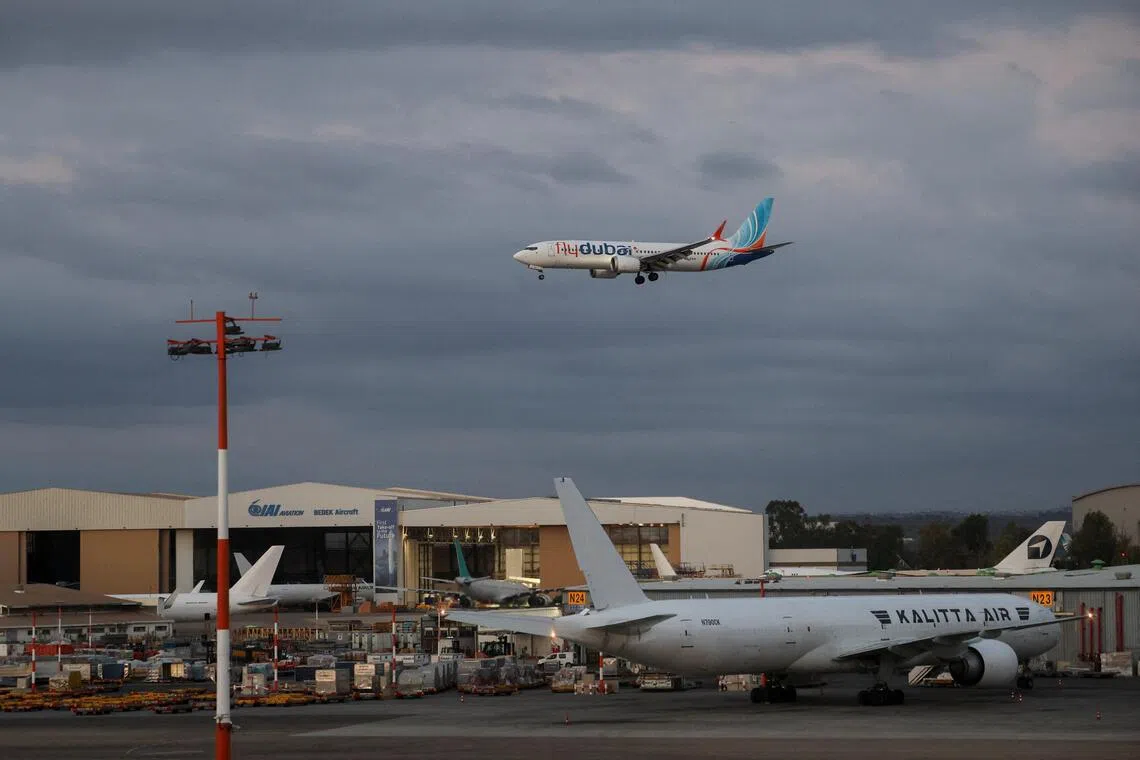
A plane, carrying passengers who were on the flydubai aircraft bound for Israel from the United Arab Emirates, which was diverted to Saudi Arabia following an emergency signal, arrives at the Ben Gurion International Airport, in Lod, near Tel Aviv, Israel, on Sept 30.
LONDON – For more than half a century, Israel built the world’s most elaborate defence around civilian aviation. Every Israeli airliner carries armed security agents. Cockpits sit behind two bulletproof doors so that one is always locked. The fleet of El Al, the Jewish state’s airliner, also carries anti-missile countermeasures – a legacy of a 2002 attempt to shoot down an Israeli airliner flying over Africa.
Behind this ring of steel is an even broader security parameter. The identity of anyone booked on a flight to Israel is checked, many hours before they are air-bound. Every air passenger leaving Israel is personally interviewed before check-in by security officers trained to spot evasion.
Yet all this was rendered irrelevant on Sept 30, when Israel was just a step away from one of the worst attacks in its history. Passengers, not government agents, saved flydubai flight FZ1073. The courage of the plane’s Indian pilot, the lucky presence of another pair of pilots and the determination of some of the Israeli passengers prevented the deaths of the 174 passengers and crew, after a co-pilot armed with a knife tried to crash the plane.
The attack exposes enduring structural weaknesses in Israel’s airline security arrangements. But it also acts as a reminder that Israel’s determination to establish formal diplomatic relations with its Arab neighbours is unlikely to buy the country the security it craves until the broader resentment felt against Israel throughout the Arab world is tackled.
Closing these security and psychological gaps will cost Israel more than its politicians care to admit.
Pilot intentions and safety lapsesIt may take weeks before a full picture of all the security ramifications of the latest incident emerges. For although the rogue pilot who attacked his cockpit colleague likely acted on political motives, there are other examples of pilots causing accidents or deliberately crashing their planes for personal reasons.
The fate of SilkAir Flight 185, which crashed in Sumatra in December 1997, springs to mind, although the evidence there remains inconclusive. But there are also the more clear-cut examples of an Egyptian pilot who crashed a plane into the Atlantic Ocean shortly after taking off from New York in October 1999, and of another pilot who crashed a German plane over the French Alps in March 2015.
Yet regardless of what transpires from the investigation, it is clear that, although the United Arab Emirates has an excellent record of safety and the country’s security services are famous for their efficiency, something went wrong in both Israel’s and the Emirates’ safety procedures.
Israeli security services routinely check the identities of pilots flying planes into Israel and are known to maintain a database of such names. The rogue pilot in the flydubai plane, allegedly a citizen of Oman, the Emirates’ immediate neighbour, only joined the company six months earlier. If he was connected to jihadi terrorist elements, both the Israeli and Emirati governments will have to ask themselves how they failed to spot such connections.
And then, there is the simpler question of how an airline pilot was able to bring on board a knife, past all the security checks to which all personnel are subjected. Was it just the problem encountered at many airports around the world, where uniformed airline staff are checked less rigorously because they are assumed to be trustworthy, or did the rogue flydubai pilot benefit from accomplices on the ground?
Israel’s security services will also be re-examining their procedures for an event everyone dreads most: a decision on whether to shoot down a hijacked plane and kill all its passengers, rather than allow it to crash into a built-up area and kill even more people.
In the flydubai incident, two Israeli fighter jets were scrambled and lay in waiting, ready to destroy the plane if it strayed beyond Jordan and entered Israeli airspace. The unenviable choice did not have to be made. But the procedures for such a grim eventuality will now be looked at again.
Israel’s politicians were elated by the actions of Saudi Arabia, a country that does not have diplomatic relations with the Jewish state. Saudi air controllers cleared the stricken jet for landing without hesitation; Saudi soldiers, nurses and doctors met it on the tarmac; passengers interviewed on their return spoke warmly of being looked after and repeatedly reassured that they were safe. Saudi security also arrested and interrogated the suspect at Israel’s request.
“On behalf of the people of Israel, I want to thank the Saudi people for the warm welcome and goodwill shown”, said Israel’s Culture and Sports Minister Miki Zohar.
Israeli Prime Minister Benjamin Netanyahu, who faces a gruelling re-election campaign in the run-up to the national ballots scheduled for Oct 27, will no doubt try to use this episode to suggest that his dream of normalising relations with the Arab states without addressing the plight of the Palestinians is working.
Yet the message from the flydubai incident is precisely the opposite: that in the absence of a real reconciliation between Israelis and their Arab neighbours, which can only come with a solution to the suffering of the Palestinians, any diplomatic arrangements Israel makes with Arab leaders will not translate into greater security.
The historic record is clear on this point. Soon after Egypt established diplomatic relations with Israel in 1979, Israelis rushed to visit the tourist wonders of Egypt, yet hostility soon drove them away. Egypt continues to have an embassy in Israel, but Israeli tourists are nowhere to be seen in Egyptian hotels. The same happened when Jordan forged diplomatic relations with Israel in 1994; a brief burst of enthusiasm, followed by a long, chilly peace.
Formal relations between the Emirates and Israel are far more intimate and diverse. The two countries’ intelligence services and military cooperate closely, and Israeli tech firms are everywhere in the Emirates. Tourism has flourished: hundreds of thousands of Israelis either go to the Gulf for holidays or pass through the Gulf on their way to other destinations in Asia.
This may continue, but many Israelis will likely choose to fly with their own national airline rather than Emirati ones. The incident may also heighten concerns among other airlines flying to Israel; the number of international flights landing at Tel Aviv’s Ben Gurion Airport is already way down because of persistent security concerns.
Israel’s response is likely to include a further tightening of its safety procedures. But with each tightening, new threats emerge. For Israel has done little to change its image in the Arab world. And there will always be those who will consider links with Israel intolerable.
Jonathan Eyal is based in London and Brussels and writes on global political and security matters.