Bangkok oil leak confirmed from Bangchak pipeline - Bangkok Post
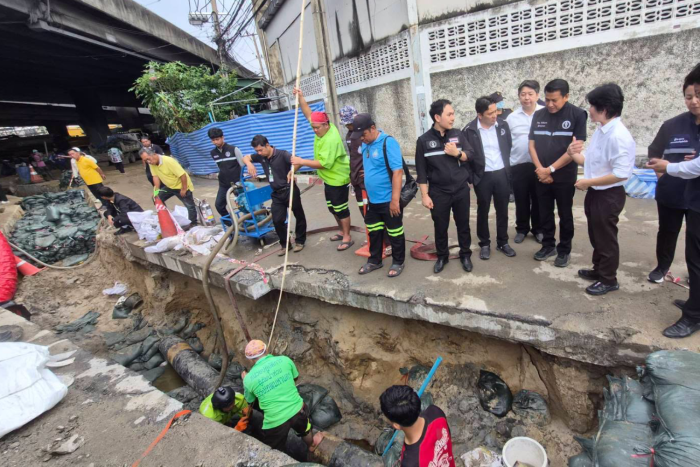
Workers and public officials inspect underground pipelines along Chuea Phloeng Road in Klong Toey district of Bangkok, concentrating on an area under the Rama III elevated bridge. (Photo: Ministry of Energy) Oil-contaminated wastewater in Bangkok has been traced to a Bangchak Group fuel pipeline along Chuea Phloeng Road in Khlong Toey district, Thitipat Chotidechachainan, secretary to the energy minister, confirmed on Thursday.
The latest leak location was found on Wednesday evening after a backhoe was used to excavate another section of the road surface about 10 metres from a site inspected earlier, Ms Thitipat said.
An oil stain was found on the pipeline at a depth of 2-3 metres underground near a bridge pier. A metal sheet had been placed near the pipeline to reduce vibration, and workers will have to move the sheet to further inspect the condition of the pipeline.
The discovery came after Bangchak said on Saturday that its own inspections using several engineering techniques had found no leaks, but that further tests would be conducted.
More sections of the road surface would be excavated on Thursday, Ms Thitipat said, adding that contamination of the capital’s drainage system was now confirmed to have been caused by the pipeline leak.
Bangchak owns Bangkok Fuel Pipeline and Logistics Co (BFPL), which operates the pipeline owned by BAFS Pipeline Transportation Co (BPT), a subsidiary of Bangkok Aviation Fuel Services Plc (BAFS). Bangchak has a 9.4% shareholding in SET-listed BAFS. The pipeline connects the Bangchak refinery to depots and major airports including Don Mueang and Suvarnabhumi.
The oil leak inspection, coordinated by several agencies, has dragged on for more than a week following public complaints about a strong oil smell in the area, concentrated under the Rama III elevated bridge at the boundary between Klong Toey and Yannawa districts.
Thousands of litres of oil-contaminated wastewater were later pumped up from underground over the past week.
BFPL and BPT would be responsible for all damage caused by the leak, Ms Thitipat said.
Ms Thitipat said the seepage might have been so small that Bangchak’s initial tests could not detect it, adding that more detailed checks were therefore required.
As for the corrective plan, she said the operator must promptly identify any damaged areas, defects or flaws along the pipeline and carry out repairs as quickly as possible.
At the same time, the pipeline owner must submit records of maintenance and repair activities for the entire system to the Department of Energy Business.
These records will support the investigation into the root cause of the incident and facilitate a comprehensive risk assessment of the system.
Following completion of the repairs, a pigging test must be carried out along the pipeline, covering 32 kilometres, to assess its internal condition and identify any areas that may be susceptible to abnormalities.
Pigging involves sending a specialised device called a “pig” (pipeline inspection gauge) through a pipe to clean, measure or evaluate internal conditions without stopping the flow.
If any irregularities are detected, operations must be suspended immediately so the affected area can be inspected and repaired before testing resumes.
Any affected section of the fuel pipeline would be replaced with a new section, Ms Thitipat said.
Rerouting the pipeline would be considered as a long-term measure, particularly for sections located beneath bridge piers or other potentially hazardous structures, to prevent similar incidents from recurring.