Bangladesh workers go on rampage, ministers blame Hasina, people across border
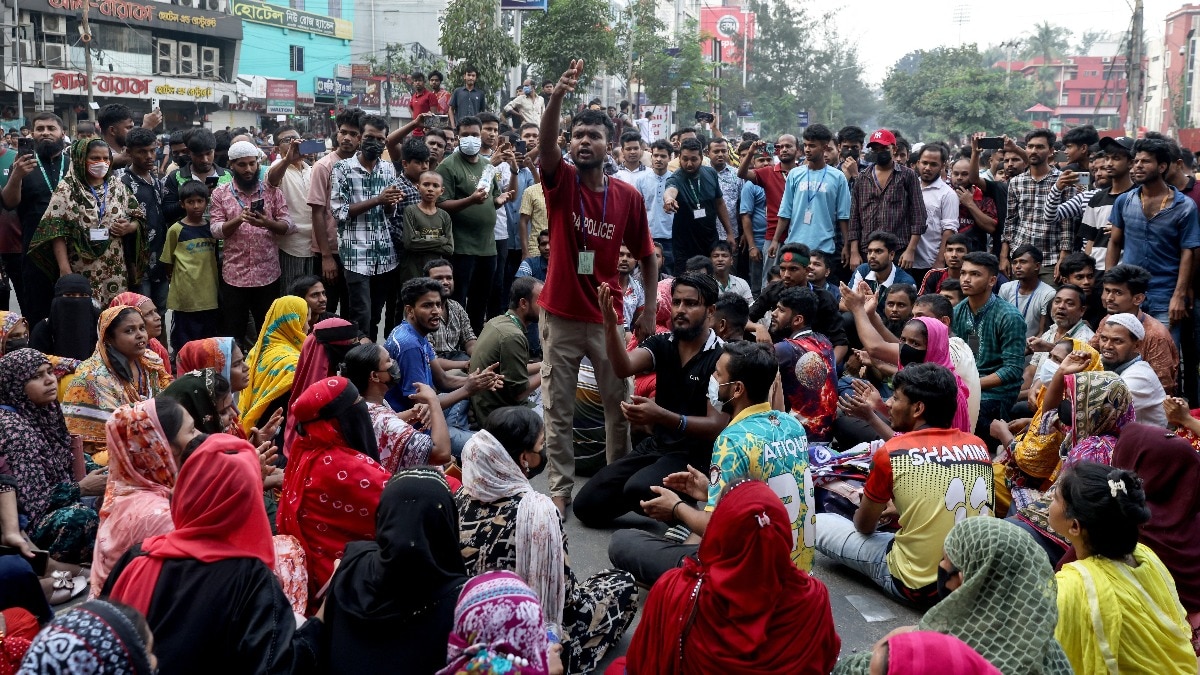
Garment industry workers in Bangladesh have been on the rampage for the last three days. They blocked highways, vandalised vehicles, including police cars, clashed with cops, burnt down a warehouse and vandalised a factory. The violent protests, demanding higher wages, have brought large parts of its vital manufacturing sector to a standstill. The protests, which continued for the third day on Monday, come amid a prolonged economic slowdown, and just ahead of former prime minister Sheikh Hasina's proclaimed return to Bangladesh from exile in India.
The World Bank has projected a GDP growth of just 3.4% in FY2025–26 for Bangladesh, the slowest pace of growth since the Covid year of 2020. As workers take to the streets amid rising inflation and stagnant wages, the government has accused Sheikh Hasina's Awami League and "several people from across the border" of instigating the violence.
Several experts have suggested that Bangladesh's economy went downhill after Hasina was forced out on August 5, 2024. It was under Hasina that the ready-made garment industry, the backbone of Bangladesh's economy, grew massively. The sector employs around four million workers, accounts for 80% of Bangladesh's export earnings and contributes about 10% of its GDP, according to data cited by Reuters.
However, the ready-made garment sector is now facing major disruption, with hundreds of factories shutting down over the weekend and nearly a million workers affected. Although some factories reopened on Monday, protests continued across Dhaka and other major garment hubs. The government has also accused the now-banned Awami League of orchestrating the unrest, just a month before Hasina's planned return. Cops fire tear gas shells as garment workers block a road during a protest calling for higher minimum wages in Dhaka on November 1. (Image: AFP)
Clashes between garment workers and police, arson attacks and road blockades have rocked Bangladesh's major industrial hubs, beginning on October 31. After several demonstrations in the second half of October, the unrest escalated over the weekend.
In Gazipur, one of Bangladesh's largest ready-made garment hubs, workers clashed repeatedly with police after blocking the Dhaka-Tangail Highway on October 31. At least 30 people were injured as police used baton charges and tear gas to disperse protesters, who vandalised 15 vehicles, including a police car, Prothom Alo reported.
The violence intensified the following day in Dhaka's Mirpur, where workers blocked the Mirpur-10 intersection and clashed with police. Protesters hurled bricks and stones at security personnel, who responded with tear gas, water cannons and baton charges, Prothom Alo and United News of Bangladesh reported. A police vehicle was set on fire beneath the Mirpur-11 metro station, while stations in Mirpur and Pallabi were temporarily closed.
In Gazipur, protesters torched a police box in Konabari, a garment-waste warehouse and a pickup van in Kaliakair. In neighbouring Savar and Ashulia, factory premises were vandalised and a security booth at a garment factory in Hemayetpur was set on fire. The unrest also disrupted traffic on the Dhaka-Tangail and Dhaka-Aricha highways.
Protests continued on November 2. The Daily Star reported that police dispersed workers attempting to take to the streets in Mirpur, while Prothom Alo reported a fresh blockade of the Dhaka-Tangail Highway in Gazipur. Ten platoons of the Border Guard Bangladesh (BGB) were deployed in the district.
The unrest has severely disrupted garment production. BBC Bangla, citing the Bangladesh Garment Manufacturers and Exporters Association, reported that at least 529 factories across Gazipur, Savar-Ashulia, Dhaka and Uttara declared holidays over the weekend, with 987,190 workers leaving their workplaces. Although some factories resumed operations on Monday, Reuters reported that manufacturers remained uncertain as the unrest continued.#WATCH | Dhaka, Bangladesh: Bangladeshi garment workers launch massive violent protests over wages. Vandalism and clashes reported in Dhaka and Gazipur. A heavy police force and Border Guard Bangladesh have been deployed to restore order in the industrial areas. https://t.co/Ga0zZ8fo5X— ANI (@ANI) November 1, 2026WHY ARE BANGLADESH'S GARMENT WORKERS PROTESTING?
At the heart of the protests is a demand for higher wages. According to The Daily Star, garment workers are seeking a monthly minimum wage of Tk 30,000, more than double the existing Tk 12,500. Rising food, housing, transport and healthcare costs have steadily eroded their purchasing power.
The last revision of the minimum wage took place in December 2023, when it was raised from Tk 8,000 to Tk 12,500.
The demand comes amid a prolonged economic slowdown in Bangladesh. The World Bank has attributed the deceleration in growth since 2023 to structural constraints, including problems in the energy sector, financial-sector vulnerabilities and weak domestic revenue mobilisation.
In its October 6 projections, the World Bank forecast GDP growth of 3.4% in both FY2025-26 and FY2026-27, citing weak investment, declining exports, elevated inflation and reduced public investment. It also warned that job creation had stalled, and rising prices had pushed an additional 2.1 million people into poverty in FY2025-26.
The slowdown has also affected workers in the garment sector. A Daily Star report published on October 22 noted that many garment workers were having to put in 16-hour shifts to earn Tk 19,000 to Tk 20,000 a month, barely enough to cover their families' expenses.
But meeting the demand for higher wages will be easier said than done. The president of the Bangladesh Knitwear Manufacturers and Exporters Association (BKMEA) told BBC Bangla: "Wages have been increased in three phases from 2013 to 2023. If the minimum wage is increased to Tk 30,000 after that, many factories will close because many employers will not be able to pay this amount of wages." Workers operate at the sewing section of a factory, in Narayanganj. (Image: Reuters) advertisementGOVERNMENT SEES AWAMI LEAGUE BEHIND WORKER UNRESTIn response to the continuing unrest, Labour Minister Ariful Haque Chowdhury announced the formation of a six-member minimum wage board on Sunday, November 1, while urging protesting workers to return to work. The board includes representatives of employers, workers and an independent category, The Daily Star reported.
However, the announcement failed to quell the unrest, with fresh protests and road blockades reported in Dhaka and other industrial hubs.
The government has increasingly blamed political interference for the demonstrations. Following an emergency meeting with cabinet ministers late on Sunday, Prime Minister Tarique Rahman directed authorities to protect workers' interests while ensuring uninterrupted production in the garment sector.
Home Minister Salahuddin Ahmed alleged that people from "across the border" were encouraging workers to create unrest and disrupt garment production and exports, BBC Bangla reported. The Daily Star further reported on Monday that Ahmed alleged that factory owners linked to the Awami League, including former ministers and lawmakers, are among those instigating unrest among workers.
Labour Minister Chowdhury, meanwhile, alleged that forces associated with the Awami League were behind the unrest. "It is clear that the people of Awami fascism have indulged in these things with December in mind. That is why the Prime Minister has instructed everyone to be vigilant so that production in the garment sector is not disrupted and instability is not created," he told BBC Bangla.
For context, the Awami League's matriarch, ex-PM Sheikh Hasina, who fled to India in August 2024, has pledged to return to Bangladesh in December this year, even as she faces a death sentence handed to her by the International Crimes Tribunal (ICT) for "crimes against humanity".
The allegations went further on Monday, when Tarique's political assistant, Rashed Khan, accused Jamaat-e-Islami and the National Citizen Party (NCP) of instigating the protests, while claiming that Awami League and Chhatra League activists had joined demonstrations posing as garment workers.
"Several people from Awami League and Chhatra League have already been arrested in connection with the arson. But shouldn't the Jamaat Ameer be brought under the law as the instigator of arson by the Awami League," asked Khan on Facebook.
Dhaka, however, is yet to provide evidence pointing to a deliberate conspiracy. In any case, for Bangladesh, the immediate challenge is twofold: restoring production in an industry that is critical to its export economy, while addressing the wage and working conditions that have brought its workforce onto the streets.- Ends(Written by Shounak Sanyal)
A history and geopolitics buff, Shounak is a newly minted writer. He looks to bring his interests into his stories. When not at work, he can be found consumed in books, videogames and drawing.