
Before his speech went viral, this boys’ school headmaster ran it past his daughter
You have reached your maximum number of saved items.
Remove items from your saved list to add more.
As Sydney was hit last month by a wave of sexual assault allegations against some young men from private schools, the headmaster of the all-boys St Joseph’s College at Hunters Hill, Michael Blake, made a speech to his own students which has since gone viral. This is his first interview since that address.
Fitz: Headmaster Blake, thank you for your time.
MB: Not a problem. You can call me “Mick”, Peter. I don’t need to go by the title “Headmaster”.
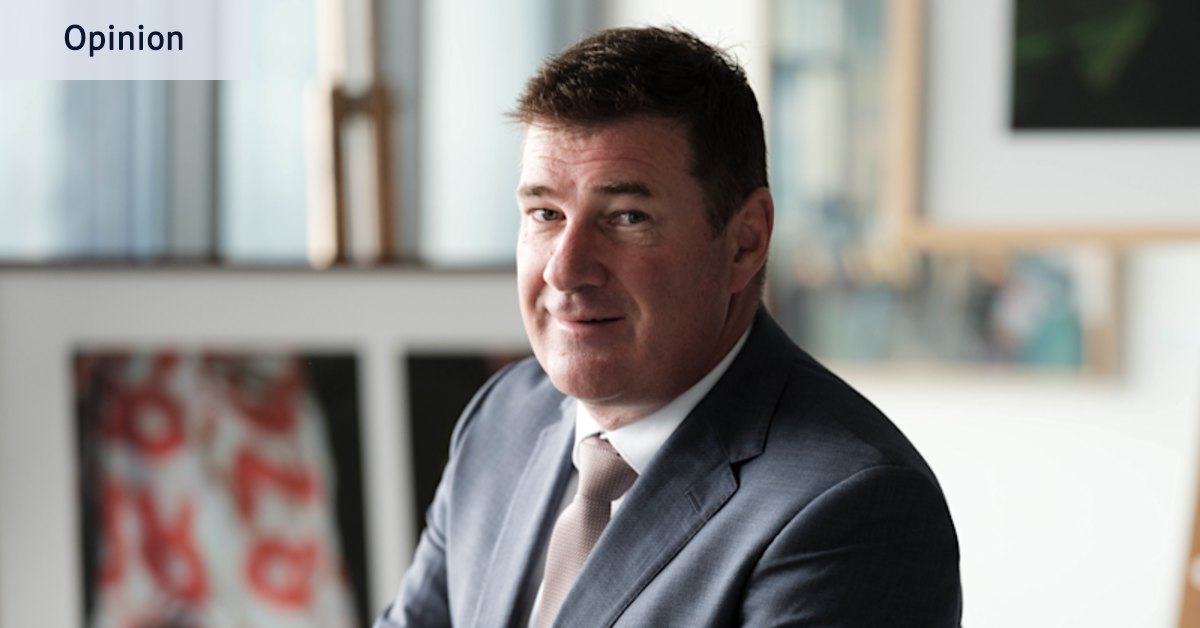
St Joseph’s College Hunters Hills headmaster Michael Blake.Oscar ColemanFitz: Thanks. Call it an atavistic reaction if you like, but after six years in an all-boys school myself, I feel more comfortable in calling you, “Yes-Headmaster-Suh!”
Fitz: OK, so you’ll be pleased to hear that your speech of four weeks ago reminds me a little of a particular feature of the Gettysburg Address. Not in content, but for the fact that while Abraham Lincoln’s speech was well received when he delivered it, it was only when it was printed by the New York Times and other papers that it really took off. Are you aware that your speech has grown in stature over the last four weeks as it has circulated online in Sydney and more widely?
MP: You’re very kind. Yeah, it has come to my attention.
Fitz: We’ll get to the content. But in the context of Sydney being submerged in a wave of devastating allegations of appalling behaviour by young men towards women, you felt compelled to speak out?
MB: Yes. When we have a school assembly at Joey’s, it’s an opportunity to get in front of the boys and very deliberately talk about things that are happening around the school, happening in the community and most importantly, happening in society. And sadly, after what had happened across Sydney in the week prior, I thought it was something that needed to be brought to their attention as men.
Fitz: Right. So when you sat down to write the speech, what did you specifically want to say to the boys?
MB: Whenever we talk to boys at an assembly, it’s important that we’re really clear in our messaging about what good men look like. What does strong masculinity look like? The challenge is there’s so much noise around them, from social media, the ’net, film and literature, that we need to present really good, clear messages. I try not to talk along the lines of “don’t do this or don’t do that”. I always try and give examples of what good masculinity looks like.
Fitz: OK, cue the headmaster, to the packed assembly hall, on this cool Thursday morning.
“Boys,” you said, “it has been a difficult week to be a man. As you would be aware over the past week, there have been multiple reports in the media regarding young men and allegations of sexual assault and ill-treatment of women... It is a time when we, as men, feel a sense that we are all being judged, being assessed for how we treat women...”
MB: I was certainly aware that they were listening closely.
Fitz: Before you lowered the boom ...
“I wonder if that is the way you are feeling?” you went on. “I hope not. In fact, I hope what I just said felt jarring. Because as tough as this week might have been to hear the media stories… it has been infinitely harder to be a female. . .
“It has been a life-changing week for the women who are the alleged victims...
“It would have been a hard week to be a young girl. Beginning to understand the world around her and slowly becoming aware that there are situations in which she may be vulnerable, simply because she is a girl.
“It would have been a hard week to be a young woman, wondering whether she is being valued for the person she is, or judged simply by how she looks. Wondering whether the boy she is with will respect her boundaries.
“It has been a hard week to be a mother, looking at her daughter and knowing that, however much she wants to protect her, there will be times when she can’t...”
Fitz: How could you not? Great opener. I have a wife and daughter, and whenever I feel myself in a minefield of writing or talking about sexual assault or feminist issues and misogyny, I show it to them, and every now and then they show me unexploded mines and issues that – as an Australian male raised in the ’60s – I was not aware were even there. Did you show this speech to female family members?
MB: I shared it with my 23-year-old daughter. And after I read the first paragraph about how hard it is to be a man, and flipped it to say, “Well, actually, it’s been infinitely harder to be a woman”, she said, “Thank God you said that because I was going to jump across this kitchen table and thump you!”
Fitz: Good for her! You went on to note that for things to change it was going to take a whole “lot more than an assembly speech”. It was going to need them to make the right decisions about the type of man they wanted to be, to “set your own high standard and lean into it”. To use the vernacular, headmaster, are you saying “boys, it’s time to be woke”?
MB: No. I don’t think that’s woke at all. I’d actually go the other way. I think it’s good old-fashioned values, going back to an era where that respect for women was at the core of what we were bringing up our young men to be. I’d be disappointed if different elements of society want to brand that real caring and empathetic nature and looking after other people as just “woke”.
Fitz: One of the culprits often identified in sometimes turning young men away from such old-fashioned values as base-level respect to all, and into misogynist monsters, is social media.
MB: Yes, rightly so. I think we’ve got to be more active in countering the influence they get through social media and what streams onto their screens – fed by damaging algorithms which keep feeding them stuff that attempts to normalise what isn’t good behaviour.
Consent campaigner Chanel Contos is calling for laws to give Australians more control over what they see on social media.Alex EllinghausenFitz: On the subject of those algorithms, the young feminist activist Chanel Contos made a very strong speech at the National Press Club last week, saying it’s the algorithms that are doing the damage, feeding “manosphere” male toxicity because it keeps their attention. Are people like you pushing “it” uphill against the power of those algorithms?
MB: I applaud Chanel Contos, and I applaud what the government are doing for bringing in the social media laws for those under 16. It may not have worked exactly the way the government intended it to, but it’s creating a lot of really healthy conversations around the influence on our kids of these things. So I don’t think we’re pushing it uphill. I think we’re part of a collective action going on in many forums.
Fitz: And so you build to the climax of the speech, to the most oft-quoted line: “I want every young woman who encounters a “Joe-Boy” to be safer because you are there. Not merely safe from you, safer because of you.” Where did that quote come from?
MB: I don’t think it’s a unique quote in terms of what we talk to our boys about here all the time. I think it’s a constant messaging around our boys that you actually want to make the world a better place because you’re in it. You want to make people feel safe because you’re around them, but you also want people to be uplifted.
I made a similar point at last week’s assembly around R U OK? Day. You can’t put up on your social media something about what a wonderful job you’re doing for a mental health charity, but then walk into a classroom or a dorm and humiliate someone yourself. You can’t publicly support a cause when, privately, you’re the reason why someone else is being broken down. In your treatment of women, you can’t just say the right things, you have to live it and take responsibility for how other boys treat women, too.
Fitz: Bravo. But there’s no doubt that some of the appalling behaviour we’ve seen in recent times has come from environments that are, unnaturally, heavily male-oriented. There’s no doubt St Joseph’s College is a well-respected school, but it’s also a hypermasculine school, famous for its fine footballers. When I was young, St Joseph’s College meant front-rowers coming at me at 60 miles an hour, head and shoulders down, legs spinning like the back wheel of a motor-bike. Have you consciously tried, as headmaster, to move the school beyond the view that being a fine rugby player is the highest form of life on Earth?
MB: I think you’ve got to be careful, Peter, that you don’t define ideal males as being one thing or the other. You can be many things. We want positive masculinity in all things encompassing what a male might look like, and we’re now very strong here at Joey’s in the arts, in drama, in music, debating and in many sports. So to me, they’re all parts of positive masculinity. I don’t think any one of those define who a young man is, but they’re all underpinned by a real set of core values around dignity, respect for others, being a contributor. I love the quote from St Francis of Assisi, where he talks about “preach the gospel daily and occasionally use words”. I think it sums up what we want for our young men, and to me, that’s what positive masculinity is. I think when you do it well, you can have an all-boys school, where the boys can be surrounded by amazing role models, men and women – our staff are 50 per cent women – that give them a sense of what goodness can look like.
Fitz: But here is what I don’t understand: there has surely never been more awareness about things like what consent consists of, and the importance of treating women respectfully. There’s never been more wonderful advocates like Chanel Contos speaking out on such issues, from major platforms like the National Press Club. There’s probably never been more about it in the media. And yet, in the particular week you made that speech, allegations of the most appalling male behaviour were just everywhere. Shouldn’t we be seeing a diminution, not a seeming increase?
MB: Well, firstly, any assault is one too many. I am not an expert and am not sure of the exact statistics, but I hope in my heart that the reason we are seeing an increase in reporting is partly because those who have been assaulted, who may have previously suffered in silence, feel that there is a community of support behind them and are now willing to come forward.
Fitz: Let’s hope that’s the case. Now, let’s finish on the final part of your speech. You said: “The line between a good bloke and a destructive one is not drawn only at the point of criminal behaviour. It is drawn much earlier... There will be moments in your life when being a good man will cost you something. It might cost you popularity... It might cost you a friendship because you were the one person in the group prepared to say no, this isn’t right. That takes courage. I would argue that is a far greater test of masculinity than almost anything else we ask of you. Because character is not revealed when doing the right thing is easy. Character is revealed when you choose the right thing, no matter what.” That’s the nub, yes, of how you wanted them to comport themselves?
MB: Yes, well, I think that speaks for itself. Building a better world doesn’t start at stopping criminality. It starts right back at your core values and how you look after and support others in moments well before criminal behaviour begins. You need to speak up because is that really the boys club you want to be in? I think you want to be in a group of boys that is respectful of others, and if someone else is doing the wrong thing, absolutely call them out. And if they don’t accept that, at least you can sleep well at night because you’ve made somebody else safe. And if that’s cost you a friendship, then yeah, I question whether that’s the sort of friendship you want long term anyway, if you’re a person of integrity.
MB: Very good. I even got you to call me Mick, so I must have made some progress.
You have reached your maximum number of saved items.
Remove items from your saved list to add more.


