Beyond the drug mule: Experts warn of growing criminal networks and local production - IOL
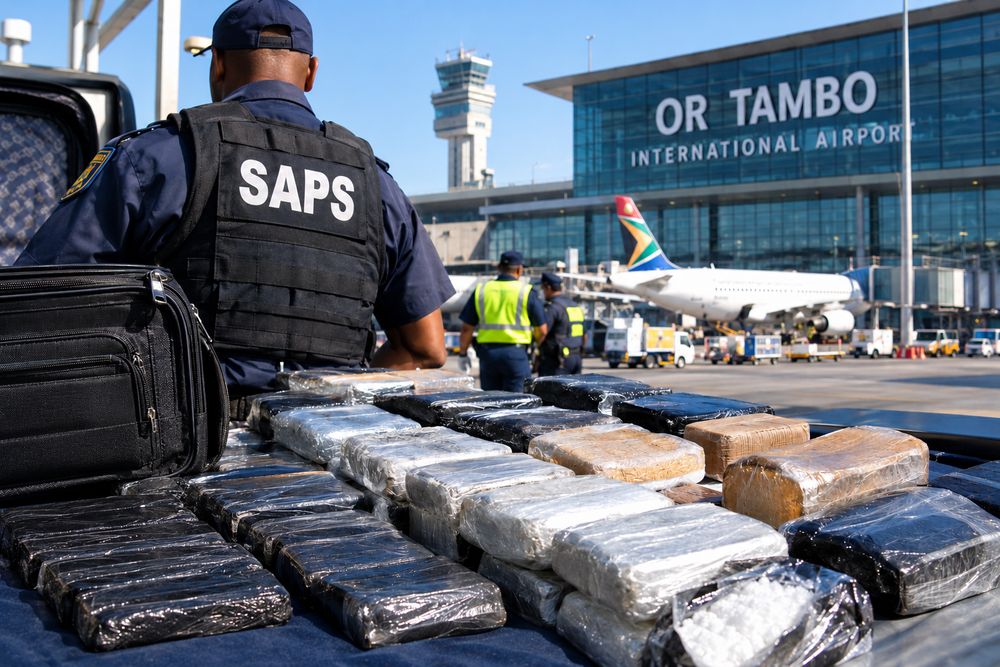
The arrest of couriers and seizure of hundreds of kilograms of cocaine may be only the visible edge of South Africa’s drug-trafficking crisis, with security experts warning that organised crime groups could be expanding into local production while exploiting gaps between customs, police, intelligence and border agencies.
Experts have warned that poor enforcement, fragmented intelligence and gaps in border control are allowing international drug-trafficking syndicates to exploit South Africa, with OR Tambo International Airport emerging as the country’s primary frontline against narcotics trafficking.
Earlier this month, IOL reported that from January to September 2026, OR Tambo had recorded the overwhelming majority of major publicly announced drug seizures and arrests involving narcotics couriers.
Intelligence-driven operations involving the SA Police Service (SAPS), SARS Customs, Airports Company South Africa (ACSA) and other law enforcement agencies have resulted in several significant cocaine and khat (a stimulant) seizures.
The latest incident occurred on September 7, when an alleged drug trafficker, 45, was intercepted and arrested at OR Tambo. Police seized approximately 2kg of cocaine with an estimated street value of more than R800,000.
Police said the man was travelling to Hong Kong, China.
He was the second alleged drug mule arrested within four days, following the arrest of a 54-year-old South African man at the same airport.
Drugs suspected to be cocaine were also seized.
On August 25, authorities intercepted more than 333kg of cocaine arriving from São Paulo, Brazil. The shipment included 83.1kg concealed in passenger luggage and 250kg hidden in unmanifested cargo. SARS valued the seizure at more than R167 million, while SAPS placed the combined street value at more than R200 million.
On July 31, SAPS intercepted another 95kg of cocaine worth about R28 million in cargo arriving from Brazil.
Other arrests included a Brazilian national caught with cocaine worth R8.7 million, a South African woman allegedly travelling to Hong Kong with cocaine and crystal methamphetamine worth more than R500,000, and Dutch and Somali nationals intercepted with khat.
Based on publicly announced SAPS and SARS operations from January 1 to September 8, authorities had seized at least 563kg of narcotics at OR Tambo, with an estimated value exceeding R236.8 million.
In response to questions from IOL, SARS Customs said it works with law enforcement and border-management partners to detect and prevent the cross-border movement of illicit goods.
“It also uses a range of initiatives that form part of SARS' broader mandate to protect South Africa's borders, facilitate legitimate trade and support efforts to combat illicit economic activity.”
SARS declined to disclose what intelligence it has on criminal networks involved in importing drugs, manufacturing equipment and precursor chemicals.
“To protect the integrity of its operations, SARS does not disclose its risk assessment methods, intelligence capabilities, enforcement strategies, or information relating to ongoing investigations and suspected criminal networks.”
SARS said it remains committed to working with domestic and international enforcement partners through intelligence-led interventions, modernisation initiatives and co-ordinated enforcement efforts.
“Where operationally appropriate, SARS communicates significant seizures and enforcement outcomes through its media channels.”
IOL also questioned SARS about trafficking routes, high-risk ports of entry, the importation of machinery and precursor chemicals used in clandestine laboratories, and whether Customs had identified companies or individuals importing such equipment.
While OR Tambo regularly features in SAPS announcements about major drug interceptions, fewer comparable seizures have been publicly reported at King Shaka International Airport and Cape Town International Airport during 2026.
However, Acting Police Minister Professor Firoz Cachalia told Parliament that the three airports collectively recorded 117 narcotics-smuggling cases between the 2023/24 and 2025/26 financial years.
“The precise classification of individual facilities forms part of security and intelligence assessments and is not publicly disclosed,” Cachalia said.
“Interventions in this regard include integrated multi-agency operations, intelligence-led profiling and the searching of suspicious cargo and conveyances, focused investigations, and strengthened access-control, supervision and integrity measures."
UNISA criminologist Professor Mpho Matlala said South Africa’s geography and infrastructure make it attractive to trafficking syndicates.
“The country offers multiple routes through air, sea and land. Or Tambo International is the biggest airport on the continent and facilitates more air traffic and cargo movements than any other in Africa.”
Matlala said weak enforcement at ports and borders was a major vulnerability.
“These are hardly policed as there is not sufficient law enforcement capacity. The containers arrive by sea at the Durban or Cape Town harbours. In most instances, these are not properly inspected due to a lack of capacity and technologies such as scanners. There's probably one scanner for containers in the whole country.”
He also raised concerns about intelligence delays.
“For example, SAPS border police often get shipping manifests three days after the vessel has left. As a result, our police rely on profiling suspect persons or vessels and Interpol comes in handy in that regard.”
Matlala said poor co-ordination between agencies creates further gaps.
“This creates a vacuum in border control and enforcement.”
Retired Interpol ambassador and security strategist Andy Mashaile said criminal networks were exploiting air, sea and land routes.
“The greater vulnerability, however, is not necessarily one particular port. It is the information gap between customs, border management, immigration, crime intelligence, the Hawks, financial-intelligence structures and the NPA.”
Mashaile said the discovery of clandestine laboratories could signal a shift towards local production.
“It suggests that organised crime may be moving from simply importing and distributing finished drugs towards greater local production and vertical integration.”
He said authorities must move beyond individual arrests.
“The problem is therefore not simply a lack of capability; it is the need for greater intelligence integration and network-level disruption.”
“Every major drug seizure should be treated as an intelligence gateway into the wider criminal network, rather than the conclusion of the investigation.”
He added, “South Africa must move from catching couriers to dismantling the architecture behind the courier - the people, money, logistics, manufacturing capacity and corrupt support structures that sustain the drug economy.”