Beyond the headlines: South Africans share their China stories - IOL
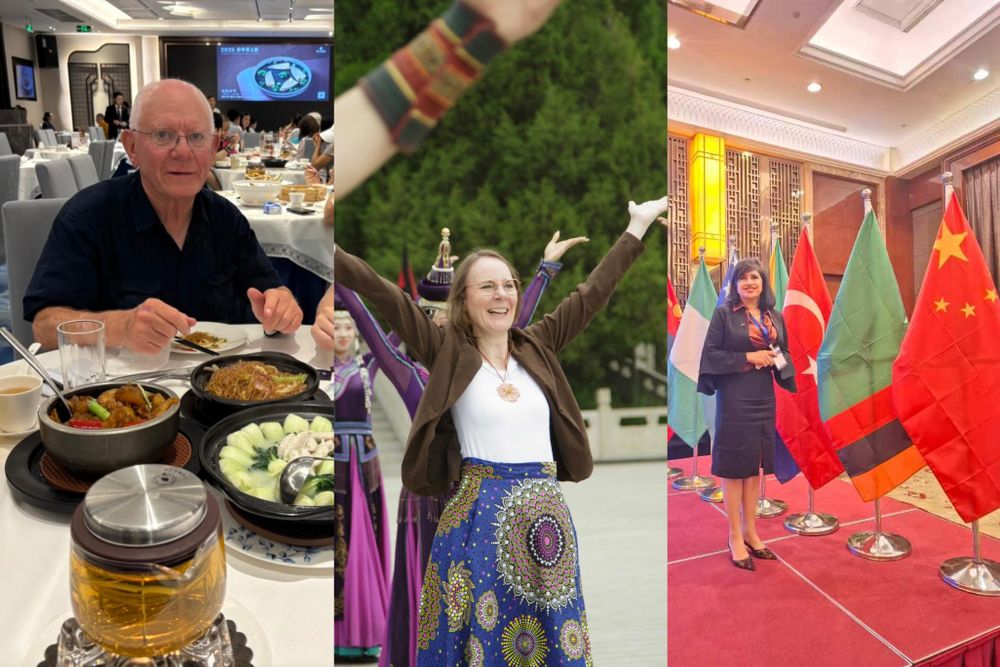
Three visitors in China. From left: Alan Ramsay, Sarah Struys, and Farhana Paruk.
Against the backdrop of the 2026 China-Africa Year of People-to-People Exchanges, people-to-people ties between China and South Africa have flourished. Streamlined visa policies have enabled more South Africans to travel to China for tourism, business, and exchanges.
An internet meme, “becoming Chinese”, popularised around the world, captures the excitement of foreign visitors keen to immerse themselves in China’s society, culture, and modern-day life.
As an old Chinese saying puts it, seeing is believing. Much of the public perception of China is formed by media headlines. Those who have travelled there offer unfiltered, first‑hand perspectives. Below, several South Africans fresh from their trips share their real-world impressions.
The trip helped challenge assumptions formed from headlines alone.
By Alan Ramsay, a South African magazine publisher, now retired, who founded “Getaway”, the South African travel magazine, visited the Beijing Motor Show in April.
China is a must-visit destination: Its advances in technology are eye-opening. The biggest surprises were scale, speed, and skill.
Skill: car design, robotics, and practical technologies such as exoskeletons.
The hospitality stood out too. The warmth of the people and quality of service made the scale of the country feel more personal. Hotels used robots for room service — an everyday example of how technology is being put to practical use.
The trip helped challenge assumptions formed from headlines alone, while the travel experience was as memorable as the big ideas. Meals were so fresh, tasty, and unlike the food many Western visitors expect. Prices were, on average, about 20% lower than in South Africa. Technology was woven into ordinary service, not kept as a novelty.
My visit to Hohhot is the highlight of my winter this year.
By Sarah Struys, Events and Tourism Manager of Kirstenbosch National Botanical Garden, who attended a seminar on Women’s Capacity Building and Integrated Development of Cultural Tourism and Ecology for Belt and Road Countries, organised by China.
While Hohhot (capital of the Chinese autonomous region of Inner Mongolia) has a rich history and numerous historical sights, it is also modern and fast-growing. The city, known for its clear blue skies, is surrounded by majestic mountains and lush grasslands.
Mongolian horses, cattle, sheep, and many bird species complete the picture. I emerged into the culture of Inner Mongolia, like being in a beautiful dream. I danced with traditional Mongolian dancers, dressed up as a Chinese princess, felted a toy sheep, made Chinese biscuits, played a horsehead fiddle, and watched a leather craftsman skillfully carve an endless knot for good luck into what was to become my favourite wallet.
While experiencing the joys of being a tourist in Hohhot, I learned from the Chinese professors in the seminar how the government of China has been investing in infrastructure and training, enabling its people to become experts in tourism experiences. The government recognised the business opportunities in tourism for women in particular, many of whom enjoy crafting, cooking, or hosting people for homestays. Tourism businesses also make it possible for women to generate income while caring for their families.
Typical crafts in Inner Mongolia include leather carving, felt and wool craft, and Mongolian embroidery. Crafters are trained to develop new products that are useful in modern life and therefore more attractive to tourists, while still staying true to their old crafting traditions.
As a tourist practitioner, it was a privilege to learn about the many tourism success stories in Inner Mongolia. And as a visitor to China, I will always fondly remember the pride and warmth with which the people of Inner Mongolia shared their cultural heritage with me.
This is a country that does not simply follow global technology trends — it sets them.
By Dr Farhana Paruk, Chairperson, South Peninsula Chapter, Cape Chamber of Commerce and Industry, who attended the Seminar on Digital Transformation and Upgrading of Manufacturing Industry for Developing Countries, which was organised by China.
There is no other word for my 14 days in Zhejiang Province. One is simply mesmerised by China's ability to stay ahead of the curve, again and again. At Zhejiang Sanhua and CFMOTO, I watched artificial intelligence and automation move from concept to factory floor with a fluency I had not witnessed before.
Electric vehicles rolled off production lines with a precision that spoke of years of deliberate investment, not luck. At the Jianghai Low-Altitude Intelligence Valley, I looked up at an economy taking shape in the sky itself. This is a country that does not simply follow global technology trends — it sets them.
And yet what moved me just as deeply was how this relentless innovation has not come at the cost of people or place. In Zhejiang's rural communities, tourism and development have lifted livelihoods without erasing culture.
At WENSLI, silk traditions older than most nations are printed without wasting a single drop of water. In Deqing County, hydrogen fuel cell innovation thrives far from any coastline — proof that transformation, done with intention, can take root anywhere.
This experience left me with a firm conviction: Africa needs to look east. For too long our continent has anchored its economic and technological partnerships to the West, particularly the United States, while a closer, faster-moving, more generous partner has been building bridges toward us in plain sight. China's openness in sharing its knowledge in AI, electric mobility, and industrial automation with delegates like myself is not a small gesture-it is an invitation. Our chambers of commerce, manufacturers, and policymakers should walk through that open door with far greater urgency.
These personal stories echo the spirit behind the global “Becoming Chinese” trend: there is no substitute for seeing a place for yourself. As people-to-people links between China and South Africa continue to expand, more South Africans will get to form their own views first-hand.