Big Crypto Is Trying To Take Down Sherrod Brown in Ohio - Newsweek
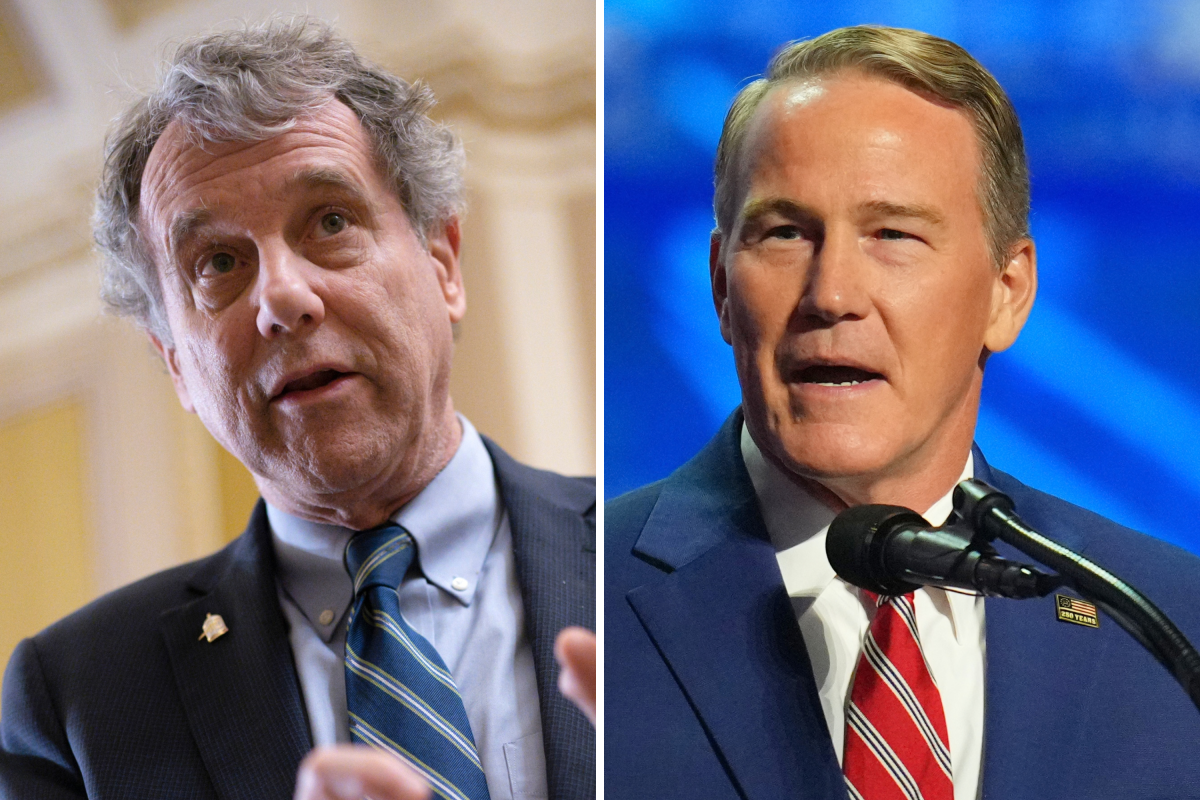
Crypto-backed super PAC Fairshake plans to spend at least $30 million against Democrat Sherrod Brown in Ohio’s November 3 Senate special election, The New York Times first reported.
Cryptocurrency groups are escalating their midterm spending after Senate Democrats opposed a procedural vote last week that would have allowed debate on the CLARITY Act, backed by President Donald Trump, leaving the bill stalled before formal debate could begin. The CLARITY Act would create a federal regulatory framework for cryptocurrencies and other digital assets, clarifying whether the SEC or the CFTC oversees them. Supporters argue it would provide long-sought regulatory certainty for the crypto industry, while critics have raised concerns about investor protections and provisions related to President Trump's crypto interests.
The industry’s largest intervention of the 2026 cycle will test whether outside money can overturn Brown’s polling advantage in a state that has moved right.
Ohio voters will choose between Brown, who is seeking an electoral comeback after representing the state in the Senate from 2007 to 2025, and the incumbent Republican Senator Jon Husted, who was appointed after JD Vance became vice president.
Patrick Eisenhauer, Brown’s campaign manager, said Husted was “for sale and the billionaires and corporations pouring millions into this race know it.”
“Of course the special interests are panicking, they know Sherrod will fight the rigged system they’re feasting on to stand up for working Ohioans,” Eisenhauer told Newsweek in an emailed statement.
Amy Natoce, a spokeswoman for the Husted campaign, said it was “understandable that Sherrod Brown is panicking about the onslaught of ads coming his way.”
“Ohioans already fired Sherrod Brown once, and they’re not willing to go back to his days of higher taxes and a wide-open border,” Natoce said.
Ohio is not an obvious center of the cryptocurrency business, making Fairshake’s spending less about defending a large local industry than opposing the return of Brown, who has frequently clashed with the crypto industry over regulation and consumer protection.
From 2021 through 2024, while chairing the Senate Banking Committee, Brown repeatedly warned about fraud, weak consumer protections and financial risks in cryptocurrency markets. Crypto-backed political groups then spent more than $40 million opposing his 2024 reelection campaign, CNBC reported.
Fairshake’s decision to make Ohio its biggest commitment of the cycle reveals how electoral influence can travel far beyond an industry’s geographic base.
Its financial backers are national companies and investors, but Ohio offers something more valuable than a concentration of crypto jobs: a chance to keep a powerful regulatory opponent out of Washington.
Crypto interests have nevertheless worked to make their case locally.
Coinbase previously advertised in Ohio, held a “Stand With Crypto” event in Columbus and recruited former Democratic Representative Tim Ryan to promote blockchain infrastructure as a possible source of jobs in rural communities.
Ryan argued that places such as Coshocton and Marietta were unlikely to receive another steel mill employing tens of thousands of people and should consider newer kinds of investment, per The Columbus Dispatch.
"There's a real opportunity here," Ryan said. "I've always made the argument coming from Youngstown that there will not be another steel mill with 30,000 people in it. That’s not how the economy works anymore."
That pitch is tailored to a state still shaped by manufacturing and industrial decline.
It asks voters to see digital infrastructure not as a coastal technology project, but as one possible element of a post-industrial economy.
Still, the immediate campaign is about federal regulation.
Fairshake’s announcement came days after Senate Democrats blocked the industry-backed CLARITY Act, although Brown is not serving in the chamber and did not participate in that vote.
Brown has also moderated his public language. He told The New York Times last month that cryptocurrency has “a part, a role, in our economy,” while maintaining that an industry should not write the rules governing itself.
Every survey in the current RealClearPolling average has Brown ahead.
Trafalgar Group’s September 14 to 16 poll of 1,085 likely voters put Brown at 45.4 percent and Jon Husted at 41.5 percent. Its margin of error was plus or minus 2.9 percentage points.
A Bowling Green State University/YouGov survey conducted September 1 to 10 among 1,000 likely voters found a 48 percent to 45 percent race. Its margin of error was plus or minus 4 percentage points.
InsiderAdvantage’s September 8 to 9 poll of 1,200 likely voters placed the candidates at 47 percent and 42 percent, with a margin of error of plus or minus 2.8 percentage points.
Fox News surveyed 1,008 registered voters from August 6 to 10 and found an eight-point lead, 53 percent to 45 percent. Its margin of error was plus or minus 3 percentage points.
In that survey, 40 percent named inflation as their leading concern, suggesting Fairshake will have to connect cryptocurrency policy with voters’ economic priorities.
Prediction markets turn the prices paid for political contracts into implied probabilities, offering a fast-moving measure of traders’ expectations rather than voter opinion.
They can react quickly to campaign news but should be treated as a forecast, not a result.
As of September 22, Kalshi gave Brown a 61 percent chance of victory against 39 percent for Husted, with about $3.94 million traded on the race.
Polymarket was more favorable to Brown, pricing the Democrat at 66 percent and the Republican at 37 percent.
Polymarket’s figures total 103 percent because its candidate contracts trade separately and their prices can overlap.
Ohio backed Barack Obama in 2008 and 2012 before voting for Trump three times.
Trump carried it by about eight points in 2016 and 2020, then by 11 points in 2024.
Republican gains in rural areas and among white working-class voters have outweighed Democratic progress around Columbus and Cincinnati.
Yet Brown won statewide in 2018 and lost to Moreno by 3.6 points six years later, leaving the state red-leaning but not necessarily beyond his reach.
Fairshake’s spending will test whether an industry centered elsewhere can translate a Washington regulatory fight into a persuasive message for Ohio voters.
Newsweek’s reporters and editors used Martyn, our AI assistant, to produce this story. Learn more about Martyn here.Contact Newsweek editors on this story: John Fitzpatrick and Gray R. Thomas