
Bilawal's rebellion: Why Sindh is his red line - Geo News
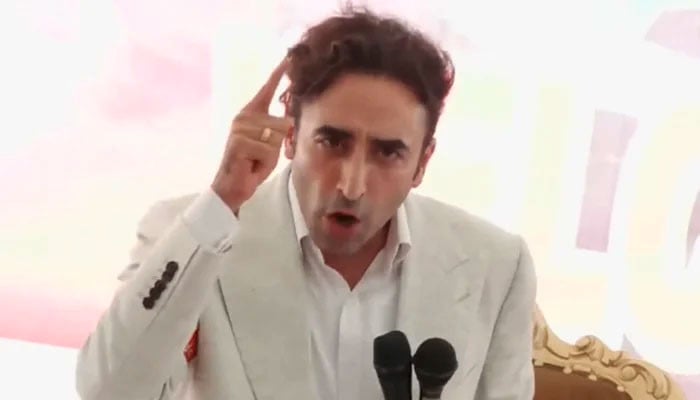
There are very few politicians left in Pakistan who can stand before journalists at a major press club and face every kind of question. On November 17, Bilawal Bhutto-Zardari, the young chairman of the Pakistan Peoples Party (PPP), delivered an explosive speech at the Karachi Press Club that was both a confession and a warning. Knowing that the journalists before him would find many contradictions in what he said, he admitted that he, too, had contributed to the destruction of the system. He said that all institutions, including parliament, the Election Commission, the judiciary and the media, had lost the public trust, and that they must now work together to restore it.
Everyone knows that the Shehbaz Sharif government survives on PPP votes, yet Bilawal's speech was full of complaints against that government. The biggest surprise concerned Defence Minister Khawaja Muhammad Asif, who recently voiced support for creating new provinces and suggested that a new system could emerge before the New Year. The defence minister had claimed that the PPP was being taken into confidence, but Bilawal made clear that the government had so far held no talks on the subject with him or with his father, President Asif Ali Zardari.
Bilawal not only rejected the proposal to create new provinces through a referendum but also described the 27th Amendment as the product of a brute majority, signalling that he will not support a 28th Amendment under similar coercion. He criticised Interior Minister Mohsin Naqvi's statement that Pakistan's current system has collapsed, clarifying that the system did not collapse on its own: it was forcibly brought down by force and now needs to be "reset".
The first reaction to Bilawal's "rebellious talk" came from Federal Minister for Information Attaullah Tarar, who said that Bilawal was enjoying the perks of government while playing the role of the opposition at the same time. Tarar added that public debate on new provinces cannot be stopped at the wish of one party, and that a referendum is a constitutional way to gauge public opinion, so Bilawal should not fear it.
In other words, the information minister, for the first time, put the government's official stamp on the idea of a referendum for creating new provinces, even though no debate on the subject has yet begun in parliament or the federal cabinet. Perhaps this is exactly what Bilawal wanted: to bring the government's position out into the open, making it easier for him to form a new political alignment. In the same speech, he called Imran Khan a political prisoner and demanded the release of all political prisoners. He also condemned the government's vindictive actions against Maulana Fazlur Rehman. This suggests that he is mentally prepared to withdraw support from the government over the issue of new provinces and to join the opposition.
At present, besides the presidency, the PPP holds the governorships of Punjab and Khyber Pakhtunkhwa, as well as the posts of Senate chairman and Deputy Speaker of the National Assembly. The chief ministerships of Sindh, Balochistan and Gilgit Baltistan are with the PPP by virtue of its numerical majority in the provincial assemblies. If the PPP withdrew its support from the government, it would have to sacrifice several important offices, including the presidency, the Senate chairmanship and the two governorships. Morally, Bilawal would also have to give up his seat on the Judicial Commission, since he obtained it under the government's quota.
The next day, Bilawal gave hard-hitting interviews to several TV channels. He warned that there would be bloodshed in Sindh if a referendum were forced upon the province to divide it. He also targeted Mohsin Naqvi repeatedly, who is regarded as being very close to the military establishment.
Why, then, is Bilawal ready to start a new political battle and risk important constitutional offices over new provinces? The reason is obvious. His party is willing to see new provinces created in Punjab and Khyber Pakhtunkhwa, because the assemblies of both provinces have passed resolutions in their favour. But he will not accept the division of Sindh at any cost, because the Sindh Assembly has passed resolutions against it more than once. Bilawal fears that if a referendum is held, the Election Commission of Pakistan will be used to produce a result of the government's choosing, and it will be declared that the people have voted for new provinces. New provinces would then be created by force and coercion, rather than through Article 239 of the Constitution.
Bilawal also made special mention of the Sindh Assembly's 1943 resolution in favour of Pakistan. The Sindh Assembly, he said, was among the first to support Pakistan, and if it does not support new provinces today, its wishes should be respected. It must be understood that the division of Sindh is not just a PPP issue. All of Sindh's nationalist parties oppose it. Only the Muttahida Qaumi Movement-Pakistan (MQM-P), which is considered the party representing Urdu speakers, wants Sindh divided. That is why Bilawal expressed fear of bloodshed: we have seen terrible ethnic riots there in the past.
Personally, I, too, have many complaints against Bilawal. Going against his earlier promises and his party's traditional stance, he got the PECA Act 2025 passed and plunged a dagger into the back of media freedom. Today, as a fight brews between him and his allies, we might be tempted to simply watch the spectacle, but it could prove very costly for all of us. God forbid, conditions could deteriorate in Sindh too, and the province could become another Balochistan.
I am reminded of Bilawal's first press conference, 18 years ago, on January 8, 2008. A few days after the assassination of his mother, Benazir Bhutto, he held a press conference in London and announced that he would carry on her mission. He was handed the leadership of the PPP at just 19, when slogans against Pakistan were being raised in Sindh in the wake of her killing. At that time, his father, Asif Ali Zardari, raised the slogan "Pakistan Khappay" (Long live Pakistan) and rejected the demand for Sindh's separation. Bilawal, too, continued the politics of the federation. His father became president twice, and Bilawal became foreign minister. Today, his party governs more than half of Pakistan.
If Bilawal is angry with the government over the division of Sindh, his intentions should not be doubted. The background to his explosive speech needs to be understood. In my view, he has so far spoken very little. He has much more to say, but perhaps, for now, he wants to confine his rebellion to the prime minister and his cabinet, so that the system gets "reset". If it does not, a bigger rebellion could follow, and I see the danger of a return to the era of General Zia-ul-Haq, when Sindh and the federation were pitted against each other, and the military establishment turned to the MQM and a separatist leader like GM Syed to counter the PPP. This claim is not mine but that of former Army Chief General Mirza Aslam Beg, who said in a TV interview that the MQM was created at General Zia's behest to counter the movement for the restoration of democracy in Sindh.
The 1973 Constitution already provides a route for creating new provinces: altering a province's boundaries requires a constitutional amendment backed by two-thirds of that province's assembly. Rather than bypassing the Sindh Assembly through a referendum, the political leadership should take the question to parliament and the provincial assemblies and build consensus. Nobody can create new provinces at gunpoint. This adventure could push Pakistan into yet another round of chaos.
The writer is a senior journalist, anchor, and columnist, associated with Geo News. He posts on X@HamidMirPAK


