
BJP won Rajasthan civic polls, but details paint a more complex picture - The Indian Express
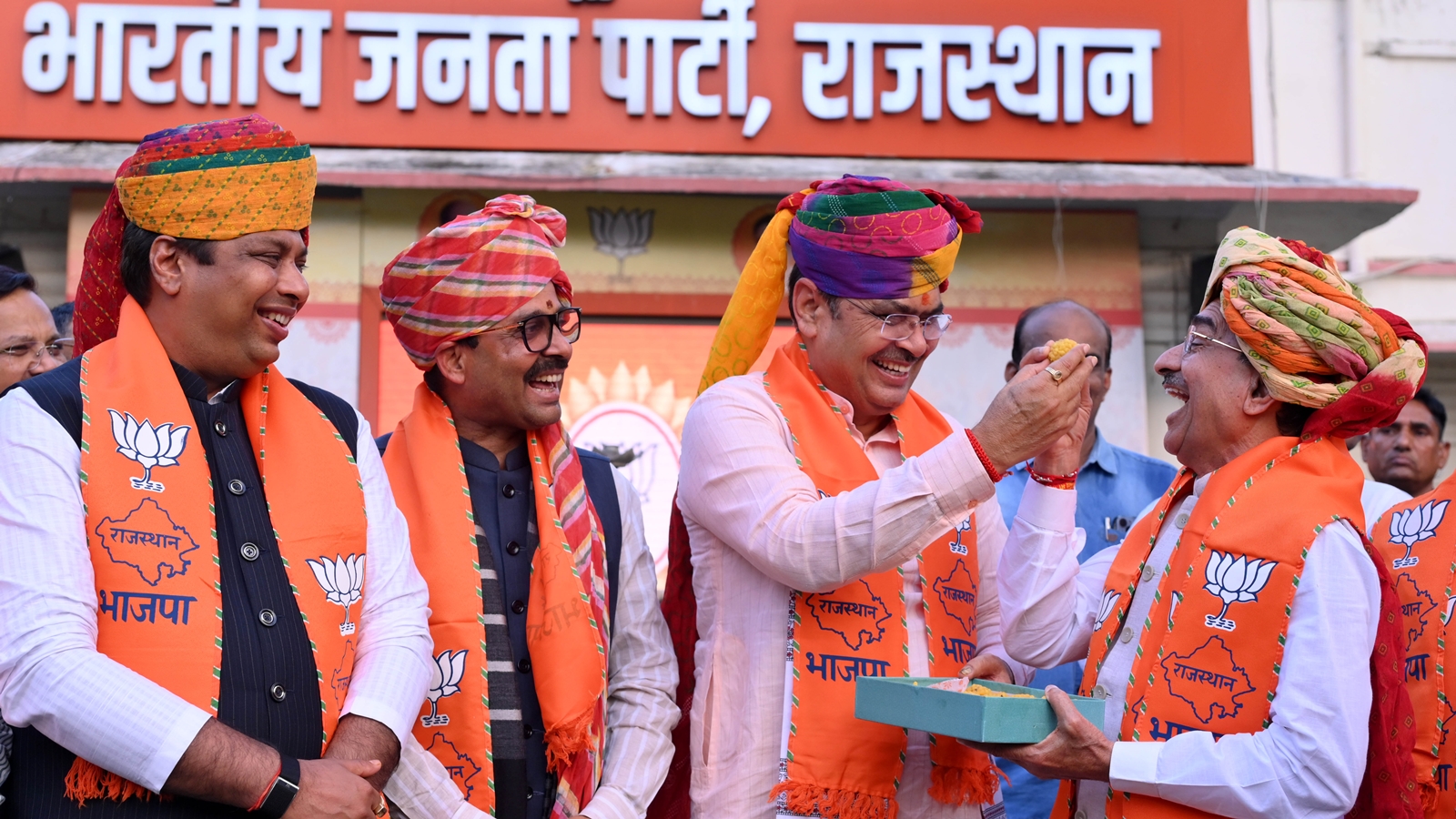
With results for almost all the 10,000 wards in the Rajasthan urban local body polls in, a finer reading indicates worrying signs for the BJP government halfway through its tenure.
Of the 10,235 wards in which results have been declared — the outcome in nine have been held due to EVM glitches in some booths — the BJP won 4,179 wards against the Congress’s 3,613 wards, while Independents won 2,273 wards, upsetting both the BJP and the Congress in several places.
Of the 10 municipal corporations, the BJP crossed the halfway mark only in four, while the Congress did so in one. In the elections to 47 Municipal Councils, the BJP secured a clear majority in 12 bodies, while the Congress crossed the halfway mark in six, and the AAP in one. The BJP clinched 70 of the 252 Municipalities as against the Congress’s 39, with Independents or smaller parties being crucial for forming Boards in most of the remaining Councils and Municipalities.
First, the results point to anti-incumbency building up against the Bhajan Lal Sharma government. The government has tried to tread carefully, but that has often led to delays in decision-making. In the last two and a half years, the government has largely been seen as being reactive to the developments, rather than taking an initiative towards their resolution early on.
Be it taking a call on Cabinet minister Kirodi Lal Meena’s resignation in 2024, the cancellation of the 2021 Sub-Inspector examination, or holding local body polls, the government is seen as being indecisive on political hot-button issues; on the last two, the courts repeatedly chided it.
Early on, the government’s image was shaped by the CM’s inexperience — he is a first-time MLA — and its dependence on bureaucrats. A side-effect of this was visible in the December 2024 Investment Summit where projects worth Rs 35 lakh crore were purportedly signed. However, after it was alleged that several of these projects were already underway, the government refused to furnish information in an RTI.
While it has managed to overcome the “bureaucrat-heavy” perception to some extent, its slip-ups haven’t stopped.
Last year, the Rajasthan Assembly sent three Bills to the Select Committee in a single session, including a Bill to regulate coaching centres. Of the three draft laws, the Rajasthan Ground Water Authority Bill was sent to the Select Committee for the second time. The Rajasthan Prohibition of Unlawful Conversion of Religion Bill too was initially withdrawn and tabled again. In contrast, under the previous Ashok Gehlot government, only two Bills were sent to the Select Committee in its five-year tenure.
Then there have been decisions which were withdrawn following a backlash: celebrating December 6 — the day in 1992 when Babri Masjid was demolished — as “Shaurya Diwas (Day of Valour)” — this was announced and withdrawn twice; Ram Katha deployment for teachers; and Sarthak Naam campaign in schools.
In February, the demand to protect Khejri trees snowballed into a major protest, which had been simmering since last December. The CM announced a law after the protest.
More recently, a delegation of the Cockroach Janta Party (CJP) was attacked in Jaipur’s Bagru, adjacent to the CM’s own Assembly seat, Sanganer. Soon after, the government listed its measures for school infrastructure and the CM’s office itself announced Rs 18 lakh for the school the CJP had inspected. This invited criticism of the government’s handling of the issue.
Earlier this year, former CM Ashok Gehlot also accused the BJP government of sitting on several major public infrastructure and healthcare projects, alleging prolonged delays and oversight.
While the CM is praised for his clean image, his public addresses, coupled with an occasional slip of the tongue, are a contrast to former CMs Gehlot and Vasundhara Raje. While Raje was known to be measured, Gehlot usually resorted to quips. And behind the scenes, while Raje benefitted from being a tough taskmaster, Gehlot was more perceptive of political messaging through his government.
Sharma has struggled to establish his own identity. Moreover, the once top party leaders in the state have been sidelined, with the control remaining with the high command. So, the accountability at the state level — and thus the stakes — are also lower. At the party level, leaders including state chief Madan Rathore have indicated a Cabinet reshuffle on multiple occasions, but it has been in abeyance. Party insiders attribute this to a lack of political will, as it carries an inherent risk.
For CM Sharma, the Independents performing better than the BJP in his home turf of Bharatpur will be a cause of concern: Independents won 36 wards in the 65-member Bharatpur Corporation as against the BJP’s 20 and the Congress’s seven. In BJP state president Madan Rathore’s home turf of Pali, out of 65 wards, the Congress bagged 29 against the BJP’s 21, while Independents won 15. The BJP also suffered a loss in the 45-member Jhalawar Municipal Council, where it got just 13 against the Congress’s 29. This region is considered a stronghold of Raje, who is an MLA from Jhalrapatan in the district. The BJP, however, won the Jhalrapatan Municipality.
For nearly three decades, Rajasthan has voted out the incumbent. Though the signs appear ominous for the Sharma government, the BJP is adept at making course corrections and still has time to make amends.
Of the total votes polled, BJP cornered 35.19% against Congress’s 34.25%, a difference of 0.94%. Independents stood at 27.38%, essentially turning it into a three-way contest in many places.
Compared to vote percentage, the difference between BJP and Congress was starker in terms of wins, with BJP winning 566 more wards and surging far ahead of the Congress.
The Congress has alleged that delimitation helped the BJP in several places. Citing “lopsided reconstitution of wards”, state Congress chief Govind Singh Dotasra claimed that if not for the “dishonest” exercise, the party would have won 1,500 more wards than the BJP.
The independents, including rebels, also played spoilsport for both the parties: ticket distribution and dissatisfaction over candidate selection led to the creation of rebels in several places. For instance, the AAP’s breakthrough win in Baran Municipal Council came with Kamal Rathore, a former Municipal Council Chairperson with the Congress.
With over 10,000 wards going to polls, it also became difficult for either party to contain and micromanage the many rebellions. Protests by “upper-caste” outfits such as the Karni Sena, demanding rollback of UGC equity regulations and linking it to the polls, also had an impact to some extent. The Sena claimed that it had backed over 70% of the winning independents.
The Congress also won more reserved Scheduled Caste (SC) and Scheduled Tribe (ST) seats, indicating that the BJP not only lost some support within traditional vote-banks but also couldn’t counter the Congress narrative of the BJP being “anti-Dalit”, especially in light of the Haldwani “purification” row in which party chief Mallikarjun Kharge was at the centre.
However, a lot of damage to the BJP was checked due to several measures, including at the organisational level, and campaigning by the party’s top brass in the state, including the CM, the ministers, all four Union Ministers, as well as delimitation. In contrast, all top leaders of the Congress maintained their distance from campaigning, with the party attributing it to a long-running trend in the state.
Traditionally, the BJP has performed well in urban areas and the mandate in local body polls usually goes in the ruling party’s favour. But the party’s underperformance indicates that it may have to quickly set its house in order, especially in light of the coming polls for panchayati raj institutions, where the Congress is expecting to fare better than it did in the urban polls.
Hamza Khan is a seasoned Correspondent for The Indian Express... Read More

