
Brad Bradford wants to scrap Toronto’s land transfer tax for some. Critics say the math doesn’t add up - Toronto Star
According to city documents, this year's $18.9-billion operating budget is relying on $850 million from that tax.
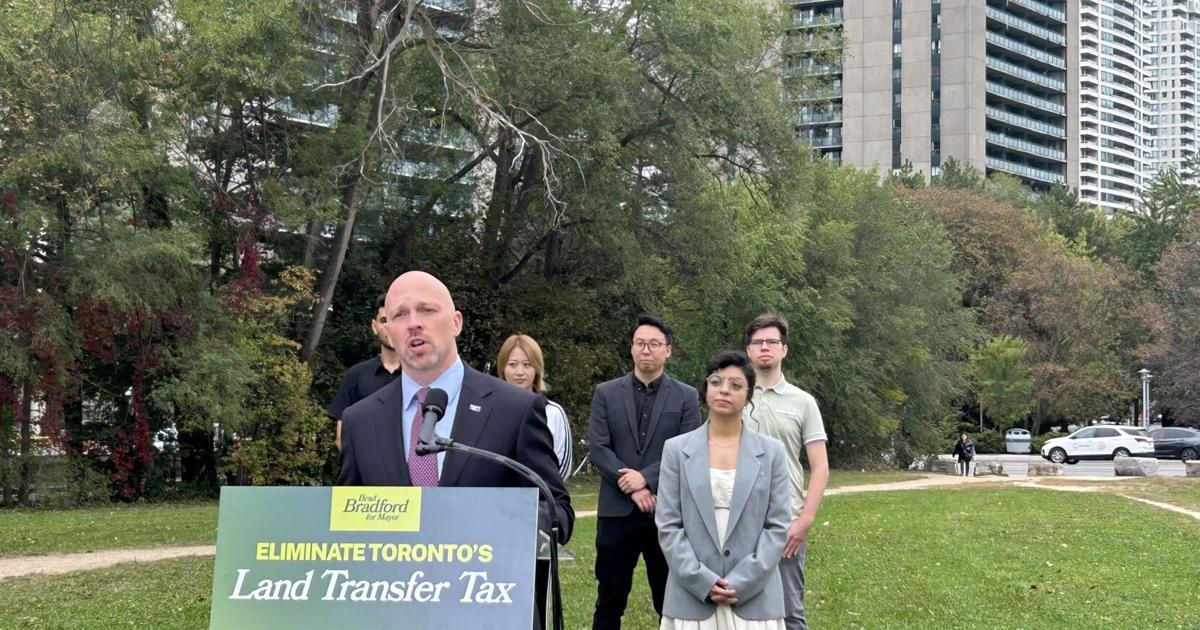
Mayoral candidate Brad Bradford announced his platform policy on eliminating the municipal land transfer tax on homes worth $1.1M and under on Tuesday in Willowdale.
Mayoral candidate Brad Bradford is promising to cut costs for some homebuyers by eliminating a key municipal revenue tool.
At a press conference in North York on Tuesday, Bradford announced he would scrap the municipal land transfer tax on the first $1.1 million of the purchase of a home, meaning homes worth at or under that, which was the average home price in 2025, wouldn’t pay the tax at all.
It’s a promise that comes on the heels of what critics called a risky proposal to change the city’s water department into an incorporated public utility.
It’s also the latest in a series of costly campaign promises which Bradford said he’d try to use strong mayor powers to impose, if he doesn’t have council support — but which experts and rivals have cautioned could yield short-term relief at the cost of kicking escalating debt down the road or service cuts.
“City Hall should be making it easier for people to buy their first home, put down roots, and build a life here,” Bradford said in a Willowdale residential area flanked by some of his younger volunteers. “If you already own a home in Toronto, and you sell it to buy another one here, you’re going to get the same break.”
The tax is one that buyers pay on the purchase of homes and which the cash-strapped municipality uses to pay for various city services. According to city documents, this year’s $18.9-billion operating budget is relying on $850 million from that tax.
In December, council approved Mayor Olivia Chow’s proposal to raise this tax on homes valued at $3 million or more and it was expected to bring in an extra $13.8 million in revenue this year. Bradford had moved to beef up the city’s first-time homebuyers rebate program from $400,000, which was set in 2008, to $800,000 but it was voted down in favour of an amendment from Chow which asked the city to “consider options to improve” the rebate program.
Bradford is also pitching to change that rebate so it falls in line with the market every year.
Existing tax rates would still apply on homes valued above that $1.1 million threshold and the rates council approved in December on homes above $3 million would also remain.
In total, Bradford said, his idea amounts to about $300 million a year in foregone revenue but would be funded through expected dividends from a plan he announced on Monday where he said he hopes to create a municipally-owned water corporation similar to Toronto Hydro by next year to reduce water bills. The proposal was slammed by election rivals and some critics because it involved taking on more debt to fund long-term infrastructure projects, all the while handing control over to the province because of new laws that govern incorporated water utilities.
Chow’s campaign spokesperson Shirven Rezvany said in a press release that Bradford’s costly platform would mean “drowning” the city in “massive” debt.
“He’s relying on an imaginary dividend from his provincially-controlled water corporation, gutting billions from the City’s capital budget, and taking on even more debt. This is not a real plan,” Rezvany said.
“When Bradford’s house of cards falls apart, he will cut and slash city services or just fail to deliver.”
Chris Alexander said in a press release he agrees the land transfer tax is too high, and that he’d want to reduce it eventually, “but you fix the books first, then you cut. What (Bradford) is proposing is worth six points of property tax, three hundred million dollars, every year. Gone.”
The tax rises and falls with the housing market and the market has fallen, he noted, so the tax is bringing in almost a quarter less than it did at its peak in 2021 and 2022.
“The other two candidates keep coming up with feel-good discounts and no solutions attached,” Alexander said, referencing what he’s previously referred to as Chow’s “regressive” fare structure for the TTC when she promised a weekly fare cap.
Bradford has also proposed freezing property taxes in his first year as mayor — effectively a budget cut, given the city’s costs go up each year — while proposing an independent audit of the city budget, a suggestion that raised the spectre of unpopular Rob Ford-era spending cuts.
Janice Baker, a former city manager at Mississauga and former chief administrative officer of Peel region, questioned the long-term benefits of Bradford’s proposal, arguing it’s not real savings in the long run if Toronto would be incurring debt with interest, and that relying on profits from a future public utility to draw dividends can be fraught.
“If you’re going to turn your water model into something like (Toronto Hydro’s), then you’re going to have to find money,” she said. “Your current utility does not generate a profit. So where’s the dividend going to come from? You’re cutting revenue. You’re affecting the financing of your capital program by borrowing.”
Baker noted water is a critical public service. “You don’t ever want to be relying on your water utility to generate additional revenue … to fund something like a land transfer tax reduction,” she continued.
Baker said she’s always advised city council that what gets resourced is what gets done, that a reduction in one area needs to be paid for in another way. But, “hope is not a strategy, and (Bradford’s idea) is based on hope, in my view.”
Mahdis Habibinia is part of the Star's city hall bureau, based in Toronto. Reach her via email: mhabibinia@thestar.ca


