
Brazil 4-0 India: Kolkata gets its Brazil night, India gets a reality check
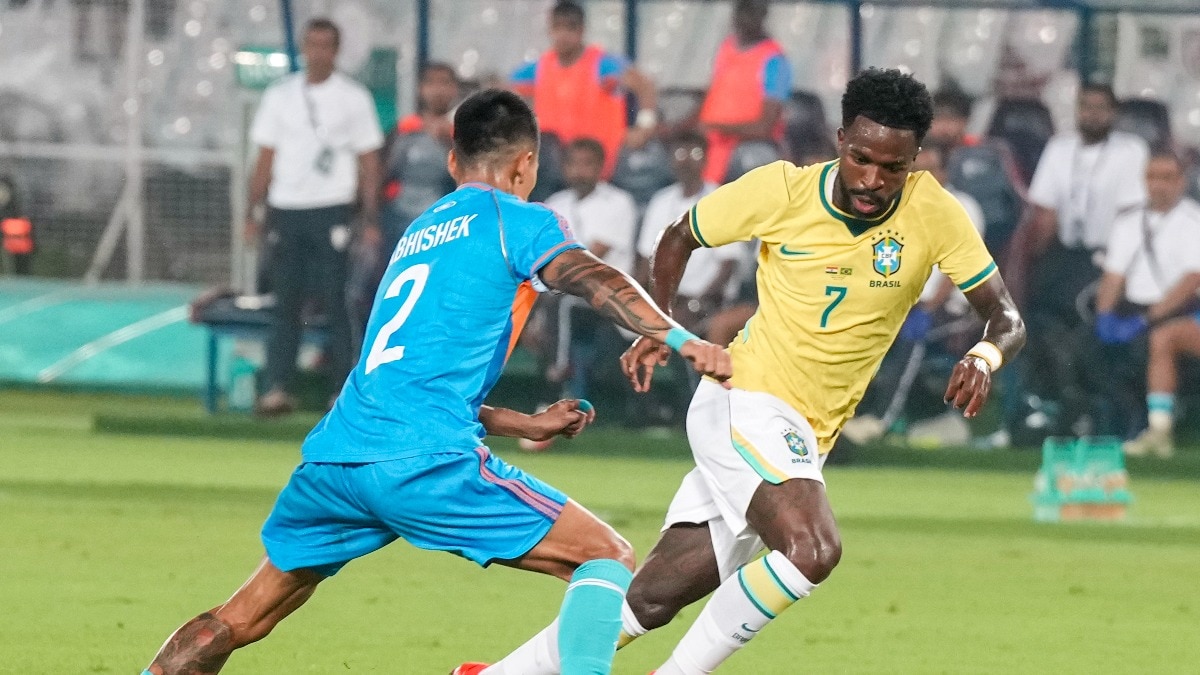
For weeks, India vs Brazil had been living in Kolkata long before the players did. It was in the arguments over ticket prices, the boycott calls, the Brazilian shirts appearing around the city, the fascination with Vinicius Jr and, above all, the question of whether a football-mad city would actually show up when Brazil finally arrived.
On Saturday, even the sky seemed determined to add to the drama. Rain swept across Kolkata for much of the afternoon, making the journey to Salt Lake Stadium harder, while large sections of the ground remained empty as the evening began. There was enough time for the weather to change and, perhaps more importantly, enough time for Kolkata to make up its mind.
The seats began filling as kick-off approached and the sound inside the stadium grew with them. When Brazil walked out for their warm-up, Vinicius Jr received the reception everyone had expected. He acknowledged the supporters and was immediately surrounded by the noise that had followed his name around Kolkata for days. On the other side, Anwar Ali and Ryan Williams were among the India players drawing some of the loudest cheers from the home support.
It was an important distinction on a night built around Brazil. The visitors had the global stars, the famous yellow shirts and the attention of the football world, but the home crowd had come with its own loyalties. They wanted to see Vinicius, but they also wanted India to make this more than a celebration of the opposition.
For the opening exchanges, India did exactly that.
The defensive line pushed high, the players looked willing to take responsibility on the ball and Brazil were not allowed the easy runs they would have wanted behind the defence. Vinicius kept trying to make those movements from the left, but India’s offside trap repeatedly caught him out.
For a while, the biggest Brazilian name on the pitch was also the player India were making work the hardest.
Sahal Abdul Samad added another dimension to India’s approach. He was willing to receive the ball under pressure, turn away from Brazilian players and carry it forward rather than simply surrender possession. Ryan Williams provided the running on the flank, while Manvir Singh tried to stretch the Brazilian defence whenever India managed to win the ball in promising areas.
It was not domination, nor was it ever likely to be. But India were making Brazil uncomfortable, and inside Salt Lake there was enough evidence to believe that this could become a proper contest.INDIA MAKE BRAZIL WORK
Brazil had more of the ball, but India were initially better at dictating the terms of the moments that mattered. Their defensive line remained compact and brave, with Bijoy Varghese and Anwar Ali doing a good job of keeping the spaces in front of Gurpreet Singh Sandhu under control.
The offside trap became one of the defining features of the opening period. Vinicius would make the run, Brazil would attempt to find him and India’s defenders would step up just in time. It happened repeatedly, and although there was always a risk attached to playing that high against a forward of Vinicius’ pace, India were executing the plan well.
Gurpreet, too, looked comfortable behind the defence during this spell. He dealt with the balls that came his way and offered the kind of calm India needed against an opponent that could punish even a small lapse.
At the other end, Sahal’s willingness to take on players gave India a useful escape route. They were not creating chance after chance, but they were at least capable of turning defensive recoveries into attacks.
Then Brazil changed the angle of the game.
Their attacks had been heavily concentrated around Vinicius and the left side, where India had become increasingly comfortable dealing with the threat. Brazil began switching the point of attack towards the right, bringing Estvo more prominently into the game.
That adjustment immediately created a different problem.advertisementESTEVAO OPENS THE DOORIn the 28th minute, Estevao found enough room for the first real breakthrough. Ashique Kuruniyan could not close him down in time, and the Brazilian took the opportunity with the kind of finish that made the difference between the two sides so stark.
His low, powerful strike went beyond Gurpreet and Brazil had the lead.
Brazil take the lead through Estevao in the 28th minute.
It was Brazil’s first real shot on target, and yet it was enough to change the complexion of the match. India had spent the opening spell playing with freedom, but the goal meant they now had to take more risks against a side that could turn those risks into further openings.
The physical demands began to show. Manvir Singh and Tekcham Abhishek were covering large distances, while Williams was dropping increasingly deep to help India progress the ball. The attacking runs became less frequent and Brazil were able to spend longer periods moving the ball around India’s defensive shape.
That was why the second goal hurt as much as it did.
Pedro’s effort in the 42nd minute did not appear to carry the kind of danger that should have produced another goal. Gurpreet got a hand to it, but the ball slipped through him and ended up in the net.
It was a goal that came from a goalkeeping error rather than a moment of Brazilian brilliance. Gurpreet had started the match looking assured, but his mistake gave Brazil a two-goal advantage without the visitors having produced the kind of flowing, attacking football associated with their greatest teams.
There was another scare before the break when Gurpreet misjudged a ball that struck his knee and ricocheted dangerously into the area. Brazil were ready to capitalise, but Bijoy Varghese reacted brilliantly to clear the danger.
India went into the interval two goals behind rather than three.
Gurpreet did not return for the second half, with Prabhsukhan Gill taking his place.
The irony was difficult to miss. Vinicius had received one of the biggest cheers of the night before the match, yet he had spent much of the opening 45 minutes being frustrated by India’s defensive line. The player everyone had come to watch had not found the space to make the kind of impact expected of him, while Brazil had largely relied on India’s mistakes rather than producing sustained attacking dominance.advertisementBRAZIL FIND ANSWERS WITHOUT VINICIUSIndia needed a strong start after the break. Instead, another defensive error put them in an even deeper hole.
Tekcham Singh made a mistake after India had initially defended the situation well, allowing Brazil to move the ball quickly through the opening. A sharp combination followed before Samuel Lino finished.
Brazil had a third, but again the goal was less about a spectacular attacking move and more about Brazil being alert enough to punish an Indian lapse. They were not playing the free-flowing, expressive football that has long been associated with the phrase Joga Bonito. They were being efficient, opportunistic and clinical when India gave them an opening.
At that point, the contest appeared to be heading towards a straightforward exercise in damage limitation. Yet India produced one of their most encouraging moments soon afterwards, and once again Ryan Williams was at the centre of it.
The winger picked up the ball and drove directly at Jair Paula da Cunha. He got beyond the Brazilian defender and continued into the area, refusing to slow down even as the space around him narrowed. Rather than rushing the finish, Williams waited for the right moment, created the angle and got his shot away.
He had done almost everything right.
Mauro Jnior, however, was in the right place at the right time and produced an excellent goal-line clearance. The rebound fell to Manvir Singh, but India could not take the second opportunity either.
It was one of those sequences that summed up the difference between creating a moment and converting one. India had managed to break Brazil open, but even then the Brazilian defence found a way to recover.
Williams was visibly frustrated. He had carried much of India’s attacking responsibility and had come as close as anyone in blue to giving the home crowd something to celebrate.
India deserved credit for that spell, just as Bijoy Varghese deserved credit for the way he defended throughout the match. The centre-back was one of the players who looked comfortable against the level of movement and physicality Brazil brought. Williams showed directness and courage, while Manvir, after a quieter first half, began to find another gear after the break.
But too many of India’s other players needed to raise their level. Against Brazil, a few strong individual performances are not enough. The team needs more players willing to take responsibility, sustain their intensity and make the right decisions under pressure.VINICIUS GETS HIS CHEER, NOT HIS GOAL
For all the attention around Vinicius before the match, his evening never developed into the performance many had anticipated.
The crowd had given him the reception he had come for. His name had been central to the build-up, his presence had helped sell the occasion and every time he came near the ball there was a noticeable reaction from the stands.
But India had prepared specifically for the threat he posed.
The offside trap repeatedly disrupted his movement, and the Brazilian forward rarely found the open field in which his acceleration becomes so difficult to contain. There were flashes of quality, but no sustained spell in which he was able to take over the game.
His form also appeared to be a factor. Vinicius has not looked at his most dangerous best in recent weeks, and that lack of rhythm was visible in Kolkata. He was not consistently beating his marker, his runs were often mistimed or caught offside and he struggled to impose himself on a match in which Brazil were expected to dominate.
That does not erase the quality he possesses. Vinicius remains one of the most dangerous wide forwards in world football when he is confident, sharp and receiving the ball in space. But this was not that version of Vinicius.
In a way, that became one of the more curious stories of the night. Vinicius was the Brazilian player Kolkata had waited to see, yet India’s defensive discipline ensured that his influence remained limited for long periods.
Brazil, of course, did not need him to score.
They had already found other ways to hurt India, mostly by waiting for mistakes and reacting faster when those mistakes arrived.INDIA’S ATTACK RUNS OUT OF LEGS
Manvir Singh then produced an interesting second-half shift. Having looked increasingly exhausted earlier, he suddenly seemed to find another reserve of energy as the game entered its final quarter.
His runs returned and he began looking more willing to stretch Brazil’s defence again. He pressed with greater purpose, carried the ball more aggressively and offered India a better outlet than he had in the opening period.
The problem was that Williams was beginning to tire.
After nearly 70 minutes of running, carrying the ball and trying to create India’s attacking moments, the winger was visibly beginning to lose some of his sharpness. The timing was unfortunate because India’s two most direct attacking players were finding their best moments at different stages of the match.
It left India with flashes rather than sustained pressure.
That distinction became increasingly important. Against many opponents, a good five or ten-minute attacking spell can completely change the momentum of a match. Against Brazil, a team with the technical quality to control possession and the individual ability to punish mistakes, those spells need to produce something tangible.
They had not turned enough of them into goals.
And by now, the physical cost of chasing Brazil was becoming obvious.
The scoreline also made the performance look more one-sided than it really was in terms of how the goals arrived. Brazil had won comfortably, but they had not spent the night producing wave after wave of irresistible football. They had been efficient when India made errors, and India had not done enough to punish Brazil when opportunities appeared.
That is where the rest of the Indian team must improve. Bijoy and Williams showed they could compete in their individual battles. Manvir found a second wind. But India needed more from the players around them, particularly in possession and in the final third.51,402 AND A DIFFERENT KIND OF ANSWER
Around the 70-minute mark, the attendance figure was announced.
The number was sizeable, although empty sections remained visible around Salt Lake Stadium. The attendance had been one of the major talking points in the build-up, so its announcement became part of the evening almost as much as the football.
Would Kolkata turn up for Brazil? Would the ticket prices keep supporters away? Would the rain make the journey difficult enough to affect the crowd?
The answer was somewhere in the middle.
The stadium was not packed wall to wall, but there was a substantial crowd and, more importantly, the noise had gradually grown. There had been cheers for Vinicius, roars for India’s players and a noticeable rise in energy whenever India managed to carry the ball forward.
The empty seats were visible, but so was the support.
For a city that had spent weeks arguing about whether it would show up, 51,402 was neither the overwhelming turnout some had expected nor the empty-stadium scenario others had feared.
It was simply another part of a complicated night.THE RHYTHM FINALLY DISAPPEARS
The football itself was beginning to slow down by then.
The substitutions became more frequent, Brazil were increasingly comfortable with their three-goal advantage and India were running low on the energy that had made the opening spell so competitive.
The match began to resemble a friendly in the final stages. Brazil no longer needed to chase the game, while India had very little left with which to force a change in direction.
Vinicius had already left the field. Williams was eventually withdrawn too, taking with him much of India’s remaining direct threat.
The crowd remained engaged, but the feeling had changed from anticipation to acceptance.
India were waiting for the whistle.
Brazil still had one more moment in them.LINO LEAVES THE LAST MARK
Samuel Lino had already scored once and, in stoppage time, found space for another.
He drove through the Indian defence and finished to make it four.
The final whistle followed soon afterwards.FULL-TIME: BRAZIL 4-0 INDIA
And just like that, the night Kolkata had spent weeks talking about was over.
The rain had passed. The crowd had arrived gradually. Vinicius had received the cheers everyone expected. India’s players had received their own. For a while, the football had even suggested that India could make Brazil work for the result.
But Brazil had ultimately shown why the gap remains so large, even without producing a vintage performance.
They found another route when Vinicius was being contained. They punished mistakes when India made them. They had enough quality to survive India’s best attacking moment and enough control to manage the final stages once the result was effectively decided.
This was not the Brazil of Joga Bonito. There was no sustained exhibition of dazzling combination play, no relentless attacking rhythm and no performance built around overwhelming India through pure creativity.
They waited for errors, reacted quickly and made India pay. The first goal came after Estvo found space, but the second was a clear goalkeeping mistake from Gurpreet, while the third also followed an Indian lapse. The final score was emphatic, but Brazil’s superiority was expressed more through efficiency than brilliance.
For India, there were genuine positives buried inside the 4-0 scoreline. The defensive organisation during the opening stages was encouraging, Bijoy Varghese produced several important interventions and Sahal showed that India can retain their composure and personality against elite opposition. Williams, particularly, gave Brazil problems and was unlucky not to get something from his best attacking moment.
Manvir also deserves credit for finding a second gear in the second half. After looking tired earlier, he became more involved and gave India another outlet when the game was beginning to drift away from them.
But there were also lessons that will be harder to ignore.
Gurpreet’s mistakes were decisive. His error allowed Brazil to double their lead, and his difficult evening ultimately ended at half-time. The third goal came after another defensive lapse, while India’s physical drop-off became increasingly visible as the match went on.
Bijoy and Williams showed that India had players capable of standing up to the occasion. Manvir showed flashes of the intensity required. The rest, however, need to amp up. India cannot rely on two or three players to carry the performance against opposition of this level. The team needs greater consistency, sharper decision-making and more courage in possession.
Perhaps the most interesting part of the night was that India had shown, for stretches, that they could make Brazil uncomfortable.
They simply could not do it for long enough.
The player who had generated so much excitement in Kolkata received the cheer, but not the goal. He was repeatedly caught offside, struggled to find the space he wanted and eventually left the field without being able to put his mark on the scoreboard.
His current form did not help. This was not the explosive, confident Vinicius who can take over a match from the left wing. He looked short of rhythm, and India’s defensive plan made sure he never had the open spaces he needed to recover it.
For all the Brazilian shirts in the stands and all the anticipation that had built around his arrival, that was perhaps the strangest part of the evening.
Kolkata got to see Vinicius Junior.
It just did not get to see him score.
The city had spent weeks asking whether it would show up for Brazil. It did, even if not in the overwhelming numbers that had been imagined. India, meanwhile, had spent 90 minutes trying to find out what it looks like to face one of the strongest teams in international football.
The answer was uncomfortable, but useful.
An all-in-all geek for football who channels his inner Real Madrid supporter to keep his Manchester United hopes alive. A preferred blind smasher of the ball when it comes to cricket, courtesy to the singing lessons by Virender Sehwag.


