Breaking the cycle: Stop blaming women for men's violence - IOL
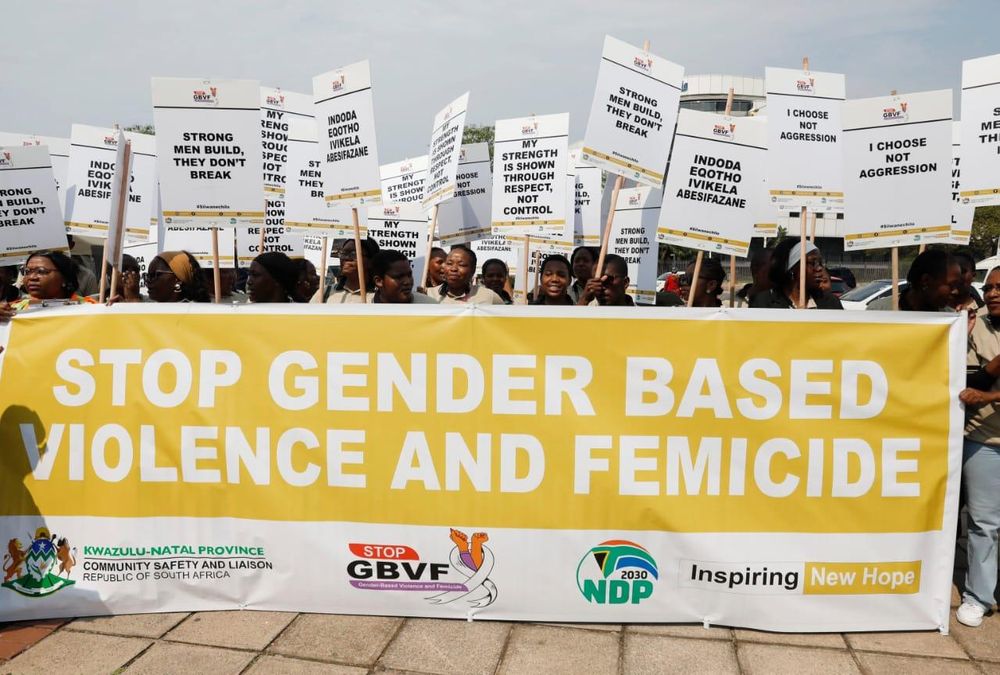
Protesters outside Durban's Magistrate's Court where a alleged serial rapist is facing 16 charges of sexual assault including rape 0n September 21.
Women of South Africa, in all their diversity, are tired of living in fear.
They are tired of women’s names trending after they have been raped, beaten, or killed. Tired of the short-lived national outrage, vigils, candle lighting, GBVF marches, wearing doeks every Friday, dressing in black, carrying symbolic coffins, withdrawing themselves from all economic activity for a day, and setting up purple profiles on their social media platforms.
Most of all, women are exasperated by the promises, followed by a predictable pattern of silence and inaction until another name, another face, another hashtag. These are not just numbers, they were women: Elizabeth "Tsontso" Moselakgomo (2026), they are Delana Cader (2023), Tshegofatso Pule (2020), Uyinene Mrwetyana (2019), Zolile Khumalo (2018), Karabo Mokoena (2017), Susan Rhode (2016), Jayde Panayiotou (2015), Reeva Steenkamp (2013), Anene Booysen (2013).
They represent a fraction of women who experienced GBVF; they are the face of those whose stories remain untold, whose bodies remain unclaimed, and whose tragic stories did not make it to social and mainstream media headlines.
This, while the latest SAPS crime statistics (April–June 2026) show that 569 women were murdered, translating to an average of more than six women killed every single day, with a further 1,052 women reported to have survived attempted murder in the same period.
Every quarter, the Minister of Police releases statistics that remind us of the brutality women face in a country that seems to be at war with them. Most recently, the 1st South African National Gender-Based Violence (GBV) Study provided baseline national estimates of Violence Against Women (VAW) alongside men’s perpetration of intimate partner violence. The results were meant to be a call to action and an opportunity to recalibrate and accelerate the GBVF response.
South Africa has some of the leading researchers globally on all forms of violence and femicide. And yet, with all this evidence, VAW remains the most pressing social issue facing the post-Apartheid South Africa today.
Researchers have spent decades studying drivers of GBV, and have identified gender inequality, harmful gender norms, constructions of masculinity, childhood exposure to violence, alcohol use, economic stress, relationship dynamics, and the social and institutional environments that enable violence.
This work has pushed prevention beyond simply engaging men and boys and raising awareness, towards changing the gender relations, social norms and, importantly, systems that sustain inequality and violence and what might prevent violence too.
Evidence should tell us where and how to intervene to end men’s perpetration of violence. This evidence is also supposed to translate into interventions that work, and whose effectiveness can be measured by declining numbers of men who perpetrate and women who experience violence in South Africa.
Our National Strategic Plan on Gender-Based Violence and Femicide recognises this. Prevention and rebuilding social cohesion are among its six pillars, with a focus on evidence-based prevention, changing behaviours and social norms, and shifting toxic masculinities. While there are documented interventions that work to prevent VAW, these remain small-scale and localised to sub-populations.
To date, not all male-oriented “interventions” implemented are evidence-based. Most are measured simply by how many men attended, how many dialogues were held, or how many pledges were signed, etc.
However, how many men attended tells us whether we reached them. How many dialogues were held tells us whether an activity happened. Neither, on its own, tells us whether men's behaviours changed.
As we are grappling with this latest spate of femicide cases and are tempted to continue doing what we have always done, we need to be careful not to confuse activity with impact. With all the investment made and the GBVF funding dispersed since the roll-out of the NSP on GBVF, we need to ask the difficult but important questions.
Failure to do this will be setting ourselves up for failure. A quick scan of what we are doing nationally with men and boys still frequently points to numbers reached or trained, men-led GBV marches, pledges signed, dialogues held, Men’s Parliaments and Boys’ Assemblies convened, positive-masculinity and behaviour-change workshops delivered, school-based programmes, marches and awareness campaigns, and recently the use of drama and poetry as an education tool to address GBVF.
Some of these efforts are important for creating critical initial spaces for conversations that many men and boys have never had and can be gateways to challenging gender and masculinity norms that have gone unquestioned. However, they will not work to curb GBVF and reduce perpetration if implemented outside a well-funded and sustained evidence-based and effective prevention agenda.
If we are serious about making our response to GBVF evidence-based, we should be asking about outcomes.
Did reported numbers of VAW cases decline? Did knowledge levels increase, and did this lead to measurable change in behaviour? Did attitudes and gender norms shift? Were those changes sustained? Did controlling behaviours decline? Did reports of physical and/or sexual violence decline? Did men perpetrate less?
Five years into the NSP on GBVF, its reflective review points to the same challenges: considerable prevention activity, but no implementation of the Comprehensive National Prevention Strategy and too many efforts remaining short-term. Importantly, this is not a story in which nothing has happened.
The review identifies progress across the broader national response and calls for the next five years to include evaluation of key prevention programmes and interventions targeting, among others, men and boys.
Yet there is no uncertainty about whose behaviour we have spent decades modifying and policing. We have made preventing GBVF a Women’s issue. Women already participate in informal behaviour-change programmes every day. It is intensive. It starts when we are girls. It happens everywhere. And it never really ends.
Don’t sit like that, sit like a girl. Don’t walk alone. Don’t wear miniskirts. Don’t run too early. Don’t run too late. Check the car boot and backseat before you get in. Share your location. Sit in front, in an Uber. Watch your drink. Don’t wear your headphones. Make your Strava private. Text me when you get home. Don’t walk alone. Don’t be outside after sunset. And that is only the obvious stuff.
Underneath all of this sits a hypervigilance that many women learn from childhood.
The threat of violence shapes how women live, even on the days when nothing happens. There is love in those warnings. There is also something profoundly wrong about how necessary they have become.
There is, of course, a place for practical safety advice. We can personally attest to their value. Give us every tool that might help us get home safely. But we should be clear about what these tools are doing. They help us manage the risk of someone else’s violence. It may save a life, but managing the risk of violence is not the same as preventing and stopping its perpetration.
And too often, when all our careful calculations fail, the scrutiny returns to women.
And after decades of asking women to anticipate violence, avoid violence, navigate violence, and protect themselves from violence, it's time to focus our national efforts on preventing and stopping men from using violence. Why do we normalise freedom for everyone except women? When do we confront the real problem? Why do we make the environment comfortable for perpetrators while constraining the freedom of women and young girls? Stop telling women to go into 'lockdown' where perpetrators should be.
Stop asking women to prevent men’s violence!
* Essack is Research Director, Zungu, Senior Research Director and Zuma, Divisional Executive at the Human Sciences Research Council. The views expressed in this article are those of the authors and do not necessarily reflect the views or policies of the HSRC.
** The views expressed do not necessarily reflect the views of the National Media Group.